Direct Answer
Working with an extruder screw barrel manufacturer is not like buying a catalogue part. Every screw and barrel is built to your machine and your resin, so the specification you send determines what you get. This guide covers the five things that belong on a purchase order: metallurgy, screw geometry, barrel tolerances and fit, the inspection documents to demand on delivery, and the commercial terms to confirm in writing.
A screw barrel carries no list price and no part number you can reorder from a catalogue. It is machined to your extruder, matched to your polymer, and expected to hold tolerance for years inside a hot, pressurised, abrasive environment.
That makes the purchase unusual. The buyer's specification does more to determine the outcome than the supplier's marketing does. Two factories quoting the same drawing can deliver very different parts if one is left to guess at the alloy and the other is told exactly what the compound contains.
What follows is the engineering side of the transaction — what to specify, what the numbers mean, and what to check on arrival. If you are still deciding which supplier to shortlist, our separate supplier due-diligence guide covers factory verification and red flags.
1. Materials, Metallurgy and Heat Treatment
A screw barrel is really two material decisions. The base steel carries the mechanical load. The surface treatment survives the polymer. Confusing the two is the most common specification error we see.
Base Steel
The base steel provides torsional strength, fatigue resistance, and dimensional stability at temperature. On a correctly built part it never touches the melt — the treated surface does all the work at the interface.
| Grade | Equivalent | Typical role |
|---|---|---|
| 38CrMoAlA | 1.8509 | The standard nitriding steel; excellent case response |
| 34CrAlNi7 | 1.8550 | Nitrides deeper and harder than 38CrMoAlA |
| 31CrMoV9 | 1.8519 | High strength with good fatigue resistance |
| 42CrMo | AISI 4140 | Tough general-purpose alloy steel |
| SKD61 | H13 equivalent | Hot-work duty, high process temperatures |
| SS304 / SS316 | — | Corrosion-critical applications |
Surface Treatment
Nitriding diffuses nitrogen into the steel surface, forming a hard case 0.4 to 0.7 mm deep. No new material is added. It handles clean, unfilled resin well and costs least.
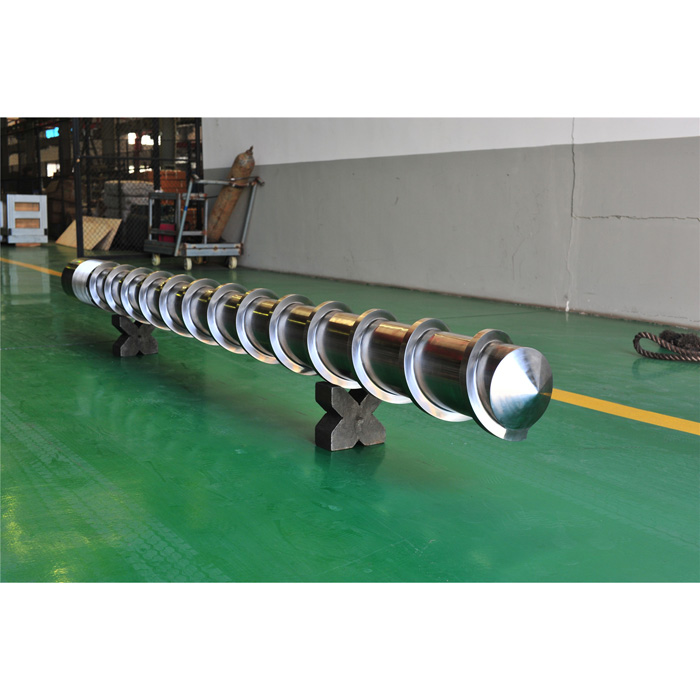
Bimetallic construction adds a genuine alloy layer, and the screw and barrel receive it by two different processes. Screws get PTA welding — plasma transferred arc — depositing 1.0 to 1.5 mm of hardfacing on the flight lands, machined back to final geometry afterwards. Barrels get centrifugal casting, spinning 2.0 to 3.0 mm of alloy into the bore.
| Your compound | Treatment | Reason |
|---|---|---|
| Clean PP, PE, PS, ABS | Nitrided | No abrasion or corrosion; bimetallic sits idle |
| Glass fibre, mineral filler | Bimetallic (tungsten carbide grade) | Filler cuts a nitride case quickly |
| Rigid PVC | Bimetallic (corrosion-led grade) | HCl release pits the bore |
| Recycled / post-consumer | Bimetallic (tungsten carbide grade) | Grit and metal fines act like sandpaper |
| Flame-retardant compounds | Bimetallic (corrosion-led grade) | Chemically aggressive additive packages |
The alloy grade matters more than the word "bimetallic." Ask for the grade name, the composition, and the layer thickness in writing on the quotation. Our nitrided versus bimetallic comparison sets out the full grade tables.
Traceability is a specification, not a courtesy. Ask for the mill certificate with the heat number before production starts, not after delivery. It is the only way to confirm the steel in your part is the steel on your order. If the application involves food or medical contact, say so at inquiry stage so the base steel and documentation can be matched to your own compliance programme.
2. Screw Geometry, Profiles and Mixing Elements
Metallurgy decides how long the part survives. Geometry decides whether the process works at all. A screw is designed around how a specific polymer melts, which is why the same diameter is built differently for PVC than for PET.
| Parameter | What it controls | Typical range |
|---|---|---|
| L/D ratio | Melting capacity, mixing length, venting room | 20:1–36:1 single; up to 52:1 twin |
| Compression ratio | How aggressively material compacts and melts | Gentle for PVC; firmer for polyolefins |
| Flight depth | Conveying volume per zone | Deep at feed, shallow at metering |
| Root diameter | Torsional strength of the shaft | Set by torque demand |
| Pitch | Conveying rate per revolution | Often equal to diameter (square pitch) |
Zones and Mixing Elements
Almost every single screw divides into three zones. The feed zone conveys solid pellets on deep flights. The compression zone shrinks the channel so material compacts and melts. The metering zone pumps a uniform melt at steady pressure.
Where mixing needs improving, three families of element get added. Barrier flights separate solid bed from melt pool for more consistent melting. Maddock or fluted mixers force material through a controlled gap for dispersive mixing. Pin and cavity mixers improve distributive blending at lower shear.
Twin screws work differently again. Parallel twins run modular kneading blocks on splined shafts, so element order sets residence time and mixing intensity, and the configuration can be rebuilt for a new formulation.
Choosing between single and twin is a separate decision with real consequences for output, mixing and maintenance. Our guide on single screw barrel versus twin screw barrel works through it in full.
3. Barrel Design, Tolerances and Machine Compatibility
The barrel gets less attention than the screw and costs more to replace. Two things belong on the order: the tolerances that determine performance, and the interfaces that determine whether the part bolts on.
Tolerances That Matter
| Specification | Value | What it prevents |
|---|---|---|
| Surface roughness | Ra 0.4 µm | Rough metal anchors stagnant melt, which degrades into black specks |
| Straightness | 0.015 mm | Deviation concentrates contact load and creates local wear |
| Bore diameter range | Ø12–500 mm | — |
| Maximum length | Up to 10 m | — |
| Nitrided case | 0.4–0.7 mm | Thin case wears through on filled compounds |
| Cast alloy lining | 2.0–3.0 mm | — |
Surface finish deserves emphasis because buyers treat it as cosmetic. On a PVC or filled line it is corrosion prevention: smooth metal gives degrading polymer nothing to anchor to. Put it on the specification.

Compatibility: Check More Than the Bore
Most fit problems are not diameter problems. They are interface problems, and they surface at installation when the line is already down.
Field measurement checklist for a replacement
- Drive-end shank — spline or keyway type, dimensions, and length of engagement
- Flange detail — bolt circle, hole count and size, pilot diameter, flange thickness
- Instrument ports — thermocouple and pressure transducer positions, thread sizes, depths
- Heater band lands — outside diameter and axial positions of each zone
- Cooling circuit — port positions and connection type, if fitted
- Feed opening — position, shape and dimensions relative to the flange face
- Overall stack — total length, and screw tip assembly type on injection machines
Photograph each interface with a rule or caliper in frame for scale. Where no drawing exists at all, EJS engineers can measure on site regardless of the machine brand, and reverse-engineer from the machine model and code.
4. Quality Assurance, Inspection and Acceptance
Two documents separate a controlled process from a hopeful one. Both should arrive with the parts, and both should be agreed before production, not requested afterwards.
| Document | What it proves | What to check |
|---|---|---|
| Material certificate (MTC) | Base-steel chemistry and mechanical properties | Heat number matches; grade matches the order |
| Inspection report | Actual measured dimensions of your part | Measured values, not design values; tolerance band stated |
| Alloy statement on quotation | Grade and layer thickness for bimetallic work | Named grade, not "nickel-based"; thickness in mm |
| Identification number | Traceability back to the production batch | Stamped on the part and recorded on the paperwork |
| Third-party lab report (optional) | Independent confirmation of layer and chemistry | Worth commissioning on a first order |
EJS supplies a material certificate and an inspection report with every screw barrel, and stamps a traceable identification number on each part during production.
Acceptance on Site
Do this before commissioning, not after a problem appears. Measure the new screw's flight outer diameter and the new bore's inner diameter at several positions and record them as your baseline. Every future wear measurement compares against these numbers rather than against a drawing value.
Then log the commissioning run: output at reference screw speed, drive current, melt temperature and head pressure. Those four figures become the reference set that tells you, two years later, how much the pair has actually degraded.
A new screw in a worn barrel is half a repair. Clearance is a property of the pair, not of either part. If you are replacing one, measure the other and decide on the evidence. Fitting a new screw into an oversized bore gives you enlarged clearance from day one and most of the old symptoms back within months.
5. Cost Drivers, Lead Times, Warranty and Refurbishment
No manufacturer can quote a screw barrel from a price list, because nothing about it is standard. What can be explained is what moves the number, so you can read a quote and compare offers on equal terms.
| Driver | Effect on cost |
|---|---|
| Diameter and length | Material volume and machining hours scale with both |
| Surface treatment | Bimetallic adds alloy cost plus welding or casting operations |
| Alloy grade | Tungsten-carbide grades cost more than standard nickel-based |
| Base steel | Stainless and hot-work grades cost more than 38CrMoAlA |
| Geometry complexity | Barrier flights, mixing sections and vents add operations |
| Twin vs single | Two screws, tighter matching, modular elements |
| Drawing availability | Reverse engineering or site measurement adds engineering time |
Judge total cost of ownership rather than unit price. A nitrided screw on glass-filled nylon is the cheaper purchase and usually the more expensive decision, because the replacement cycle arrives sooner and takes production with it. The reverse is also true: bimetallic on clean PE is protection you never call on.
Lead Time, Terms and Warranty
| Item | Terms |
|---|---|
| Quotation turnaround | Within one working day once the specification is clear |
| Production lead time | 20–70 days after drawing confirmation, plus transport |
| Faster option | Common conical sizes held as semi-finished stock |
| Payment, new customers | 50% deposit, balance before shipment, by T/T |
| Small amounts | PayPal, Western Union or MoneyGram |
| Warranty | One year on pure plastics |
| Warranty claim | Free replacement against a formal non-conforming report; customer covers transport |
Be clear-eyed about what a warranty on a wear part means. It covers manufacturing defects and material non-conformance. It does not cover abrasion from your own compound, because that rate is set by what you process — which is exactly why the resin description on your order matters.
Refurbishment
Refurbishment often beats new manufacture when the base steel and geometry are still sound but the wear surfaces have gone. A worn screw can be re-welded with fresh PTA hardfacing and machined back to original geometry; a worn bore can be re-bored and re-lined by centrifugal casting. The original shaft, keyway and journal are retained.
It makes most sense when the OEM part is discontinued, when lead time on a new part is long, or when the existing geometry has served well. It makes least sense when the shaft is bent, the flight roots are cracked, or the geometry never suited the compound in the first place — in which case the replacement is the right moment to fix the specification.
6. What to Send With Your Inquiry
Six items turn a vague request into an accurate quote inside one working day.
Inquiry checklist
- Machine make and model — parts are built to drawing or reverse-engineered from the brand and code
- Screw diameter and L/D, or the conical size code such as 65/132
- Resin and filler, stated honestly — "PP" and "PP with 25% talc and 15% regrind" are different wear problems with different alloy answers
- Process temperature range — actual zone temperatures, not design values
- New build or replacement — for replacements, send wear measurements and photos of the worn part
- Drawing if available — otherwise photos with a scale reference plus major dimensions
EJS has manufactured extruder screws and barrels at its Zhoushan factory since 1992, across single screw, parallel twin, conical twin, injection and rubber geometries, in nitrided and bimetallic construction, with PTA welding and centrifugal casting done in-house.
7. Frequently Asked Questions
What should I specify when ordering from an extruder screw barrel manufacturer?
Specify six things: the machine make and model, the screw diameter with L/D ratio or conical size code, the base steel and surface treatment, the resin including any filler or regrind, the process temperature range, and whether the part is a new build or a replacement. Screw barrels are close to 100 percent custom, so a drawing gives the fastest accurate quote. Without a drawing, photos plus major dimensions allow budget pricing, and a capable manufacturer can reverse-engineer from the machine model or measure on site.
What documents should come with a new screw and barrel?
Two documents matter. A material certificate shows the base-steel chemistry and heat number, which is how you confirm the part is made from the steel you ordered. An inspection report records the actual measured dimensions of your finished parts rather than the design values. For bimetallic construction, the alloy grade and layer thickness should also appear in writing on the quotation. EJS supplies a material certificate and an inspection report with every screw barrel and stamps a traceable identification number on each part.
How do I verify a replacement screw barrel will fit my machine?
Check five interfaces beyond the bore diameter and length: the drive-end shank including spline or keyway detail, the flange bolt pattern and pilot diameter, the thermocouple and pressure-transducer port positions, the heater band land dimensions, and the cooling circuit connections. Send a drawing where one exists. Where it does not, photograph each interface with a scale reference and record the major dimensions, or arrange on-site measurement by the manufacturer.
What surface treatment should I choose for my resin?
Choose nitriding for clean unfilled resins such as natural PP, PE, PS and ABS, where a case 0.4 to 0.7 mm deep handles the duty at lower cost. Choose bimetallic construction for abrasive or corrosive compounds including glass fibre, mineral filler, flame retardant, rigid PVC and recycled feed. Bimetallic adds 1.0 to 1.5 mm of PTA-welded hardfacing on the screw and 2.0 to 3.0 mm of centrifugally cast lining in the barrel, in an alloy selected for your specific contamination.
What lead time and payment terms are normal for custom screw barrels?
Production typically runs 20 to 70 days after drawing confirmation, depending on size, construction and workload, with transport on top. Bimetallic parts take longer than nitrided because welding and casting add steps. For new customers EJS works on 50 percent deposit with the balance before shipment by T/T, and smaller amounts can go through PayPal, Western Union or MoneyGram. Suppliers holding common sizes as semi-finished stock can deliver faster than a full custom build.
When is refurbishment better than buying a new screw and barrel?
Refurbishment suits parts where the base steel and geometry are still sound but the wear surfaces have gone. A worn screw can be re-welded with fresh PTA hardfacing and machined back to original geometry, and a worn bore can be re-bored and re-lined by centrifugal casting. It keeps the original shaft, keyway and journal, which helps most when the OEM part is discontinued or lead time is long. A bent shaft, cracked flight roots, or a geometry that never suited the compound all point to new manufacture instead.
What warranty applies to a custom extruder screw barrel?
EJS warrants new screws and barrels for one year on pure plastics. Within the warranty period a non-conforming part is replaced free of charge against a formal non-conforming report, with the customer covering transport. Note what a warranty on a wear part can and cannot cover: it covers manufacturing defects and material non-conformance, not normal abrasion from your compound. Wear rate depends on what you process, which is why the resin description on your order matters.