Quick Answer
Spec a nitrided screw barrel when the resin is clean and non-abrasive — the thin diffused case (0.4–0.7 mm) is hard, cost-effective, and lasts well on pure plastics. Spec a bimetallic screw barrel when the feed is abrasive, glass- or mineral-filled, corrosive, or recycled: a PTA-welded hardfacing layer on the screw and a centrifugally cast alloy lining in the barrel resist the wear that eats a nitrided surface alive. The harder question isn't bimetallic-or-not — it's which alloy, and that comes down to your feedstock.
1. Nitriding: What It Is, When It's Enough
Nitriding diffuses nitrogen into the surface of the base steel, forming a hard nitride case without adding a separate layer of different material. On a screw barrel the case runs roughly 0.4 to 0.7 mm deep, with a hard surface that resists moderate sliding wear and holds up well against clean polymer melts.
For a lot of work, that is plenty. Running natural PP, PE, PS, or ABS with no abrasive filler? A nitrided screw and barrel in a steel like 38CrMoAlA gives reliable service at a lower cost than bimetallic, and there's no reason to pay for hardfacing the duty doesn't need. The base steels EJS nitrides include 38CrMoAlA (1.8509), 34CrAlNi7 (1.8550), 31CrMoV9 (1.8519), 42CrMo, and 40Cr — chosen to the machine and the duty.
Where nitriding runs out of road is abrasion and corrosion. The hard case is thin. Once an abrasive filler — glass fiber, talc, calcium carbonate, mineral reinforcement — starts cutting into it, the case wears through, and below it sits softer core steel that erodes fast. The same goes for corrosive chemistry like the HCl released when PVC degrades: nitriding alone doesn't hold up. That's the line where bimetallic takes over.
2. Bimetallic: How It's Made, Why It Lasts
"Bimetallic" means two metals: the structural base steel, plus a wear- and corrosion-resistant alloy layer metallurgically bonded to the surfaces that actually do the work. The screw and the barrel get there by two different processes — a detail that matters when you compare suppliers.
On the screw, EJS applies the alloy by PTA (plasma transferred arc) welding — hardfacing deposited onto the screw flights, then machined back to final geometry. The hardfacing layer runs about 1.0 to 1.5 mm. This is the same family of process the high-end bimetallic names use; the alloy chemistry and welding control are what separate a good deposit from a poor one.
On the barrel, the alloy goes in by centrifugal casting: molten alloy is spun inside the barrel bore so it lines the inner wall as a dense, even layer, roughly 2.0 to 3.0 mm thick. For bimetallic parallel twin barrels, EJS first produces bimetallic liners and then lines them into the barrel housing. The barrel layer is thicker than the screw's because the bore is the surface the screw runs against down its entire length.
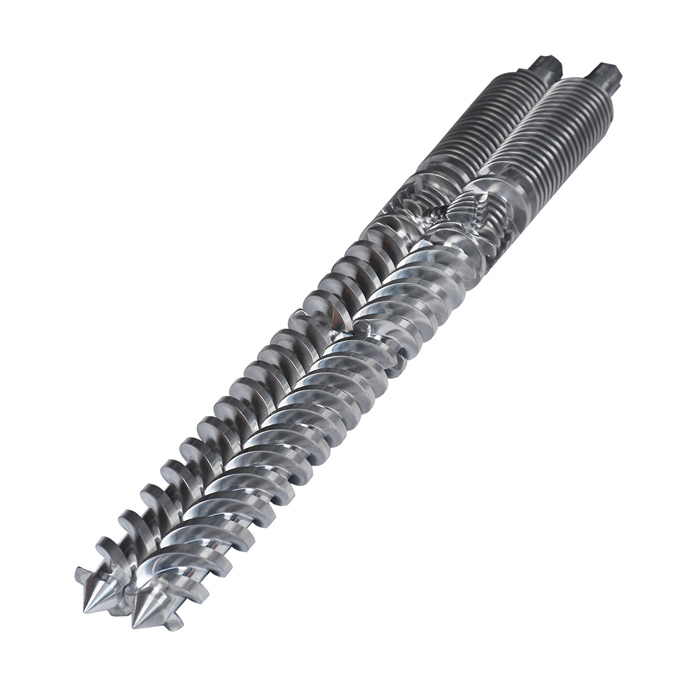
Both surface treatments — bimetallic, nitriding, through-hardening, and hard chrome-plating — are available across the EJS range. The point of this guide isn't that one is universally superior. It's that each fits a different feedstock, and matching the treatment and alloy to the duty is what gets you service life without overpaying. For the underlying product details, see our bimetallic screw barrel page.
3. Screw Hardfacing Alloys: Ni60, Colmonoy 56, Colmonoy 83
For the screw, EJS hardfaces by PTA welding in three common alloys. Ni60 covers the everyday cases. Beyond it, the Colmonoy grades — and tungsten-carbide-bearing alloys — step up for harder wear and tougher chemistry. Here's how they line up:
| Alloy | Composition | Anti-Wear | Anti-Corrosion | Hardness |
|---|---|---|---|---|
| Ni60 | Ni+Cr+Fe+Si | ★★★ | ★★★★ | HRC 56–62 |
| Colmonoy 56 | Ni+Cr+Si+Fe | ★★★ | ★★★★ | HRC 53–58 |
| Colmonoy 83 | Ni+Wc+Cr+C | ★★★★ | ★★★★ | HRC 50–55 |
Reading that table the way a process engineer would: Colmonoy 83 carries the tungsten carbide (the "Wc" in its composition), which is why it earns the top anti-wear rating even though its bulk hardness number looks lower than Ni60's. Hardness and abrasion resistance aren't the same thing — the embedded carbides do the work against abrasive fillers, not the matrix hardness alone. So for glass-filled nylon or a heavily mineral-loaded compound, Colmonoy 83 is the screw alloy to ask about. For clean-to-moderate wear with a corrosion component, Ni60 or Colmonoy 56 covers it at lower cost. Base steels under the hardfacing are typically 38CrMoAlA, 34CrAlNi7, 31CrMoV9, or 42CrMo.
4. Barrel Casting Alloys: EJS01 to EJS04
The barrel uses a different alloy family, applied by centrifugal casting. EJS runs four proprietary grades, EJS01 through EJS04, each tuned to a different balance of wear, corrosion, and temperature. This is the table worth keeping when you write a barrel spec:
| Alloy | Composition | Anti-Wear | Anti-Corrosion | Hardness | Max Temp |
|---|---|---|---|---|---|
| EJS01 | Fe+Ni+Cr+B | ★★★ | ★★ | HRC 58–62 | ≤ 400°C |
| EJS02 | Ni+Cr+Co+B | ★★ | ★★★ | HRC 50–58 | ≤ 450°C |
| EJS03 | Ni+Cr+Co+V+B | ★★★ | ★★★ | HRC 55–60 | ≤ 450°C |
| EJS04 | Ni+Wc+Cr+B | ★★★★ | ★★★ | HRC 55–60 | ≤ 600°C |
The logic maps cleanly onto duty. EJS01 is the general-purpose wear grade — strong hardness, good abrasion resistance, best where corrosion isn't the main threat and temperatures stay moderate. EJS02 shifts toward corrosion resistance, trading some anti-wear for it — the grade to look at for chemically aggressive melts. EJS03 adds vanadium and balances wear against corrosion, a sensible default for mixed or uncertain duty. EJS04 carries tungsten carbide for the top anti-wear rating and tolerates the highest temperature, up to around 600°C — the premium grade for the most abrasive, hottest work.
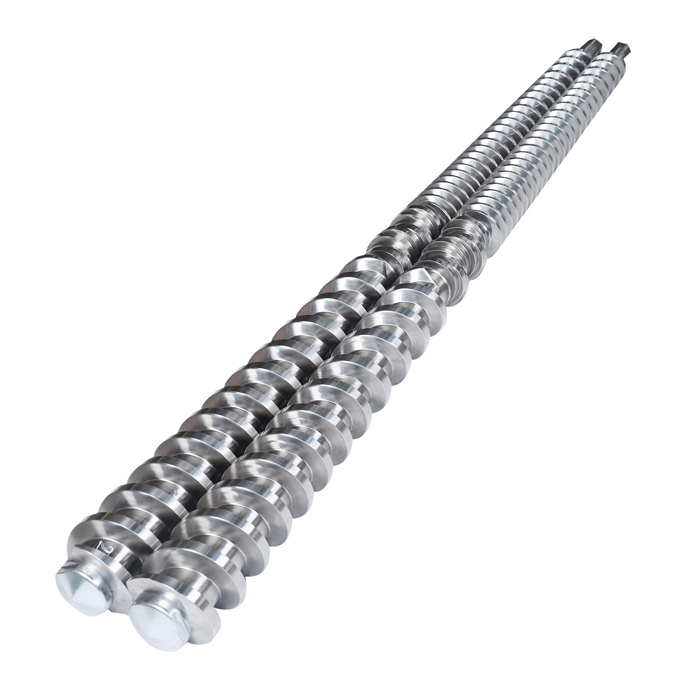
5. Choosing by Application
Put the screw alloy and the barrel alloy together and the selection falls out of the feedstock. A few common cases:
Clean, non-abrasive resins (natural PP, PE, PS, ABS)
Nitrided screw and barrel is usually enough. No abrasive filler, no aggressive chemistry — the diffused case handles it, and bimetallic would be paying for protection the duty never calls on.
Glass-fiber or mineral-filled compounds
This is bimetallic territory. The glass and mineral act like sandpaper on a nitrided case. Ask for a Colmonoy 83 screw (tungsten-carbide-bearing) against an EJS01 or EJS04 barrel, depending on how aggressive the loading is and how hot the process runs.
PVC and corrosive chemistry
Corrosion leads here, not just abrasion. The barrel alloy wants a corrosion-resistant grade — EJS02 or EJS03 — and the screw a corrosion-strong hardfacing such as Ni60 or Colmonoy 56. Rigid versus flexible PVC and the stabilizer package shift the answer, so the feedstock detail matters.
Recycled and post-consumer feed
Contaminated regrind brings grit, metal fines, and inconsistent melt — abrasive and unpredictable. Bimetallic with a tungsten-carbide-bearing screw alloy (Colmonoy 83) and a hard barrel grade earns its keep here. We cover this case in depth in the twin-screw vs single-screw recycling guide, and the demand driver behind it in the PPWR article.
High-temperature engineering polymers
When the process runs hot, temperature limit becomes a gating spec. EJS04 tolerates up to around 600°C, which is why it shows up on the most demanding high-temperature, high-abrasion jobs.
6. Cost and Service-Life Trade-Off
Bimetallic costs more than nitrided. The hardfacing alloys, the PTA welding time, the centrifugal casting — all of it adds to the build. The bimetallic vs nitrided screw barrel decision isn't whether bimetallic costs more; it's whether the duty pays it back.
On clean resin, it often won't — nitrided lasts well and the extra spend sits idle. On abrasive, filled, corrosive, or recycled feed, the math flips: a nitrided part wears through its thin case and needs replacing far sooner, while a bimetallic part keeps running. Across a few replacement cycles, the longer-lasting part usually wins on total cost even though its sticker is higher. How much sooner, and how much it saves, depends entirely on the resin, the filler loading, the throughput, and the duty cycle — which is why a credible supplier asks about your feedstock before talking service life, rather than quoting a universal multiplier.
Because screw barrels are almost 100% customized, there's no list price to compare. The cost reflects alloy grade, base steel, surface treatment, L/D ratio, and length. The way to compare two suppliers fairly is to hand both the same drawing and the same feedstock detail, then read the quotes against each other.
7. How to Specify When You Request a Quote
A bimetallic quote is only as good as the information behind it. To get a sound recommendation and an accurate price from EJS — or any serious manufacturer — put these on the table:
- Resin and filler. Base polymer, filler type, and loading percentage (e.g. PA66 + 30% glass fiber). This drives the whole alloy choice.
- Process temperature range. Sets the barrel-alloy temperature limit — the EJS01–EJS04 grades cap at different points.
- Machine and geometry. OEM model, screw diameter, L/D ratio, and length. A drawing is ideal; without one, product photos plus major dimensions (diameter, length, flange information) let EJS budget the price.
- Single, parallel twin, or conical twin. The build differs across single-screw extruder barrels and conical twin-screw barrels.
- New build or OEM replacement. EJS reverse-engineers existing OEM geometry and can upgrade a worn nitrided part to a bimetallic build in a suitable alloy.
- Surface treatment preference, if any. Or simply describe the duty and let the EJS engineers recommend the alloy.
With clear information, EJS issues a quotation within one working day. New screw barrels carry a one-year warranty when running pure plastics. For more on vetting any China-based supplier before you commit, see the buyer checklist.
8. Frequently Asked Questions
What is the difference between a bimetallic and a nitrided screw barrel?
A nitrided screw barrel is hardened by diffusing nitrogen into the base steel, producing a thin hard case of about 0.4 to 0.7 mm. A bimetallic screw barrel adds a separate wear-resistant alloy layer — PTA hardfacing on the screw flights (1.0 to 1.5 mm) and centrifugally cast alloy inside the barrel bore (2.0 to 3.0 mm). Nitriding suits clean, non-abrasive resins; bimetallic suits abrasive fillers, glass fiber, and corrosive or recycled feed where service life matters.
Which screw hardfacing alloy is best for glass-filled or highly abrasive plastics?
For the most abrasive duty, Colmonoy 83 — a nickel-tungsten-carbide grade (Ni+Wc+Cr+C) — gives the highest wear resistance among the common screw hardfacing options. Ni60 is the everyday choice for moderate wear, and Colmonoy 56 sits in between with strong wear and corrosion balance. EJS hardfaces all three by PTA welding, selected to the feedstock.
What barrel alloy should I choose for corrosive plastics like PVC?
For corrosion-led duty, EJS02 (Ni+Cr+Co+B) and EJS03 (Ni+Cr+Co+V+B) carry the higher corrosion-resistance rating among the EJS barrel casting alloys. EJS03 balances wear and corrosion for mixed duty, while EJS04 (Ni+Wc+Cr+B) is the premium tungsten-carbide grade for the most demanding abrasion and elevated temperatures up to around 600°C.
How thick is the wear layer on a bimetallic screw versus a bimetallic barrel?
On a bimetallic screw, the PTA-welded hardfacing layer is about 1.0 to 1.5 mm on the flights. On a bimetallic barrel, the centrifugally cast alloy lining is about 2.0 to 3.0 mm. The barrel layer is thicker because it is the wear surface the rotating screw runs against across the full bore length.
Is a bimetallic screw barrel always better than nitrided?
No. For clean, non-abrasive resins running pure plastics, a nitrided screw barrel can deliver good service life at lower cost. Bimetallic earns its higher cost when the feedstock is abrasive, glass- or mineral-filled, corrosive, or recycled — there the longer service life and protection against premature wear change the total-cost picture. The right call depends on resin, filler, and duty, which is why drawing and feedstock details are needed to quote.
Can EJS supply a bimetallic replacement for an existing OEM screw and barrel?
Yes. EJS reverse-engineers existing OEM screw and barrel geometry to original spec and can upgrade the metallurgy — for example moving a worn nitrided part to a bimetallic build in a suitable alloy. Provide the OEM model, the original drawing if available, or product photos plus major dimensions such as diameter, length, and flange details, and EJS issues a quotation within one working day.