Choosing between a twin-screw extruder and single-screw extruder for plastic recycling depends on feed quality, contamination level, and output spec. Single-screw extruders suit cleaner post-industrial regrind and mono-stream PE / PP recycling at lower hardware cost. Twin-screw extruders are essential for heavily contaminated post-consumer feed, bottle-to-bottle PET, and food-grade approved recyclate. At EJS we manufacture bimetallic plastic recycling extruder screw barrels for both architectures — single-screw barrels from Ø14 to Ø500 mm, parallel twin-screw extruder barrels from Ø20 to Ø250 mm. Standard lead times are 8 to 12 weeks for single, 12 to 16 weeks for twin, ex-factory. This guide covers the technical differences and how to specify when requesting a quote.
How Twin-Screw and Single-Screw Extruders Work Differently
The two architectures move and melt plastic in fundamentally different ways.
A single-screw extruder uses one rotating screw inside a smooth or grooved barrel. Material moves forward by friction against the barrel wall — drag flow — while pressure builds toward the die. Melting happens through shear heat between the screw flights and the barrel surface. It is a simple, well-understood machine. For mono-stream, relatively uniform feed, it works well.
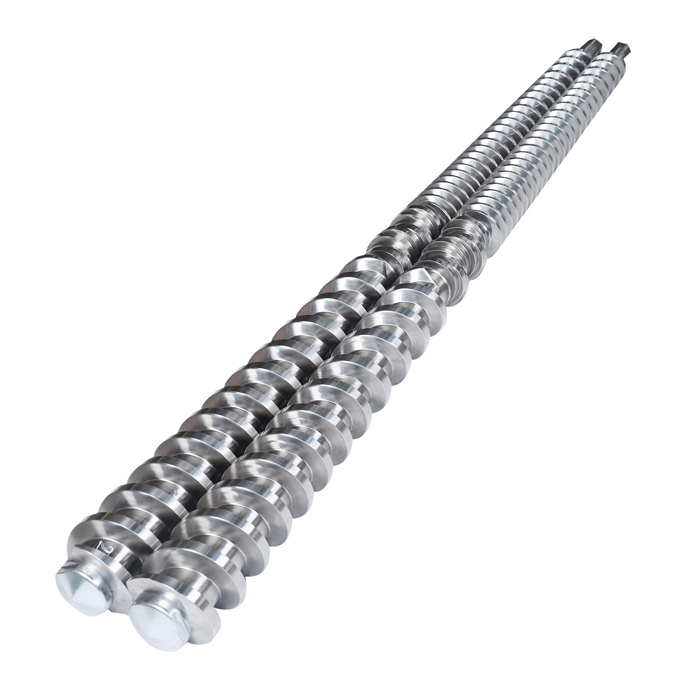
A twin-screw extruder uses two intermeshing screws. Material moves by positive displacement between the screws and the barrel — closer to a gear pump than a friction conveyor. Mixing is far more aggressive because of the kneading blocks and mixing elements you stack along the screw. Most recycling and compounding lines use co-rotating intermeshing twin-screws (the ZSK-style geometry). The result is better dispersive and distributive mixing, narrower residence time distribution, and the ability to handle wildly variable feedstock.
That last point — variable feedstock — is why twin-screw dominates serious post-consumer recycling. Post-industrial regrind is consistent. Post-consumer is not. Twin-screw handles the variance.
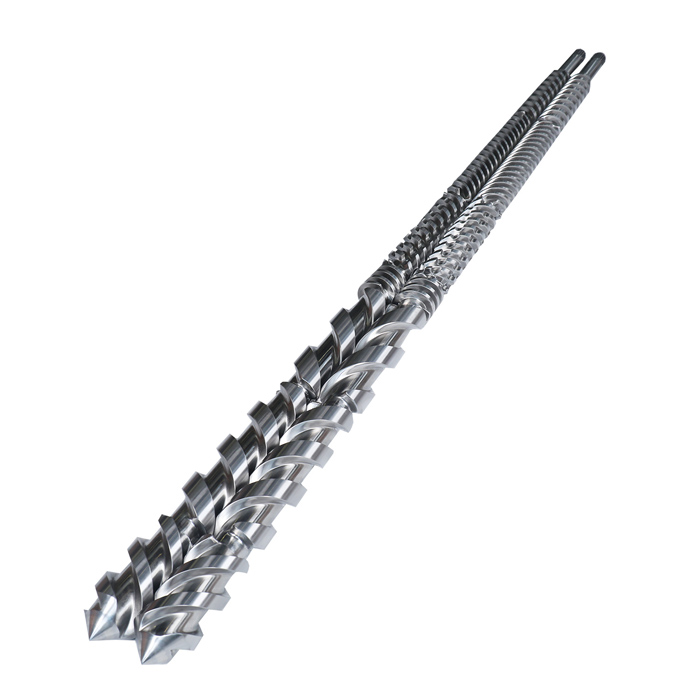
For PVC profile and pipe extrusion, conical twin-screws (counter-rotating) are the standard, though they appear less often in recycling lines specifically. At EJS we stock semi-finished 55/110 and 65/132 conical twin sets to shorten delivery for those applications.
Single-Screw Extruders: Where They Win in Recycling
For roughly the past decade we have been quoting more recycling-specific single-screw orders, primarily for these use cases:
- Post-industrial regrind from converters' own factory scrap (sprues, runners, edge trim)
- Mono-polymer recycling of clean PE film, PP, or PS
- Recycle-to-pellet pelletizing lines after melt filtration
- Recycle-to-sheet thermoforming where feedstock is already washed and sorted
- High-throughput film or sheet extrusion from sorted regrind
The economic logic is straightforward. A single-screw extruder with a bimetallic barrel and PTA-welded screw runs at roughly 30 to 50% of the hardware cost of a comparable-throughput twin-screw. For a converter dealing with clean material that does not need intensive mixing, paying for twin-screw mixing capability is paying for something you do not use.
Where single-screw falls short is contamination tolerance. A standard single-screw cannot shear-disperse paper labels, metal flecks, or sand fines effectively. Run heavily contaminated post-consumer feed through one and you will see surging, gels, inconsistent melt quality — and the screw and barrel wear out faster than the math supports.
At EJS our single-screw extruder barrel range covers Ø14 to Ø500 mm, with screws up to 10 meters in length. We manufacture these in 38CrMoAlA, 42CrMo, 40Cr, and SS304 base steels, with bimetallic Ni60, Colmonoy 56, or Colmonoy 83 hardfacing where the recycled feed demands it. Lead time for a custom single-screw and barrel set is typically 8 to 12 weeks ex-factory. More on our extruder screw barrel page for recycling configurations.
Twin-Screw Extruders: Where They Win in Recycling
Twin-screw extruders make high-quality plastic recycling possible at industrial scale, earning their premium in four scenarios.
Bottle-to-bottle PET recycling. The biggest single application driving EU PPWR-compliant capacity expansion. Co-rotating twin-screws with vacuum venting decontaminate PET flake to food-grade quality through high-temperature, high-residence-time devolatilization. Regulators have validated several twin-screw process platforms — EREMA, Starlinger, Gneuss, Coperion — for food-contact rPET.
Heavily contaminated PCR streams. Mixed-stream curbside material, washed film bales, post-consumer PE flake — feedstock with paper, metal, sand contamination at levels single-screw cannot handle. Twin-screw's mechanical action and barrier filtration tolerate the variance.
Compounding recycled resin with additives. When you need to blend regrind with stabilizers, impact modifiers, colorants, or virgin resin to hit a final spec, twin-screw is the only architecture that gives you the mixing intensity and residence time control to do it properly.
Modular screw element design. Twin-screw geometry can be redesigned per zone — conveying, kneading, mixing, vacuum venting, pressure build — by swapping screw elements on a splined shaft. EJS manufactures screw elements in Ø15.6 to Ø250 mm sizes for the major twin-screw OEM extruders.
The trade-off is twin-screw extruder hardware cost (roughly 2x to 3x single-screw at equivalent throughput) and lead time (12 to 16 weeks for custom bimetallic configurations). For converters supplying EU markets under PPWR, those numbers are a cost of doing business, not a barrier. For parallel twin-screw extruder barrel sourcing, we cover Ø20 to Ø250 mm bore — see our parallel twin screw barrel page for full specifications, or our conical twin screw barrel page for PVC and select recycling applications.
Cost, Lead Time, and Total-Cost-of-Ownership
For procurement teams, three numbers usually matter most: capital cost, lead time, and lifecycle cost.
Capital cost. At equivalent throughput, twin-screw extruder hardware runs roughly 2x to 3x the cost of single-screw equivalent. A 90 mm bimetallic single-screw extruder barrel set might cost X; a parallel twin-screw set at equivalent kg/h output would land near 2.5X. Conical twin-screw sits between the two, closer to single. We are happy to provide concrete pricing once you send specifications — typical quotation turnaround is 24 to 48 hours.
Lead time at EJS. Custom single-screw and barrel sets typically ship 8 to 12 weeks ex-factory. Parallel twin-screw or conical twin-screw configurations run 12 to 16 weeks. We stock semi-finished conical twin sets at 55/110 and 65/132 dimensions specifically to compress this window — for those sizes, lead time drops to roughly 4 to 6 weeks. Add 3 to 4 weeks of sea freight to Europe or North America.
Spares and lifecycle cost. Twin-screw has a long-term advantage because screw elements are modular. When wear concentrates in a specific zone (typically the kneading section in recycling lines), you replace those elements only — not the full screw. Single-screw geometry does not permit this; once flight clearances open past spec, the entire screw comes out for re-machining or replacement.
Energy. Twin-screw consumes more energy per kg of throughput than single-screw at the same diameter, primarily because the kneading work is intentional. For recycling that needs the mixing, this is correct sizing. For mono-polymer simple recycling, it is wasted kWh.
Bimetallic Hardening: Critical for Both Architectures
Whichever architecture you choose, every plastic recycling extruder demands a bimetallic screw barrel. This is not optional for production-scale recycling lines.
Recycled feed carries abrasive contamination — paper fibers, glass micro-fragments, metal flecks, sand — at levels that destroy nitrided screws in months. We covered the wear mechanics in detail in our EU PPWR recycling extruder demand article; the short version is that a bimetallic screw barrel lasts three to five times longer than nitrided equivalents on contaminated PCR feed.
Bimetallic screws are produced by PTA (plasma-transferred arc) welding using Kennametal Stellite equipment. The hardfaced alloy layer runs 1.0 to 1.5 mm thick. EJS standard alloys are Ni60, Colmonoy 56, and Colmonoy 83 — the last is a nickel-tungsten-carbide grade reserved for the most abrasive recycled feedstocks. Hardness lands at HRC 50 to 62.
Bimetallic barrels are produced by centrifugal casting with a 2.0 to 3.0 mm alloy layer fused to the bore. EJS manufactures four proprietary barrel alloys — EJS01 (Fe+Ni+Cr+B, general purpose), EJS02 (Ni+Cr+Co+B, corrosion-focused), EJS03 (Ni+Cr+Co+V+B, balanced), and EJS04 (Ni+Wc+Cr+B, premium grade rated to 600°C service temperature).
For most recycling applications the standard specification is bimetallic screw paired with bimetallic barrel. Quote both together — replacing a worn screw inside a worn barrel just transfers the problem to the next outage. Our bimetallic screw barrel page covers the full alloy table.
How to Specify a Twin-Screw or Single-Screw Order When Requesting a Quote
Most incoming quote requests are incomplete. Including the right information up front lets us issue an accurate ex-factory quotation in 24 to 48 hours.
For a complete quote request, include:
- Application. Recycled material type (rPET, rPE, rPP, mixed), contamination level (post-industrial regrind versus post-consumer), and target output product (pellet, sheet, film, profile).
- Output requirement. kg/h target. This drives diameter sizing.
- Screw architecture. Single, parallel twin co-rotating, or conical twin counter-rotating. If unsure, send us the application and we will recommend.
- Diameter and L/D. If you have a working specification. Otherwise we size based on output.
- OEM extruder make and model. If this is a replacement screw or barrel for an existing line (Coperion ZSK, EREMA Intarema, Starlinger recoSTAR, Battenfeld, Krauss-Maffei, JSW, Berstorff, etc.), the OEM model tells us the geometry. We can also reverse-engineer from a worn part.
- Surface treatment. Bimetallic (specify alloy if known) or nitrided. For recycling lines we default to bimetallic; tell us if your application is the exception.
- Quantity. Single piece, set, or batch. Affects unit pricing.
- Delivery target. The ex-factory date you need to hit. Helps us prioritize against current order book.
- Drawing or sample. If available. When no drawing exists, we can send a sales engineer to your facility for on-site measurement, or you can ship the worn part to our Ningbo office.
Our six English-speaking export sales engineers handle quotes daily and respond within one business day. Send specifications to sales@ejsscrewbarrel.com or use the inquiry form linked below.
Common Mistakes in Architecture Selection
We see the same selection errors repeatedly. All of them are expensive once they show up in production.
- Buying single-screw for heavily contaminated PCR. The hardware costs less upfront but produces inconsistent recyclate and wears out faster. False economy.
- Buying twin-screw for clean post-industrial regrind. Twin-screw mixing capability is wasted on uniform feedstock. You pay for capability you do not use.
- Specifying nitrided when bimetallic is needed. For any recycling line running PCR, nitrided is a corner-cut that shows up in 6 to 12 months as flight wear, declining throughput, and unplanned outages.
- Wrong L/D for the recycling task. Bottle-to-bottle PET needs L/D 32 to 40 with vacuum venting. Simple PE film recycle-to-pellet works at L/D 28 to 30.
- No spare strategy at order time. Lead times double when expediting under outage pressure. Order one full spare screw and one barrel liner with the original line build.
Single-Screw vs Parallel Twin vs Conical Twin: At a Glance
| Criterion | Single-Screw | Parallel Twin (co-rotating) | Conical Twin (counter-rotating) |
|---|---|---|---|
| Best for | Mono-stream, clean regrind | Contaminated PCR, bottle-to-bottle PET, compounding | PVC profile/pipe, select recycle-to-profile |
| Diameter range (EJS) | Ø14 – Ø500 mm | Ø20 – Ø250 mm | 30/70 – 188/330 |
| Bimetallic screw alloy | Ni60 / Colmonoy 56 / Colmonoy 83 (PTA welded, 1.0–1.5 mm) | ||
| Bimetallic barrel alloy | EJS01 / EJS02 / EJS03 / EJS04 (centrifugally cast, 2.0–3.0 mm) | ||
| Modular screw elements | No (one-piece screw) | Yes (segmented) | No |
| Hardware cost (relative) | 1.0× baseline | 2.0 – 3.0× | 1.5 – 2.0× |
| Lead time at EJS | 8 – 12 weeks | 12 – 16 weeks | 12 – 16 weeks (4 – 6 weeks for stock 55/110, 65/132) |
| Energy per kg | Lower | Higher (intentional mixing work) | Mid |
Ex-factory pricing and lead times reflect EJS standard configurations. Add 3 to 4 weeks of sea freight for delivery to Europe or North America. Quote-specific values may differ — request a formal quotation for your project.
Frequently Asked Questions
How much does a bimetallic twin-screw extruder barrel cost?
Pricing depends on diameter, L/D ratio, alloy selection, and quantity. For a parallel twin-screw barrel with EJS bimetallic alloy in the 50 to 90 mm range, expect 2x to 3x the cost of an equivalent single-screw bimetallic barrel. We issue formal ex-factory quotations within 24 to 48 hours of receiving complete specifications.
Can EJS make replacement screws for Coperion, EREMA, or Krauss-Maffei extruders?
Yes. We have produced replacement screw and barrel parts for most major OEM extruder builds, including Coperion ZSK, EREMA Intarema, Starlinger recoSTAR, Battenfeld, Krauss-Maffei, Berstorff, JSW, and Battenfeld-cincinnati. We can work from your existing drawings or reverse-engineer from a worn part if no drawings exist.
Do you offer OEM bimetallic screw barrels?
Yes. A significant share of our production goes to OEM extruder builders who specify their own design. We sign confidentiality agreements as standard and do not display OEM customer names on our website or marketing.
Can I get a quote without a drawing?
Yes. Either send us the OEM extruder make and model and we will work from that, or we can travel to your facility for on-site measurement. We also accept worn parts shipped to our Ningbo office for measurement and reverse-engineering.
What is the minimum order quantity for a bimetallic screw barrel from EJS?
One piece. We accept single-screw replacement orders for spares and small builds, as well as large OEM contract volumes. There is no MOQ on standard configurations.
What is the lead time for a stock conical twin-screw set?
For our semi-finished stock sizes (55/110 and 65/132 conical twin-screw), lead time is typically 4 to 6 weeks for final machining and finishing. Other custom configurations run 12 to 16 weeks ex-factory. Add 3 to 4 weeks of sea freight to Europe or North America.
Working with EJS as Your Screw Barrel Manufacturer
EJS Industry has been making extruder screw barrels on Jintang Island since 1992. Today we run 21 workshops on 40,000 m² of plant with 400 full-time employees and over 300 machines. Our 10 in-house technical engineers and 6 English-speaking export sales staff cover customers in the United States, Brazil, Mexico, Germany, Italy, Russia, Turkey, and the United Kingdom.
For recycling lines we manufacture the full range of bimetallic screw barrels under one roof: single-screw plastic recycling extruder barrels Ø14 to Ø500 mm; parallel twin-screw extruder configurations Ø20 to Ø250 mm; conical twin-screw sets 30/70 to 188/330; injection screw barrels Ø16 to Ø317 mm; and the screw elements (Ø15.6 to Ø250 mm) that go into major OEM twin-screw compounders.
We are a direct screw barrel manufacturer in China, not a trading agent. Pricing comes from our factory cost structure with no distributor markup. Whether you need a single replacement screw or a multi-line OEM contract, we would like to quote.