The EU Packaging and Packaging Waste Regulation (PPWR, Regulation 2025/40) starts applying on August 12, 2026. Packaging sold into Europe will need to hit recyclability targets by 2030 and binding post-consumer recycled (PCR) content thresholds shortly after. Most of that PCR has to come from somewhere — meaning more plastic recycling extruder lines across Europe and its supply regions, and more screw and barrel hardware to run them.
The August 12 Deadline: What Just Became Law in Europe
After more than two years of debate in Brussels, PPWR was published in the EU Official Journal on January 22, 2025, entered into force on February 11, 2025, and now applies from August 12, 2026. Unlike the previous Packaging Waste Directive (94/62/EC) that it replaces, PPWR is a Regulation. That distinction matters. A Regulation applies directly in all 27 member states without each country having to pass its own transposition law. One text, one set of obligations, no local variations.
Three headline rules drive the next decade:
- All packaging on the EU market must be recyclable by January 1, 2030, graded A (≥95% recyclable by weight), B (≥80%), or C (≥70%). Anything below 70% cannot be placed on the market from 2030.
- Mandatory minimum PCR content in plastic packaging kicks in from 2030, with steeper targets in 2040.
- PFAS in food-contact packaging is banned from August 12, 2026 — the same day the regulation starts applying.
For brand owners, this is a packaging compliance question. For everyone upstream — recyclers, compounders, extrusion equipment builders, and screw and barrel suppliers like us at EJS — it is something different. It is a forced expansion of mechanical recycling capacity inside Europe and across every supply region that ships into Europe.
From Packaging Law to Screw and Barrel Order Book
The logic is straightforward. If contact-sensitive PET packaging (other than single-use bottles) must contain at least 30% PCR by 2030, and non-PET contact-sensitive plastic packaging at least 10% PCR, then Europe needs far more clean, food-grade recycled resin than it currently produces. Closing that gap takes new mechanical recycling capacity — bottle-to-bottle PET, polyolefin recycling for PE and PP, and the compounding lines that turn recyclate into usable feedstock.
K 2025 in Düsseldorf made the direction very clear. Over 175,000 visitors from 167 countries came through, 3,257 exhibitors filled 18 halls, and the show's official motto — "The Power of Plastics! Green, Smart, Responsible" — translated directly into hall content. Almost every major extrusion brand showed recycling-specific lines. Coperion showcased the ZSK FilCo filtration compounder for recyclate filtering and compounding in a single step. Herbold Meckesheim debuted the T 150-300 Mechanical Dryer for washed flake. Starlinger announced PET bottle-to-bottle capacity up to 4.5 tonnes per hour on its recoSTAR PET art series.
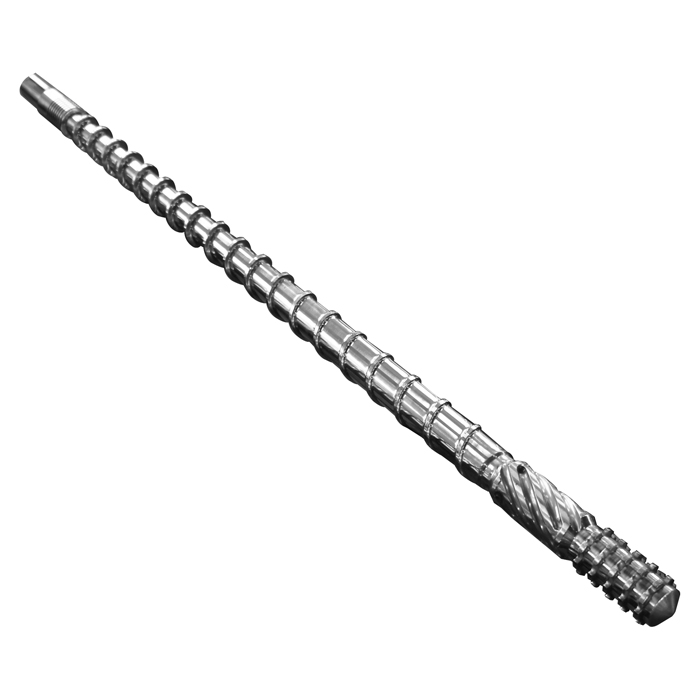
Every one of those lines runs on a screw and a barrel. And when the feedstock is recycled, those screws and barrels work harder than they ever did on virgin resin.
What Recycled Feedstock Does to Screw and Barrel Hardware
We've been making screws and barrels in Zhoushan since 1992. In the past two years the conversations with our recycling customers have shifted — different questions, different pain points than the converters running virgin resin. The hardware tells the story.
Recycled feedstock — even washed and screened — carries contamination that virgin resin does not. Residual paper fibers from label adhesives. Aluminum and glass micro-fragments from cap and seal residue. Sand and grit from collection-bin contamination. Even "clean" rPET regrind typically lands at 100 to 300 ppm of solid contaminants, much of it Mohs hardness 5 or above. That material runs through your compression zone every second.
Bulk density also misbehaves. Virgin pellets feed at roughly 500 to 600 kg/m³ and self-meter reasonably well. Recycled flake, washed film, and post-consumer fluff drop as low as 20 to 100 kg/m³. That means the same screw geometry sees radically different solids transport behavior. Surging, intermittent feed, and back-pressure swings are typical. So is local overheating where the screw bridges instead of conveying.
Trapped moisture compounds the problem. rPET that has not been crystallized and dried below 50 ppm degrades on the screw under shear, producing acetaldehyde and surface haze. rPE film flake often arrives wetter than spec, and the steam pocket created downstream of the feed throat accelerates corrosion on the barrel inner diameter.
The result is measurable. A standard nitrided screw on contaminated post-consumer regrind typically wears two to three times faster than on virgin resin. Flight lands erode first, clearances open, throughput drops, and the operator either accepts declining output or pulls the screw early.
Bimetallic Coating: Why Recycling Lines Are Switching
Most of the recycling-line projects we quote in 2025 and 2026 specify bimetallic construction rather than nitrided. The reason is hardware life, not specification snobbery.
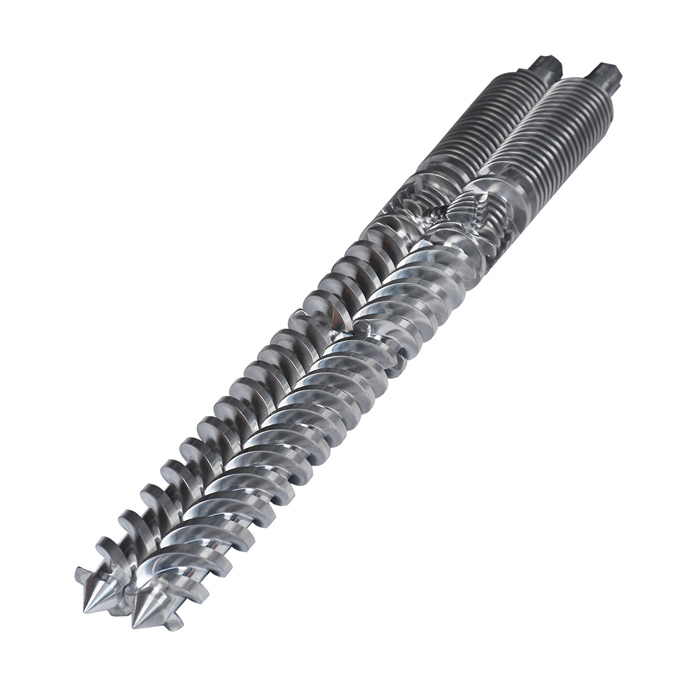
Bimetallic construction is not a single process — it is two. Bimetallic screws are hardfaced using plasma-transferred arc (PTA) welding, which deposits a 1.0 to 1.5 mm wear-resistant alloy layer onto a base substrate of 38CrMoAlA or 42CrMo. The screw alloys we run are Ni60, Colmonoy 56, and Colmonoy 83 — the last is a nickel-tungsten-carbide grade we reserve for the most abrasive feedstocks.
Bimetallic barrels are produced separately by centrifugal casting, with a thicker 2.0 to 3.0 mm alloy layer fused to the bore. For barrels we use our own EJS01 through EJS04 alloy series; EJS04 (Ni+Wc+Cr+B) handles service temperatures up to 600°C. Both screw and barrel finish at HRC 50 to 62 after heat treatment. By comparison, a nitrided layer on 38CrMoAlA is 0.4 to 0.7 mm thick and typically lands around 65 to 72 HRC at the surface but with a steep hardness gradient that drops within the first 200 microns.
Across our customer base, the pattern is clear: bimetallic screws and barrels last three to five times longer than nitrided equivalents on contaminated streams. Upfront cost is significant — a bimetallic 90 mm extruder set might run 60 to 90% more than nitrided — but the total-cost-of-ownership math reverses inside the first replacement cycle.
This is the reason our bimetallic screw barrel line has become the default specification for our European and North American recycling-line customers, where uptime economics matter more than tooling capex.
Sizing Up: Capacity Planning Before 2030
The 2030 deadline is not theoretical. PCR content reporting begins annually per manufacturing facility once PPWR applies, and brand owners need verified compliant supply lined up well before then.
For screw and barrel procurement, two implications follow.
First, the recycling extruder install base is going to grow fast between now and 2030, then keep growing through 2040 when PCR thresholds jump (50% for PET contact-sensitive non-bottle, 25% for non-PET contact-sensitive). Custom screw and barrel lead times in this industry typically run 8 to 16 weeks for standard configurations, longer for high-L/D twin-screw geometries. The lines that get built first will lock down preferred suppliers and capacity allocations.
Second, every recycling line built today will need spare-parts support for the next 15 to 20 years. Operators who run lean on spares discover that the hard way during their first unplanned outage. We typically recommend that anyone running continuous recycling extrusion keep at least one full spare screw on the shelf, two for critical lines. The cost is real, but a week of lost throughput on a 1,500 kg/h line is more.
For converters that have not yet committed to a recycling line and are evaluating ROI, the plastic recycling extruder screw barrel page on our site walks through the geometry options and material specifications we use for PE film, PP, PET, and mixed-stream applications.
Common Mistakes When Sourcing Screws for Recycling Lines
When customers come to us for plastic recycling extruder screw barrel projects, we see the same handful of specification errors over and over. They are all expensive when they show up six months into a production contract.
- Spec'ing virgin-grade hardware for contaminated streams. A nitrided screw works fine on clean industrial scrap or post-industrial regrind. It does not work on post-consumer kerbside material. Operators who assumed the two were interchangeable now run a screw replacement schedule three times more frequent than budgeted.
- Ignoring barrel liners. Replacing a worn screw on a worn barrel just transfers the problem. The clearance between flight tip and barrel ID determines pumping efficiency. We always quote screw and barrel as a matched set for recycling applications.
- No spare strategy for L/D greater than 30. Long screws need longer lead times and cost more to expedite. If you are running an L/D 33 or 40 single-screw or any twin-screw recycler, your spares plan should be locked in at line commissioning, not after the first failure.
- Designing for pellet feed when the actual feed is fluff or flake. This shows up most often on retrofit projects where the original line was built for virgin pellets. The compression ratio, feed zone depth, and grooved-barrel option all need to be re-specified for low-bulk-density inputs.
PCR Content Targets by Year (EU PPWR)
The following table summarises the post-consumer recycled (PCR) content thresholds set by PPWR for plastic packaging. Targets apply per manufacturing unit and are calculated annually.
| Plastic Packaging Category | 2030 PCR Minimum | 2040 PCR Minimum |
|---|---|---|
| Single-use PET beverage bottles | 30% | 65% |
| Contact-sensitive PET (other than beverage bottles) | 30% | 50% |
| Contact-sensitive plastic (non-PET) | 10% | 25% |
| Non-contact-sensitive plastic packaging | 35% | 65% |
Source: Regulation (EU) 2025/40 (PPWR). Verify the exact statutory wording against the official text before contracting on these numbers.
Frequently Asked Questions
When does PPWR actually apply?
The Regulation entered into force on February 11, 2025. General application starts on August 12, 2026. Specific milestones — recyclability grading, PCR thresholds, and packaging design rules — phase in through 2030, 2035, and 2040.
Does PPWR affect non-EU manufacturers?
Yes. PPWR applies to all packaging placed on the EU market, including imports. A converter outside Europe that ships packaged product into the EU is required to meet the same recyclability and PCR thresholds as a converter inside the EU.
Is bimetallic always the right choice for recycling lines?
Not always. For lightly contaminated, post-industrial regrind streams, nitrided hardware can still be cost-effective. The trade-off depends on actual contamination levels, throughput, and uptime cost. We typically run a wear-rate estimate against the customer's specific feedstock spec before recommending a construction.
How long does a bimetallic screw last on PCR feed compared to virgin?
Industry experience varies, but a typical figure we see is roughly half the life on heavily contaminated post-consumer feed compared to virgin resin. Even so, bimetallic on PCR generally outlasts nitrided on the same feed by a factor of three to five.
What screw geometries work best for film and fluff?
Low compression ratios (typically 2:1 to 2.5:1), deeper feed channels, and barrier or pin-mixing sections downstream. Grooved feed bushings help solids transport at very low bulk densities. We design the geometry around the specific feed stream rather than offering a single "recycling screw."
What lead time should I plan for?
For a custom screw and barrel set in the most-ordered single-screw range (65 to 200 mm), plan for 8 to 12 weeks ex-factory. Twin-screw and conical-twin sets run 12 to 16 weeks. Add roughly 4 weeks of sea freight to Europe and North America. Order spares with the original line build to lock in price and lead time.
Working with EJS on Recycling-Line Screws and Barrels
We started making screws and barrels in 1992 on Jintang Island — the part of Zhoushan known locally as the "island of screws" because of how much of the world's screw-and-barrel production comes from this one place. Today we run 21 workshops, 400 full-time employees, and 40,000 square meters of plant, with customers in the United States, Brazil, Mexico, Germany, Italy, Russia, Turkey, and the United Kingdom.
Recycling-line screw and barrel work is, increasingly, a large share of what we ship. We produce single-screw barrels from Ø14 to Ø500 mm (with screws up to 10 meters long), parallel twin-screw configurations from Ø20 to Ø250 mm, and conical twin-screw sets across the 30/70 to 188/330 range — with 55/110 and 65/132 kept as semi-finished stock for shorter lead times. Common recycling applications include PET bottle-to-bottle, polyolefin compounding, and replacement parts for the major OEM extruder builds.
If you are planning a recycling-line build for the 2030 PPWR window — or you need to replace screws on an existing line that is now running PCR feed — we are happy to quote.