Quick Answer
When sourcing from a Chinese screw barrel manufacturer, the first filter that matters is factory or trader. Real manufacturers run their own deep-hole drilling, heat treatment, PTA welding, and centrifugal casting in-house. Trading companies do not. The twelve checks below separate the two — and help buyers spot the kind of supplier who can deliver a 10-meter bimetallic screw to spec, on time, with the documentation a serious procurement file needs.
1. Factory or Trader — The First Filter
Roughly half the companies listing themselves as a screw barrel manufacturer on B2B platforms do not physically manufacture anything. They are trading companies. Middlemen. They source from one or two real factories and resell with a 15 to 30% markup. There is a place for traders in some markets — but for technical components like extruder screws and barrels, going direct to the factory cuts cost and shortens the loop between the buyer and the people running the lathes.
How to tell, quickly:
- Check the address. A real factory sits at an industrial address, not a CBD office tower. Look up the address on Baidu Maps. If the building looks like a glass office, it is almost certainly a trading company.
- Video-call the floor. Ask for a live walkthrough. A trader stalls or schedules for "later." A factory engineer picks up the phone and walks past the drilling line and the centrifugal casting cell.
- Ask a technical question they cannot fake. What alloy thickness does the bimetallic barrel deliver? What hardness range? What straightness tolerance over a 10-meter screw? A trader deflects. A factory engineer answers in seconds.
- Check the business license. Request a copy. If "manufacturing of mechanical equipment" is not in the registered business scope, the company is not a manufacturer regardless of what the website claims.
- Look at the domain age. Real factories often run domains registered 10 to 20 years ago. Trading companies rotate websites every 2 to 3 years.
Not every trader is a scam. Some have long, real relationships with specific factories and add value through English-language coordination and documentation. But the buyer should know which one is on the other end of the email before signing a PO.
2. The 12-Point Buyer Checklist
Once it's clear the company is a real manufacturer, the twelve points below let buyers compare one factory against another with apples-to-apples criteria. Most can be checked before any deposit changes hands.
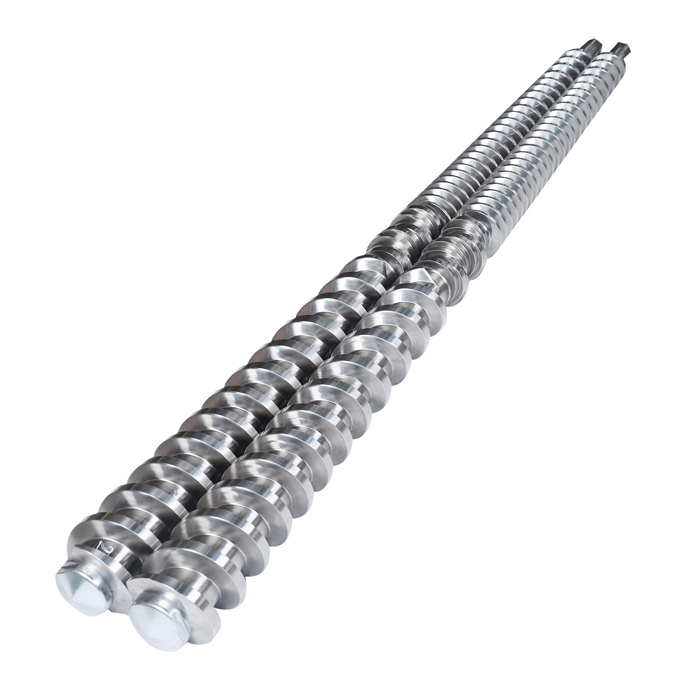
Verify the physical factory exists.
Request a recent video walkthrough showing the address sign, production floor, and machinery. Cross-check with satellite imagery on Baidu Maps or Google Maps. EJS sits at the Xihou Industrial Zone in Jintang Town, Zhoushan — known locally as the "island of screws" for the density of screw barrel factories there.
Match the company name to the business license.
The English website name and the registered Chinese business name should map cleanly. If a factory website says "Zhoushan ABC Co., Ltd" but the proforma invoice is issued by "Ningbo XYZ Trading Ltd," the buyer is looking at two different companies — usually a trader sitting between the buyer and the real factory. Ask for both the manufacturing license and the export license, and verify the names match.
Audit production equipment count, age, and brand.
A real screw barrel factory has, at minimum: deep-hole drilling machines (typically Sino-German or Italian), heat treatment furnaces, CNC turning centers, centrifugal casting equipment for bimetallic barrels, PTA welding stations for bimetallic screws, and a metallurgical lab. EJS runs 300+ machines across 40,000 m². The count alone is not the story though — ask when each major machine was installed, when it was last serviced, and who operates it.
Confirm hardfacing capability is in-house.
This is the biggest separator in the screw barrel industry. Bimetallic screws require PTA (plasma transferred arc) welding with consistent alloy chemistry. Bimetallic barrels require horizontal centrifugal casting under inert gas. A factory that outsources its bimetallic work is, at best, a finishing shop. Ask exactly how the bimetallic layers are manufactured, what alloys are used, and what thicknesses are delivered. EJS bimetallic screws run Ni60, Colmonoy 56, or Colmonoy 83 depending on the wear environment, with 1.0 to 1.5 mm alloy thickness welded via PTA. Bimetallic barrels use EJS01 through EJS04 alloys at 2.0 to 3.0 mm centrifugally cast.
Request material certifications.
Every batch of base steel should arrive with a mill test certificate (MTC) showing chemical composition and mechanical properties. Common base materials include 38CrMoAlA (the standard nitriding steel in Asia), 34CrAlNi7, 31CrMoV9, 42CrMo, and SS316 for corrosion-sensitive applications. Ask for sample MTCs from past orders before placing the first one.
Specify and validate alloy options.
For nitrided screws, nitriding layer depth (0.4 to 0.7 mm) and surface hardness (HV 850 to 950) should be in the spec. For bimetallic construction, the alloy grade matters more than the brand name — Colmonoy 56 from one factory may not perform identically to Colmonoy 56 from another, because welding parameters change the deposited metallurgy. Always request a sample piece for third-party metallurgical analysis before committing to bulk volume.
Confirm geometric tolerance specifications.
Critical tolerances include: bore straightness (0.015 mm/m or tighter), surface roughness (Ra 0.4 µm on the flight lands is standard), and concentricity. Ask for the format of the QC report. If the factory cannot produce a written report from a coordinate measuring machine or geometric measurement device, it does not have an audit-grade QC process.
Review the QC documentation package.
A real factory provides: dimensional inspection report, MTC for base material, hardness test report, NDT (ultrasonic or magnetic particle inspection) for the bimetallic interface bond, and a factory acceptance test (FAT) certificate. Ask what a typical QC package looks like for a 90 mm bimetallic screw. The answer reveals process maturity faster than any sales deck.
Establish IP protection terms.
When ordering a screw geometry developed in-house, or to a reference drawing from an OEM, the buyer needs NDA terms in writing — covering drawing handling, sample destruction, and non-circumvention. Reputable Chinese factories sign NDAs for custom drawing work without hesitation. EJS signs NDAs as standard practice for any custom geometry.
Negotiate payment terms appropriate to order size.
A common structure for first-time buyers is 50% T/T deposit at order confirmation and 50% before shipment. EJS works on these terms for new customers, with more flexible arrangements available once a track record is built; smaller amounts can also run through PayPal, Western Union, or MoneyGram. Avoid any factory demanding 100% upfront from a new customer, and make sure the receiving company name matches both the manufacturing license and the export license — not a personal or unrelated account.
Document warranty and dispute terms before the order.
Get the warranty in writing before the order, not after a problem. EJS gives a one-year warranty on screw barrels running pure plastics — abrasive or contaminated recycled feed is a different wear case and should be discussed up front. Within warranty, a confirmed defect gets a free replacement against a formal non-conforming report, with the customer covering return transport. Make sure the replacement timeline and the option of third-party inspection are written into the sales contract rather than assumed.
Run a small order before committing big volume.
For a new supplier relationship, place one screw and barrel order at moderate volume — one to three sets — before committing to a year's volume. Track delivery accuracy against the promised lead time, documentation completeness against the QC package list, and quality consistency against the first article. The first order tells the buyer everything about how the relationship will run.
3. Red Flags to Walk Away From
Some patterns show up often enough across the industry to deserve naming. Any one of them is grounds to pause the relationship before sending a deposit.
- Refusal to provide a live video walkthrough. No real factory has anything to hide on the production floor. Hesitation here usually means there is no production floor.
- No willingness to sign an NDA. A factory that handles drawings without legal protection handles every customer's drawings the same way.
- Pricing far below everyone else. A bimetallic screw and barrel set has roughly knowable input costs — base steel, alloy powder, machining hours, PTA welding hours. When one quote lands dramatically under every other quote for the same drawing, something is being cut. Usually alloy thickness, sometimes alloy substitution, occasionally fake material documentation. Cheap against a thinner alloy layer is not cheap.
- Refusal to ship FOB Ningbo or Shanghai. A real factory has its own export rights and can book the container. A trader without export rights insists on EXW because it cannot actually arrange the shipment.
- The "we do everything" promise. A factory claiming to make single-screw, twin-screw, planetary, injection, and rubber screws — all in-house, all to OEM tolerances, across every diameter imaginable — is overstating. Real factories have a defined range and known limits, and they will tell you what those limits are.
- Payment to a personal account or a Hong Kong company. The export company name must match the manufacturing license name. Mismatches are a red flag for tax fraud, customs evasion, or an undisclosed trader sitting in the middle.
4. How Pricing and Lead Time Actually Work
A point buyers new to this category often miss: a screw barrel has no list price. The parts are almost 100% customized, so a real factory cannot quote until it sees what you need. EJS builds every quote from a drawing — or, when no drawing exists, from clear product photos plus the major dimensions: diameter, length, flange details. Give that information clearly and a quotation comes back within one working day.
What moves the number? Alloy grade, base steel, surface treatment, L/D ratio, and overall length. A nitrided 38CrMoAlA screw and a bimetallic bimetallic screw barrel in Colmonoy 83 for the same machine are not in the same price bracket — the metallurgy is the cost. This is exactly why a like-for-like comparison between two suppliers only works when both get the same drawing and the same spec sheet. A cheaper quote against a thinner alloy layer is not actually cheaper.
Going factory-direct removes the trading-company layer. A trader sourcing the same part from the same factory adds overhead and margin on top — and that markup buys you nothing in metallurgy, tolerance, or delivery speed. It just sits between you and the people running the lathes.
On lead time: production starts after the drawing is confirmed and typically runs 20 to 70 days depending on the product, the factory's current schedule, and order quantity. The exact figure goes into the offer and the proforma invoice — not left vague. The 55/110 and 65/132 conical twin-screw sets EJS keeps as semi-finished stock move faster, because the heavy heat treatment and rough machining are already done. On top of production, add transit: EJS handles sea freight to seaport, air freight to airport, or courier to door, and will quote the pre-paid cost and transit time for whichever you pick.
5. Payment Terms, IP, and Quality Disputes
T/T is the standard method. For first-time buyers, EJS works on 50% deposit at order confirmation and 50% before shipment. Regular customers can negotiate more flexible terms, and for smaller amounts PayPal, Western Union, and MoneyGram are accepted to keep bank charges down. One rule does not bend: the receiving account name should match the manufacturing and export license. Payment to a personal or unrelated third-party account is a warning sign, and any factory demanding 100% upfront from a new customer deserves a second look.
IP protection on custom drawings starts with the NDA. A serious manufacturer treats geometry drawings as protected information — does not shop the design to other buyers, does not use the geometry in its own product catalog, and returns or destroys drawings at the end of the project. This is not unusual; it is the baseline of how a competent factory operates.
For quality disputes, the typical resolution path runs:
- Photo or video evidence sent promptly after receipt
- A formal non-conforming report documenting the defect
- Inspection at the factory, with a third-party agent if the customer prefers
- Free replacement once the defect is confirmed, with the customer covering return transport
This is exactly how EJS handles it: a one-year warranty on screw barrels running pure plastics, and a free replacement within warranty against a formal non-conforming report. A real factory takes complaints seriously because returned goods cost it more than getting the part right the first time — and in the screw barrel trade, reputation among OEM converters travels fast.
6. What to Expect From EJS
We started building screw barrels at Jintang Island in 1992. The factory has grown to 40,000 m², 300+ machines, and 400 staff including 10 engineers and 6 English-speaking export sales. The whole production chain runs in-house — rough turning, deep-hole drilling, heat treatment, PTA welding, centrifugal casting of bimetallic barrels, and final QC. EJS is a direct manufacturer, not a trading agent, and we do not work through distributors who add markup.
On where we sit in the market: we benchmark against Xaloy and Bernex, the high-end bimetallic names a lot of OEM machines ship with. The honest framing we give buyers is that those brands set the bar, and our job is to deliver comparable wear performance from China at a price that is a good deal lower. Screw barrels from our factory have shipped to Italy, Spain, Germany, the UK, the USA, Chile, Japan, India, and beyond since 1992.
Product lines manufactured in-house:
- Single-screw extruder barrels: Ø14 to Ø500 mm, up to 10 m long
- Parallel twin-screw barrels: Ø20 to Ø250 mm
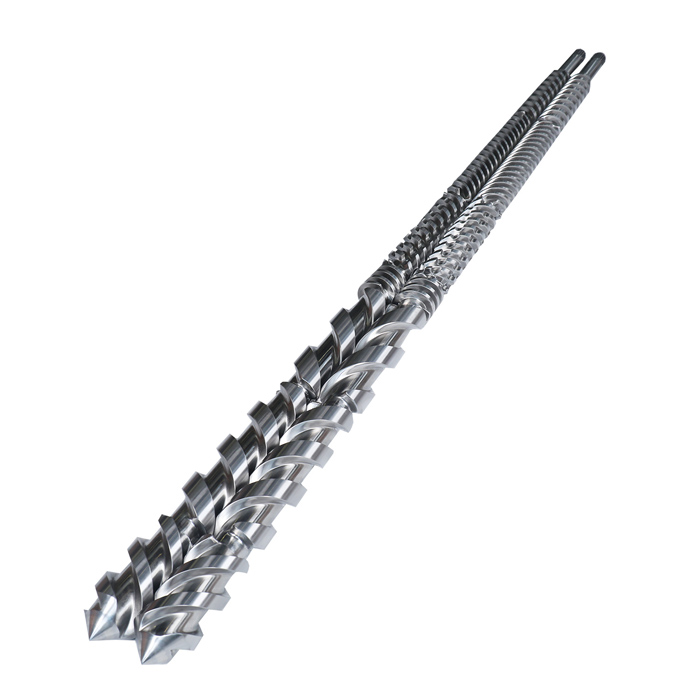
- Conical twin-screw barrels: 30/70 to 188/330 mm
- Injection molding screws and barrels: Ø16 to Ø317 mm
- Rubber extruder pin screws: Ø60 to Ø500 mm
- Hot and cold feed rubber barrels: Ø60 to Ø650 mm
- Screw elements for compounding: Ø15.6 to Ø250 mm
- Planetary roller extruder hardware: 500 to 5,000 kg/h capacity
The 55/110 and 65/132 conical twin-screw sets are kept as semi-finished stock for faster delivery. Other custom sizes run on a production window of roughly 20 to 70 days after drawing confirmation, depending on the part and the current schedule, with the exact figure given in the offer and proforma invoice. Custom geometries for specific OEM platforms — Coperion ZSK, EREMA Intarema, Starlinger recoSTAR, Battenfeld, Krauss-Maffei, Berstorff, JSW — are reverse-engineered to original spec or upgraded per customer drawing.
For the broader picture on why screw barrel demand is shifting in 2026, see our earlier piece on EU PPWR and recycling extruder demand, and on choosing between single-screw and twin-screw for recycling applications, the 2026 sourcing guide.
7. Frequently Asked Questions
How can I tell if a Chinese screw barrel manufacturer is a real factory or a trading company?
Ask for a live video walkthrough of the production floor showing the address sign, deep-hole drilling line, hardfacing equipment, and QC lab. Real factories provide it within a day. Trading companies stall or send pre-recorded marketing footage. Cross-check the registered business name against the export company name on the proforma invoice — a mismatch usually means a trader sitting between the buyer and the factory.
What is the typical MOQ for a Chinese screw barrel order?
For custom screw and barrel sets, MOQ is usually 1 set. Factories do not impose volume minimums on custom orders because each piece is individually machined to a drawing. The same goes for the 55/110 and 65/132 conical twin barrels EJS keeps as semi-finished stock — order one set, with a shorter lead time than a full custom build because the heavy machining is already done.
How is a Chinese screw barrel quoted, and how fast can I get pricing?
Screw barrels are almost 100% customized, so there is no list price. Quotes are built from your drawing — or, if no drawing is available, from product photos plus major dimensions such as diameter, length, and flange details. With clear information, EJS issues a quotation within one working day. The quote reflects alloy grade, base steel, surface treatment, L/D ratio, and length, so a fair comparison between suppliers means giving every factory the same drawing and the same spec.
Can a Chinese factory make OEM replacement screws for European or Japanese extruders?
Yes. Most established Chinese screw barrel manufacturers reverse-engineer OEM platforms including Coperion, EREMA, Starlinger, Battenfeld, Krauss-Maffei, Berstorff, and JSW. The buyer provides the OEM model number, L/D ratio, and ideally a sample part or original drawing. The replacement is built to original geometry with equal or upgraded metallurgy, at a significant cost saving over the OEM spare.
What payment terms are standard for a Chinese screw barrel manufacturer?
T/T is the most common method. For new customers, EJS uses 50% deposit at order confirmation and 50% before shipment. Regular customers can discuss more flexible terms, and smaller amounts can go through PayPal, Western Union, or MoneyGram to save on bank charges. Whatever the method, pay to the company account whose name matches the manufacturing and export license — not a personal account. Be cautious with any factory demanding 100% upfront from a first-time buyer.
What lead time should I plan for a custom screw barrel order from China?
Lead time has two parts: production plus transportation. Production starts after drawing confirmation and typically runs 20 to 70 days depending on the product, the factory's production schedule, and order quantity — the exact figure is stated in the offer and proforma invoice. Stock items in standard diameters such as 55/110 and 65/132 conical twin ship faster because rough machining and heat treatment are already done. On top of production, add ocean, air, or courier transit time from China to your port or door.