A pharmaceutical twin screw barrel turns hot melt extrusion (HME) into a real solution for poorly soluble drugs — but only when its geometry, metallurgy, and thermal control all line up. Co-rotating intermeshing screws prevent stagnation, 316L stainless steel resists corrosion from APIs and cleaning agents, and modular designs let one line cover multiple formulations. This article walks through what to look for in a pharma-grade twin screw barrel, and how to source a custom or replacement set built to your spec.
1. Why the Barrel Matters in Pharmaceutical Hot Melt Extrusion
Solving drug solubility is not just a formulation problem. It is also a hardware problem — and the barrel is where the hardware either holds the process together or quietly undoes it.
Hot melt extrusion is a solvent-free, continuous process that converts crystalline active pharmaceutical ingredients (APIs) into amorphous solid dispersions inside a polymer matrix. The result is faster dissolution and better bioavailability. This matters more every year: research published in Molecular Pharmaceutics estimates that roughly 40% to 70% of new chemical entities entering the drug pipeline are poorly water-soluble.
Inside an HME line, the twin screw barrel is not a passive container. It is the place where heat transfer, pressure, and intensive mixing happen at the same time, across processing zones engineered to a specific thermal profile. API morphology can shift from crystalline to amorphous in seconds — and the barrel's bore geometry, metallurgy, and zone-by-zone temperature control decide whether that transformation is uniform across the batch or patchy. Small deviations in barrel tolerances introduce local thermal gradients that either degrade the API or yield inconsistent dispersions, neither of which survives a quality audit.
The hardware decisions that follow — co-rotating versus counter-rotating, alloy choice, surface finish, modular versus one-piece — flow from this fact. The right parallel twin screw barrel built to the right drawing is what converts a formulation in development into a reproducible commercial product.
2. Why Co-Rotating Twin Screw Geometry Dominates
Two problems drive geometry choice in pharma HME: material stagnation and uneven thermal exposure. Co-rotating intermeshing twin screws solve both, which is why they dominate the configuration of pharmaceutical-grade extruders.
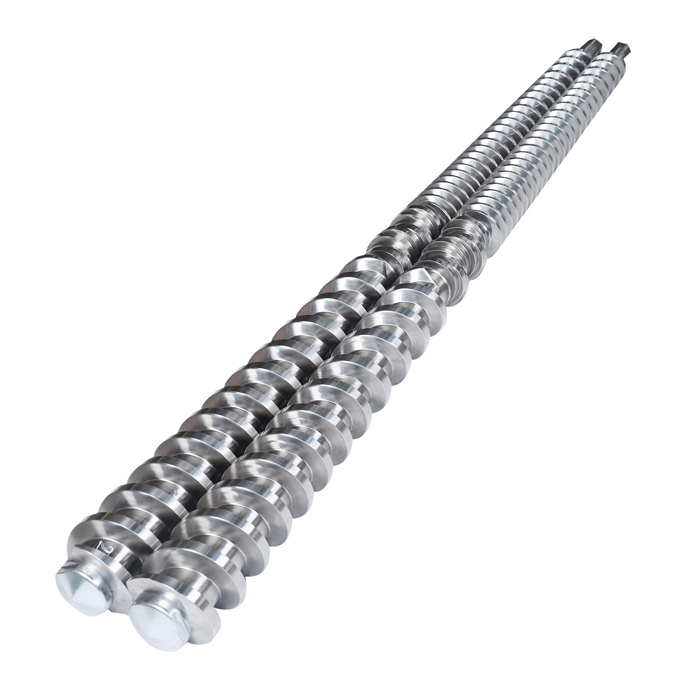
The defining mechanical advantage is the self-wiping action. With both screws turning the same direction and the flights intermeshing closely, each screw continuously wipes the surface of the other. Material does not accumulate in dead spots, does not linger against hot walls, and does not have the chance to degrade before reaching the die. According to work cited by Chemical Engineering Progress / AIChE, co-rotating twin screw barrels deliver self-wiping action that minimizes stagnant zones and produces a narrow Residence Time Distribution (RTD).
Why does narrow RTD matter so much? RTD measures how long individual material parcels actually spend inside the barrel. A wide RTD means some material flies through while other portions sit and overheat — unpredictable thermal exposure, in other words. For heat-sensitive APIs that is a direct safety concern, because the long-residence fraction can degrade before exit. A narrow RTD keeps the whole batch on the same thermal history, which is the only basis on which batch-to-batch reproducibility is even possible.
Co-rotating designs also avoid the localized hotspots that counter-rotating screws can create. Counter-rotating geometry forms high-pressure calendering zones between the flights, concentrating frictional heat unevenly. For commodity polymer compounding that can be acceptable; for pharma HME it usually is not. The advantages co-rotating geometry brings to the line include:
- Continuous self-wiping: Intermeshing flights stop API-rich material from sticking to barrel walls and cooking against them.
- Uniform distributive mixing: Consistent screw engagement disperses API into the polymer matrix evenly, making dissolution predictable.
- Tunable shear: Co-rotating geometry lets formulators dial mechanical energy in or out — essential when balancing shear and heat for a thermally fragile API.
3. Thermal Management — Managing Heat Without Degrading the API
Thermal management is probably the most consequential engineering challenge in pharma HME. Get it wrong and even a perfectly chosen screw geometry will not save the API.
Heat in a co-rotating twin screw system comes from two sources at once: external barrel heaters, and the frictional shear the rotating screws put into the melt. These two energy sources have to be calibrated against each other, not summed naively. High shear at high temperatures compounds thermal stress, which is exactly the situation thermally labile or moisture-sensitive APIs cannot tolerate.
The barrel's segmented construction is what makes that calibration possible. Each zone along the barrel length holds an independently controlled temperature, so the process can ramp heat gently in the early zones, hold it steady through the mixing zones, and sometimes pull it down near the die. Pharmaceutical Technology notes that the modular design of twin-screw barrels allows precise control over residence time and shear stress, which is critical for processing heat-sensitive pharmaceutical compounds. That zone-by-zone control is what separates pharma-suitable hardware from generic industrial barrels.
The risk to watch is local hotspots — small areas where material stagnates against a barrel wall and crosses its degradation threshold even when the average zone temperature reads fine. Mixing and conveying elements that keep material in continuous motion through the melt zone are what prevent this. Conveying elements that match the L/D and viscosity profile of the formulation are part of the same engineering, which is why the screw and barrel are quoted together rather than separately.
4. Materials: Why 316L Stainless Steel Is the Pharma Default
Material selection sits next to screw geometry in importance — get the alloy wrong and every upstream decision is undone by contamination risk.
Standard industrial alloys are not built for pharmaceutical environments. Carbon steel and lower-grade stainless corrode against the acidic polymers, hygroscopic APIs, and aggressive cleaning agents that show up routinely in HME and wet granulation. Corrosion byproducts become contaminants. In a regulated environment, even trace elemental contamination is grounds for batch rejection or a regulatory observation.
316L stainless steel is the response. The "L" — low carbon content — reduces carbide precipitation at the weld zones where corrosion typically starts. Beyond that, 316L's molybdenum content protects against chloride pitting, which matters whenever cleaning agents or excipients introduce halide ions into the barrel. That chemical compatibility is why 316L has become the de facto pharma standard cited across the pharmaceutical HME literature.
Surface finish is the other discipline. Pharma-grade contact surfaces commonly target an internal roughness average (Ra) at or below 0.8 µm, which is what makes clean-in-place (CIP) and sterilize-in-place (SIP) validation feasible. Rough surfaces harbor microbial biofilm and residual API; clean surfaces do not. Electropolishing after precision machining knocks the surface micro-peaks down further, producing a finish that resists adhesion and survives repeated cleaning cycles.
EJS includes SS316 and SS304 in the standard base steel options for both parallel twin screw barrels and conical twin screw barrels. The catalogue also lists 38CrMoAlA, 34CrAlNi7, 31CrMoV9, 40Cr, 42CrMo, and SKD61 for non-pharma duty. Surface treatment options include nitriding, through-hardening, hard chrome-plating, and bimetallic — the trade-offs there are covered in detail in the bimetallic vs nitrided guide. For a pharmaceutical twin screw barrel specifically, the alloy decision generally lands on 316L with an electropolished interior, with the surface finish target driven by the buyer's own validation requirements.
5. Modular Barrel Design for Multi-Formulation Lines
Modern pharma extrusion lines are rarely single-purpose. A modular barrel — assembled from segments that can be reconfigured — is what lets one line cover multiple drug products without rebuilding the platform every time the formulation changes.
One-piece barrels are mechanically simpler and have their place. But when a formulation changes — say, moving from a high-viscosity polyvinyl acetate to a lower-melt HPMC-AS — segmented barrels with interchangeable liners let engineers swap the affected zones rather than the whole assembly. That keeps downtime and capital cost manageable, particularly when several formulations share one line. As research published in PMC confirms, twin screw extruders blend APIs with thermoplastic polymers at the molecular level through the combination of heat and mechanical energy — a process sensitive enough that minor barrel degradation can compromise dispersion quality.
The barrel's L/D ratio — total length divided by diameter — sets how thoroughly the matrix is mixed before the die. Longer L/D, often 40:1 and above, gives extended residence time and is the route for dispersing poorly soluble APIs into denser polymer carriers. Shorter L/D suits heat-sensitive compounds where extended thermal exposure is itself the risk. Configuring L/D against the formulation, paired with the right zone layout, is how mixing intensity gets tuned without redesigning the extruder.
Wet granulation and hot melt extrusion need different barrel configurations, too. Wet granulation runs need liquid injection ports, moisture-tolerant seals, and lower temperature zones; HME needs precise thermal zoning and melt-pressure resistance. A modular barrel platform can carry both, which is what makes it a strategic asset as a pipeline diversifies.
6. Selection Criteria for a Pharma-Grade Barrel Assembly
Selecting a pharmaceutical twin screw barrel is where the strategy meets the procurement file. Three non-negotiable criteria carry the decision:
- Self-wiping co-rotating geometry first. The configuration that suppresses dead zones, controls RTD, and prevents localized API degradation. For thermally sensitive compounds this is not optional.
- 316L stainless steel on every contact surface, with electropolished interior. Get full alloy certification from the manufacturer before approval. Verify the certificate matches the heat number on the part.
- Modularity built in from the start. A modular barrel system with interchangeable segments protects the line against future formulation changes without forcing a fresh capital cycle.
Procurement teams that treat these three as baseline requirements — rather than negotiable preferences — usually report fewer regulatory holds and faster scale-up. The supplier who can deliver all three, with documented tolerances and traceable material, is where the hardware decision turns into a commercial outcome.
7. Sourcing Custom Twin Screw Barrels for Pharma HME From EJS
A word on what EJS actually does, and does not, claim. EJS is a screw and barrel manufacturer based in Zhoushan, China, building extrusion and injection screw barrels since 1992. EJS is not a turnkey pharmaceutical equipment vendor and does not hold pharma-specific certifications such as GMP packages or pre-validated CIP/SIP systems. Buyers operating in pharma run their own qualification programs — what EJS contributes is the custom screw and barrel hardware those programs specify.
Within that scope, EJS builds:
- Parallel twin screw barrels from Ø20 to Ø250 mm bore, up to 10 m long
- Conical twin screw barrels from 30/70 to 188/330 mm
- Custom builds in SS316 or SS304 base steel, alongside the standard alloy and nitriding steel grades
- Surface finish targets per buyer specification, including polished interiors suited to high-cleanability duty
- Reverse-engineered replacement geometry for existing OEM twin screw extruders, when a drawing or sample is supplied
What a clean quote from EJS needs from a pharma buyer: the machine make and model (or original drawing); screw diameter, L/D, and length; resin or polymer carrier; required base steel and surface finish; and the buyer's own cleanability or finish requirements. With that in hand, EJS issues a quotation within one working day. For vetting any China-based supplier before committing to a build, the buyer checklist walks through the factory-vs-trader checks that matter most.
8. Frequently Asked Questions
Why does pharmaceutical hot melt extrusion rely so heavily on the twin screw barrel?
Hot melt extrusion converts crystalline APIs into amorphous solid dispersions inside a polymer matrix, improving dissolution and bioavailability. The barrel is where heat, pressure, and mixing happen simultaneously — its geometry, alloy choice, and temperature profile determine whether the transformation is uniform and reproducible. A barrel that runs hot in one zone or stagnates material in another can degrade an API before it ever leaves the extruder.
Why is co-rotating twin screw geometry preferred for pharma HME?
Co-rotating intermeshing twin screws self-wipe each other's flights, removing the dead zones where material would otherwise overheat or degrade. The result is a narrower residence time distribution and tighter control over thermal exposure — both essential for heat-sensitive APIs. Counter-rotating designs by contrast generate localized calendering zones that concentrate frictional heat unevenly.
Why specify 316L stainless steel for a pharma twin screw barrel?
316L resists corrosion from acidic polymers, hygroscopic APIs, and the cleaning agents used between batches. The "L" (low carbon) reduces carbide precipitation at weld zones — a typical corrosion starting point — and its molybdenum content protects against chloride pitting. Combined with electropolishing and a tight surface finish, 316L supports the cleanability that pharmaceutical processes require.
Does EJS supply pharmaceutical-grade twin screw barrels?
EJS does not market itself as a pharmaceutical equipment vendor and does not hold pharma-specific certifications such as GMP or pre-validated CIP/SIP packages. What EJS does is build parallel twin screw barrels (Ø20-250 mm) and conical twin screw barrels (30/70 to 188/330) to customer drawings — including in SS316 base steel — for buyers whose own qualification programs cover the rest. If the buyer provides the geometry, surface finish, and material specification, EJS manufactures the screw and barrel set to that spec.
Can EJS make a replacement barrel for an existing pharmaceutical extruder?
Yes. EJS reverse-engineers existing OEM twin screw barrel geometry to original spec when a drawing is available, or builds from product photos plus major dimensions when it is not. Common base steels include 38CrMoAlA, 31CrMoV9, 34CrAlNi7, SS304, and SS316. The buyer specifies surface finish, alloy, and any cleanability requirements; EJS quotes within one working day when the information is clear.
Is a modular barrel design better than a one-piece design for pharma lines?
Modular barrels with interchangeable segments let formulators adapt one platform across multiple drug products — adding mixing elements, swapping worn segments, or reconfiguring temperature zones without replacing the whole assembly. One-piece barrels are mechanically simpler but less flexible. The right choice depends on how many formulations the line will run and how often the geometry needs to change.