A rubber screw barrel is built around the fact that rubber does not melt the way plastic does — it shears, warms, and mixes, but never crosses the line into scorch. That changes everything: lower barrel temperatures, shallower screw channels, and often a pin barrel design that plastic extruders never use. EJS builds pin screw barrels Ø60–500 mm and hot/cold feed rubber barrels Ø60–650 mm, in nitrided or bimetallic construction, plus refurbishment of worn parts. This guide covers what to spec for tire, cable, hose, and profile rubber duty.
1. Why Rubber Extrusion Is Not Like Plastic Extrusion
Most extruder hardware advice quietly assumes thermoplastic — a screw that melts polymer and pushes the melt through a die. Rubber breaks that assumption completely. Rubber compounds do not melt. They are uncured elastomers loaded with carbon black, silica, oils, and a vulcanization package, and the extruder's job is to warm them, mix them, and form them without activating the cure.
That single fact reshapes the whole hardware. Barrel temperatures are typically held at 80 to 120°C — well below thermoplastic melt temperatures — because crossing that line risks scorch, the point at which the rubber starts to vulcanize prematurely inside the extruder. Scorched compound is a write-off; it cannot be reprocessed.
Screw geometry adapts. Rubber screws use shallower flight channels, lower compression ratios, and often L/D ratios shorter than typical thermoplastic screws (because the compound does not need long melting zones — it needs controlled shear and conveying). Heat in a rubber extruder comes mostly from frictional shear at the flight clearances; that has to be tuned carefully against the barrel cooling system, because runaway friction is what triggers scorch. The wear story is different too: heavily filled rubber compounds are abrasive on different surfaces than filled plastics, with carbon black and silica grinding at flight lands rather than the through-bore. We'll come back to that in the materials section.
2. Pin Barrel: The Rubber-Specific Design
The pin barrel is the most distinctive rubber-extrusion design — and it exists for one reason: distributive mixing without raising temperature.
The principle is simple. Radial pins penetrate from the barrel wall into the screw channel, between the flights. As rubber flows along the screw, the pins repeatedly cut, fold, and redirect the stream. The compound's elements — carbon black agglomerates, oil pockets, undispersed curatives — get broken up and redistributed across the cross-section. The screw provides the conveying; the pins provide the mixing.
What makes this design valuable specifically for rubber is that it improves mixing without adding shear heat. In a thermoplastic system you can solve mixing problems by raising shear; in a rubber system that would push the compound toward scorch. The pin barrel lets you separate the two — convey gently, mix aggressively, hold temperature.
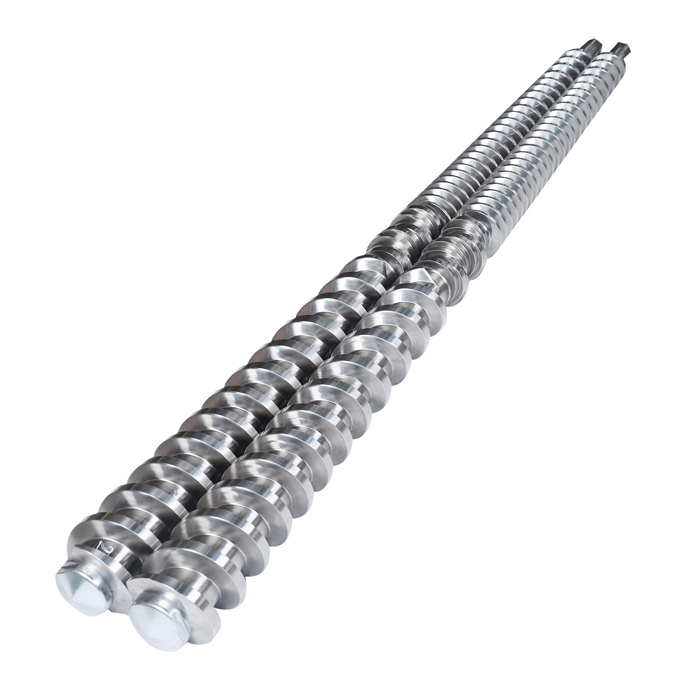
EJS makes pin screw barrels (pin barrel) in the Ø60 to Ø500 mm bore range. The pins themselves are typically removable, which matters when a worn pin needs replacing or the geometry needs adjusting for a different compound — pin barrels are not one-time-fit hardware. Tire-component lines, cable-insulation lines, and seal-profile lines are the most common users of pin barrel construction. For a compound where dispersion quality drives the finished product (rolling resistance in tires, dielectric uniformity in cable insulation, surface finish in seals), the pin barrel earns its place in the design.
3. Hot Feed vs Cold Feed Rubber Extruders
Two extruder configurations dominate rubber processing, and they ask for different screw and barrel hardware. Knowing which one your line runs is the first step in specifying a replacement.
Hot feed extruders
A hot feed extruder takes rubber that has already been warmed and partially mixed on an open mill or in an internal mixer. The stock arrives soft and pliable, so the extruder's job is mostly conveying and forming — pushing the prepared compound through a die without doing much further mixing. That allows shorter screws, larger diameters, and simpler geometry. The hot feed rubber barrel range EJS makes runs from Ø60 mm up to Ø650 mm — the largest diameters in the rubber-extruder catalogue, because hot feed extruders handle the highest throughput per pass when the compound is ready to extrude.
Cold feed extruders
A cold feed extruder takes room-temperature rubber stock — strips, pellets, or chunks — and does all the warming, mixing, and forming inside the barrel itself. That asks a lot more of the screw: longer L/D, more carefully engineered flight design, and frequently a pin barrel section for distributive mixing. Cold feed barrels typically run smaller bore than hot feed (the EJS Ø60-650 mm rubber barrel range covers both, but the cold feed end of the line usually sits at the smaller diameters with longer screws). Cold feed extruders dominate modern rubber processing because they eliminate the open-mill warming step, reducing labor and improving line consistency.
The hardware difference shows up in the quote. A hot feed barrel order is mostly about diameter, length, and abrasion resistance. A cold feed order adds questions about pin barrel sections, mixing-zone design, and the L/D ratio needed for the specific compound.
4. Sizes, Materials, and Surface Treatment
The EJS rubber extruder screw barrel range, as built in-house at the Jintang Island factory:
| Parameter | Range |
|---|---|
| Pin screw barrel diameter | Ø60 mm – Ø500 mm |
| Hot / cold feed rubber barrel diameter | Ø60 mm – Ø650 mm |
| Working length, bimetallic screws | up to 10 m |
| Working length, nitrided screws and barrels | up to 10 m |
| Base steels | 38CrMoAlA (1.8509), 34CrAlNi7 (1.8550), 31CrMoV9 (1.8519), 40Cr, 42CrMo, SKD61, SS304 |
| Surface treatment | Bimetallic, nitriding, through-hardened, chrome-plated |
| Bimetallic layer (screw) | 1.0 – 1.5 mm |
| Bimetallic layer (barrel) | 2.0 – 3.0 mm |
| Nitriding layer | 0.4 – 0.7 mm |
| Surface roughness | Ra 0.4 µm |
| Surface straightness | 0.015 mm |
The bimetallic-vs-nitrided decision plays out the same way it does on the plastic side. Nitriding diffuses a hard case 0.4 to 0.7 mm into the steel — cost-effective and durable on cleaner rubber compounds and lower-shear duty. Bimetallic adds a PTA-welded hardfacing layer (1.0 to 1.5 mm) on the screw and a centrifugally cast alloy lining (2.0 to 3.0 mm) in the barrel, which is where you go for abrasive compounds — heavily filled with silica, calcium carbonate, or carbon black. The full reasoning, the alloy options (Ni60, Colmonoy 56, Colmonoy 83 on the screw; EJS01–EJS04 on the barrel), and where each one earns its keep is in the bimetallic vs nitrided guide.
One detail worth flagging for rubber duty: the pin sockets and the pins themselves are wear points distinct from the bore. A worn pin or an oversized pin socket can be replaced individually, which is part of why pin barrels stay in service for years even on aggressive compounds.
5. Choosing by Application
Tire components (treads, sidewalls, inner liners)
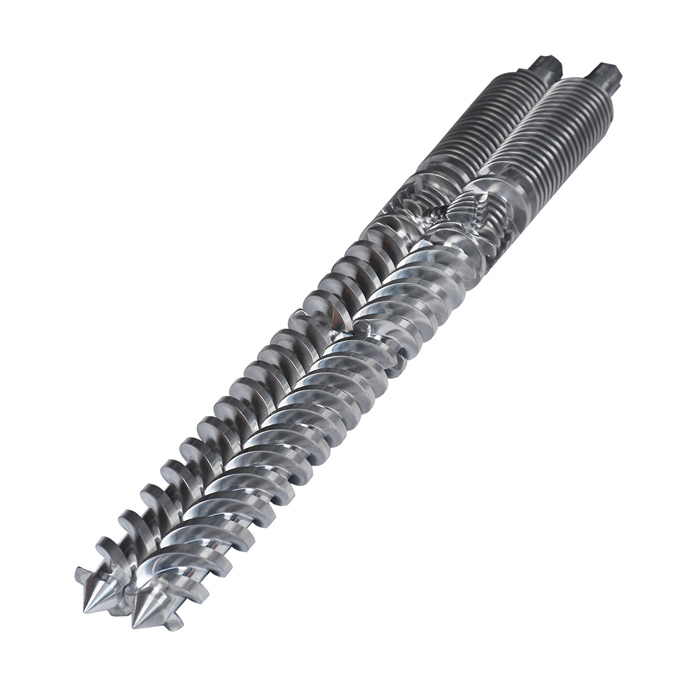
Tire compounds are among the most abrasive in the rubber world. Treads are loaded with silica and reinforcing carbon black at high volume fractions to deliver wet grip and rolling resistance. A bimetallic cold feed pin barrel with a Colmonoy 83 or tungsten-carbide-bearing screw hardfacing is the durable answer. Throughput requirements are high, so larger bore (often in the Ø150–Ø250 mm range for component extruders) and well-engineered cooling are both critical.
Cable and wire insulation / jacketing
Cable-jacket rubber needs consistent dimensional control and uniform dispersion of flame-retardant and stabilizer additives. Pin barrel cold feed extruders dominate here, often in smaller bore (Ø60–Ø150 mm) with longer L/D to give the mixing zones room to work. Bimetallic is standard when the jacket compound carries chlorinated polymers or heavy filler loadings.
Hose and tubing
Rubber hose extrusion — automotive cooling hoses, hydraulic hose covers, garden and industrial hose — typically uses mid-size cold feed extruders with a pin barrel for mixing quality. Service life can be very long if the compound is well-formulated and the screw is matched to it; this is one of the categories where nitrided construction often suffices for moderate-filler compounds.
Sealing profiles and weatherstripping
EPDM and similar weatherstrip compounds are usually less abrasive than tire-tread compounds, and the duty is profile extrusion at moderate throughput. Nitrided cold feed extruders handle most of this work well, with bimetallic reserved for higher-filler grades or lines where uptime is critical.
Shoe soles, mats, and miscellaneous extruded rubber goods
A broad category, often running on smaller cold feed extruders or hot feed extruders fed from internal mixers. Compound abrasiveness and throughput drive the construction choice. EJS builds across the full Ø60–Ø650 mm range for this kind of mixed-duty work.
6. Refurbishment — Rebuilding a Worn Rubber Barrel
Rubber barrels wear. Pin sockets enlarge, flight lands erode, the bore opens up beyond its original tolerance — and at some point throughput drops, product dimensions drift, and the extruder needs attention. EJS does refurbishment alongside new builds, and for rubber lines this is often the more practical option.
What refurbishment typically covers:
- Re-boring and re-lining the barrel. A worn bore can be machined back to a new internal diameter, then re-lined with bimetallic centrifugal casting or refreshed nitriding. The original housing stays, only the wear surface changes.
- Rebuilding worn screws. Flight lands that have eroded can be re-welded with PTA hardfacing, then re-machined to original or upgraded geometry. The base shaft, the keyway, the journal — all preserved.
- Pin replacement on pin barrels. Individual pins or whole pin rows can be swapped without rebuilding the rest of the barrel.
- Upgrade paths. A part that started life nitrided can come back bimetallic if the compound has changed and abrasion has increased. The refurbishment quote often opens that conversation.
When does refurbishment make more sense than ordering new? Two common cases. First, when the OEM extruder is no longer in production and the manufacturer's spare parts are unavailable or have long lead times — refurbishing the existing screw and barrel is sometimes the only realistic path. Second, when the housing is in good shape and only the bore liner or hardfacing has worn — paying for new structure makes no sense when the existing one is sound. EJS handles the inspection, quote, and rebuild on a case-by-case basis.
7. How to Spec a Rubber Screw Barrel Quote
Whether ordering new, replacing a worn part, or refurbishing the existing assembly, the same information gets a fast accurate quotation from EJS:
- Machine make and model. EJS builds per drawing or per machine brand and code. The model often pins down the geometry directly.
- Hot feed or cold feed, and whether the barrel has a pin section.
- Screw diameter and L/D ratio. The two numbers that place the part in the Ø60–Ø650 mm range.
- Compound type. Tire tread? EPDM weatherstrip? Cable jacket? Silicone? Filler type and loading drive the alloy and surface treatment choice.
- New build or refurbishment. For refurbishment, photos of the worn part and a description of the symptoms (throughput drop, surface defects, dimensional drift) help scope the work before the part arrives at the factory.
- Drawing if you have one. Otherwise photos plus major dimensions — diameter, length, flange details — let EJS budget the price.
With that information, EJS issues a quotation within one working day. New screw and barrel sets carry a one-year warranty when running pure rubber compounds. For evaluating any China-based supplier before committing, the buyer checklist walks through the factory-vs-trader checks that matter most.
8. Frequently Asked Questions
How is a rubber extruder screw barrel different from a plastic one?
Rubber does not melt the way thermoplastic does. A rubber extruder runs at much lower barrel temperatures — typically 80 to 120°C — and the screw works by shearing and warming the compound rather than melting it. Crossing temperature limits risks scorching the cure system. As a result, rubber screws use shallower channels, lower compression ratios, and often a pin barrel design that plastic extruders never use.
What is a pin barrel and when is it the right choice?
A pin barrel is a rubber-extrusion-specific design where radial pins penetrate from the barrel wall into the channel between screw flights. The pins interrupt and redirect rubber flow, dramatically improving distributive mixing of carbon black, fillers, and curatives without raising melt temperature. Pin barrels are common in cold-feed extruders for tire components, cable insulation, and seal profiles where mixing quality matters.
What sizes of rubber screw barrel does EJS make?
EJS builds pin screw barrels from Ø60 mm to Ø500 mm, and hot or cold feed rubber screw barrels from Ø60 mm to Ø650 mm. Maximum working length is up to 10 meters. Screws are built per customer drawing or per machine brand and code, and EJS reverse-engineers existing geometry when no drawing is available.
Hot feed or cold feed — which rubber extruder type needs which barrel?
Hot feed extruders take pre-warmed rubber from a mill or mixer, so the screw mostly conveys and forms — short L/D, large diameter, simpler geometry. Cold feed extruders start with room-temperature stock and rely on the screw to do all the warming and mixing — longer L/D, often a pin barrel, more demanding on flight design. Hot feed uses larger barrels up to Ø650 mm at EJS; cold feed barrels are usually smaller bore with longer L/D.
Does EJS refurbish worn rubber screws and barrels?
Yes. Rubber screw barrel refurbishment is part of the standard service. A worn barrel can be re-bored and re-lined with bimetallic or nitrided treatment; a worn screw can be re-welded and re-machined to original geometry, or rebuilt with upgraded hardfacing. This is often more economical than buying new when the OEM part lead time is long or the part is no longer in production.
Should a rubber screw be bimetallic or nitrided?
Nitriding works for many cleaner rubber compounds and lower-shear duty. Bimetallic earns its higher cost on abrasive compounds — heavily filled with silica, calcium carbonate, or carbon black — and on production lines where uptime makes service life the dominant economic factor. Tire-tread compounds and abrasive cable-jacket rubbers usually call for bimetallic; many sealing-profile rubbers run fine nitrided.