A bimetallic screw barrel carries a separate wear-resistant alloy layer metallurgically bonded to a steel base — not a coating, not a plating. Screws get PTA-welded hardfacing at 1.0–1.5 mm. Barrels get centrifugally cast lining at 2.0–3.0 mm. The upgrade earns its cost on abrasive or corrosive compounds, and wastes money on clean unfilled resin.
A screw arrives back at our factory with the flight lands rounded off. The customer runs 30% glass-filled nylon. The screw is nitrided. It lasted fourteen months.
The same geometry in bimetallic construction, on the same compound, comes back for inspection years later and still measures in tolerance.
That gap is what a bimetallic screw barrel buys. But the gap only exists because the compound is abrasive. Run clean PE through both screws and you would struggle to tell them apart at end of life — and you would have wasted money on the upgrade.
This guide explains what bimetallic construction is, how it is actually manufactured (two different processes, which most articles get wrong), which alloy grades matter, and — the part nobody else writes — when the upgrade is a waste of your budget.
Quick Answer
- Bimetallic means a wear-resistant alloy layer metallurgically bonded to a steel base — not a coating, not a plating.
- Screw and barrel are made differently. Screws get PTA-welded hardfacing (1.0–1.5 mm). Barrels get centrifugally cast lining (2.0–3.0 mm).
- Buy it when your compound is abrasive or corrosive: glass fibre, mineral filler, flame retardant, rigid PVC, recycled feed.
- Skip it for clean unfilled resin. Nitrided handles natural PP, PE, PS, and ABS at a fraction of the cost.
- The grade matters more than the word. Ask for the grade name, the layer thickness, and the hardness.
1. What Is a Bimetallic Screw Barrel?
A bimetallic screw barrel combines two metals that do two different jobs. The base steel provides structural strength, fatigue resistance, and dimensional stability. A separate alloy layer, bonded to the working surfaces, delivers the wear resistance and corrosion resistance the polymer demands.
"Bi" means two. The two metals are fused, not mixed. A mixture of metals is an alloy; a bimetallic part keeps its two materials in distinct layers with a metallurgical bond between them.
That distinction matters commercially. A chrome-plated barrel is not bimetallic — plating sits on the surface and can flake. A nitrided barrel is not bimetallic — nitriding diffuses nitrogen into the existing steel rather than adding a new material. A bimetallic screw barrel adds real alloy, several millimetres thick, that becomes part of the component.

The Base Steels
| Base Steel | Standard | Where It's Used |
|---|---|---|
| 38CrMoAlA | 1.8509 | The workhorse nitriding steel across Asia |
| 34CrAlNi7 | 1.8550 | Nitrides deeper and harder than 38CrMoAlA |
| 31CrMoV9 | 1.8519 | High strength, good fatigue resistance |
| 42CrMo | AISI 4140 | Tough, widely available |
| SKD61 / SS316 | — | High-temperature and corrosion-critical duty |
2. Two Different Processes: Screw vs Barrel
Here is where most articles on this topic go wrong. They describe bimetallic screw barrels as if one process makes both parts. Two entirely different processes are involved, and knowing which is which tells you whether a supplier actually manufactures in-house.
The Screw: PTA Welding (Hardfacing)
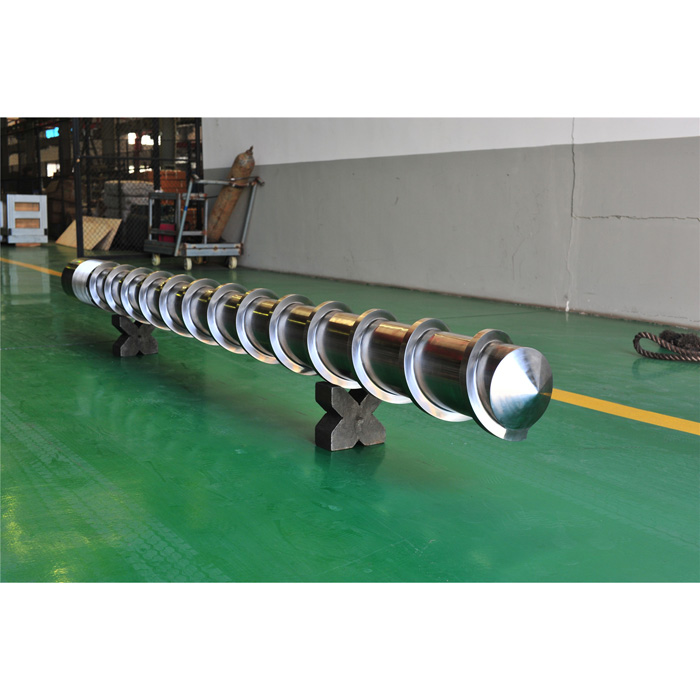
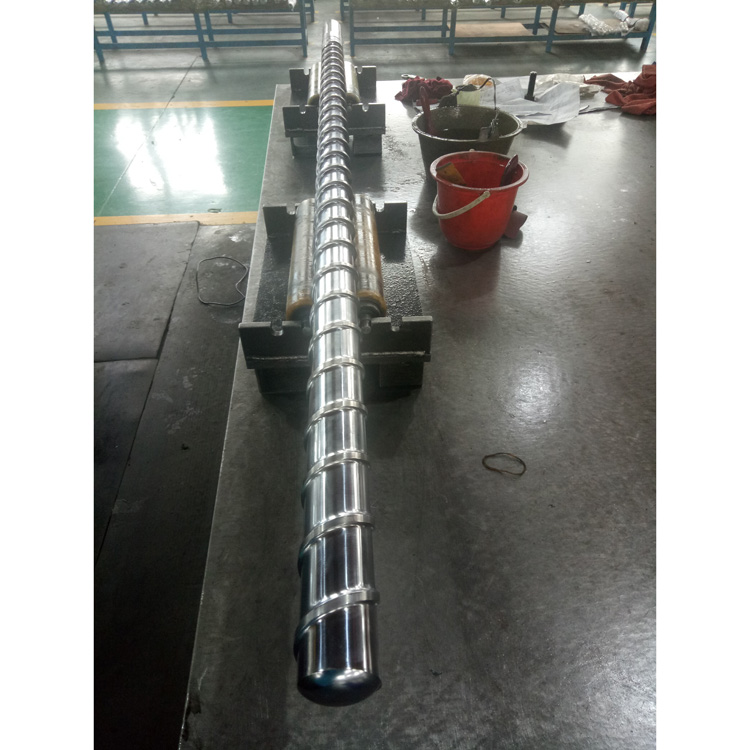
PTA stands for plasma transferred arc. A plasma torch melts alloy powder and deposits it onto the screw flight lands as a weld bead. The deposited alloy fuses metallurgically with the base steel — this is a weld, not a spray.
After welding, the screw goes back to the lathe. The oversized hardfacing gets machined down to final flight geometry and tolerance. What remains is a 1.0 to 1.5 mm layer of wear-resistant alloy exactly where the screw touches the barrel wall. The flight lands are where a screw wears out, so hardfacing them is the entire point.
The Barrel: Centrifugal Casting
The barrel bore gets its alloy by horizontal centrifugal casting. Molten alloy is poured into the spinning barrel body; centrifugal force throws it against the inner wall, where it solidifies as a dense, even lining. Casting under controlled atmosphere keeps porosity out and the bond sound.
The result is a 2.0 to 3.0 mm alloy lining down the full bore length. Why thicker than the screw? Geometry and economics. The bore is the surface the screw runs against along its entire length, and a barrel costs far more to replace than a screw.

| Component | Process | Alloy Layer | What It Protects |
|---|---|---|---|
| Screw | PTA welding (hardfacing) | 1.0 – 1.5 mm | Flight lands — the sliding contact surface |
| Barrel | Centrifugal casting | 2.0 – 3.0 mm | Full bore — the surface the screw runs against |
A practical test for suppliers. Ask them to describe how they apply the alloy to the screw and how they apply it to the barrel. A real manufacturer names two different processes without hesitating. A trading company gives you one vague answer about "coating."
3. Bimetallic vs Nitrided: What Actually Changes
Nitriding diffuses nitrogen into the surface of the steel, creating a hard case. No new material is added. The case runs 0.4 to 0.7 mm deep, and the surface reaches roughly HV 850–950 on 38CrMoAlA.
That case is genuinely hard. Its weakness is that it is thin, and it is chemically limited.
| Property | Nitrided | Bimetallic |
|---|---|---|
| Layer type | Diffused case (no added material) | Added alloy, metallurgically bonded |
| Screw layer depth | 0.4 – 0.7 mm | 1.0 – 1.5 mm |
| Barrel layer depth | 0.4 – 0.7 mm | 2.0 – 3.0 mm |
| Surface hardness | HV 850 – 950 | HRC 50 – 62 (grade dependent) |
| Abrasion resistance | Moderate | High to excellent |
| Corrosion resistance | Limited | Good to excellent (grade dependent) |
| Relative cost | 1.0× | Higher — alloy and process both add cost |
| Best duty | Clean, unfilled resin | Filled, corrosive, or recycled feed |
Once abrasive filler cuts through a nitride case, softer core steel sits underneath and erodes fast. That is why nitrided parts on glass-filled compounds do not degrade gracefully — they hold up, then fail quickly.
A bimetallic layer has millimetres of depth to give. It wears down slowly, and the wear rate stays roughly linear. That depth is where the wear resistance lives — and it is the reason service life on abrasive compounds separates so sharply between the two constructions.
4. The Alloy Grades — Ask for the Number
Most suppliers describe their alloy as "nickel-based" or "tungsten carbide." That tells you almost nothing. Ni60 and Colmonoy 83 are both nickel-based, and they perform very differently.
Screw Hardfacing Alloys (PTA-Welded)
| Alloy | Composition | Anti-Wear | Anti-Corrosion | Hardness |
|---|---|---|---|---|
| Ni60 | Ni+Cr+Fe+Si | ★★★ | ★★★★ | HRC 56–62 |
| Colmonoy 56 | Ni+Cr+Si+Fe | ★★★ | ★★★★ | HRC 53–58 |
| Colmonoy 83 | Ni+Wc+Cr+C | ★★★★ | ★★★★ | HRC 50–55 |
Barrel Casting Alloys (Centrifugally Cast)
| Alloy | Composition | Anti-Wear | Anti-Corrosion | Hardness | Max Temp |
|---|---|---|---|---|---|
| EJS01 | Fe+Ni+Cr+B | ★★★ | ★★ | HRC 58–62 | ≤ 400°C |
| EJS02 | Ni+Cr+Co+B | ★★ | ★★★ | HRC 50–58 | ≤ 450°C |
| EJS03 | Ni+Cr+Co+V+B | ★★★ | ★★★ | HRC 55–60 | ≤ 450°C |
| EJS04 | Ni+Wc+Cr+B | ★★★★ | ★★★ | HRC 55–60 | ≤ 600°C |
The Detail That Trips People Up
Look at Colmonoy 83. Its hardness reads HRC 50–55 — lower than Ni60 at HRC 56–62. Yet Colmonoy 83 carries the top anti-wear rating.
Hardness and abrasion resistance are not the same property. High surface hardness resists indentation; wear resistance against abrasive filler comes from carbide particles embedded in the alloy. Colmonoy 83 carries tungsten carbide (the "Wc" in its composition). Those embedded carbide particles do the work against glass fibre, mineral, and grit in recyclate, and the matrix around them can be softer without hurting the result.
So when a supplier quotes you hardness alone, they are quoting the wrong number. Ask for the composition.
Matching the Grade to the Compound
| Your Compound | Screw Alloy | Barrel Alloy | Why |
|---|---|---|---|
| Glass-fibre nylon, mineral-filled | Colmonoy 83 | EJS01 or EJS04 | Tungsten carbide handles the abrasion |
| Rigid PVC | Ni60 or Colmonoy 56 | EJS02 or EJS03 | HCl corrosion leads, not abrasion |
| Recycled / post-consumer feed | Colmonoy 83 | EJS01 or EJS04 | Grit and metal fines act like sandpaper |
| Flame-retardant compounds | Colmonoy 56 | EJS02 or EJS03 | Chemically aggressive packages |
| High-temperature engineering polymers | Colmonoy 83 | EJS04 | EJS04 tolerates up to about 600°C |
| Clean PP, PE, PS, ABS | Nitriding is enough | No abrasion, no corrosion — save the money | |
5. When It Pays for Itself
Five conditions justify the upgrade. Any one of them is usually enough.
- Abrasive fillers. Glass fibre, calcium carbonate, talc, mineral reinforcement. These cut a nitride case like sandpaper cuts softwood.
- Corrosive chemistry. Rigid PVC releases HCl as it degrades. Many flame-retardant packages are chemically aggressive. Fluoropolymers attack steel directly.
- Recycled and post-consumer feed. Regrind carries grit, metal fines, and unpredictable contamination — the most abrasive material most processors run.
- High throughput where downtime hurts. If a screw change costs three days of production, the economics shift toward the part that needs changing less often.
- Wear history says nitrided was the wrong call. A nitrided part that wore out fast on your compound is telling you something. The replacement is the cheapest moment to fix the specification.

The total-cost-of-ownership case is straightforward. Bimetallic costs more upfront. On abrasive duty, the extended screw barrel life drops the cost per running hour below nitrided, usually inside the first replacement cycle. The exact maths depends on your resin, filler loading, throughput, and what an hour of downtime costs your line — which is why any supplier who quotes a universal life multiplier without asking about your compound is guessing.
6. When You Should NOT Buy Bimetallic
No competitor writes this section. Read it anyway — it may save you money.
Clean, unfilled resins do not need bimetallic. If you run natural PP, PE, PS, or ABS with no abrasive filler and no corrosive additive, a nitrided screw and barrel in 38CrMoAlA will serve you well and cost far less. The bimetallic protection sits idle. You paid for armour against an enemy that never shows up.
Low-throughput or intermittent lines. If the machine runs a few hours a week, wear accumulates slowly regardless of construction. The payback period stretches past the point where it makes sense.
When the real problem is something else. Premature wear sometimes comes from a misaligned screw, a bent shaft, contamination in the feedstock, or a process running far above design temperature. Bimetallic construction will not fix any of those — it will just wear out more slowly while the underlying fault continues. Diagnose before you upgrade.
Honest suppliers will tell you this. Ask a manufacturer whether your compound justifies bimetallic, and pay attention to whether they ask what you actually run before answering.
7. How to Verify You Actually Received Bimetallic
The word "bimetallic" appears on many invoices. The alloy does not always appear on the part. Four checks protect you.
Verification checklist
- Ask for the alloy grade in writing, on the quotation. Not "nickel-based alloy" — the grade name. Ni60, Colmonoy 56, Colmonoy 83, or the manufacturer's own designation with published composition.
- Ask for the layer thickness in writing. Screw hardfacing should be 1.0–1.5 mm. Barrel lining should be 2.0–3.0 mm. A supplier quoting 0.5 mm on a barrel is selling you something else.
- Request the material certificate for the base steel. Every batch should carry a mill test certificate showing chemistry and mechanical properties. Cross-check the heat number.
- On the first order, have a sample piece analysed. A metallurgical lab can section a coupon and confirm layer thickness, alloy chemistry, and bond quality. The cost is trivial against a container of screws.
A manufacturer that builds bimetallic in-house answers all four without friction. EJS supplies an inspection report and a material certificate with every screw barrel, and stamps a traceable identification number on each part during production. Hesitation on any of these points is worth noticing.
8. How to Spec a Quote
Screw barrels are close to 100% custom parts. No list price exists — a manufacturer builds the quote from your specifics, so the quality of your inquiry sets the quality of the answer.
Send these six items and a serious factory quotes within one working day:
- Machine make and model. Parts are built per drawing or per machine brand and code.
- Screw diameter, L/D ratio, and overall length.
- Your compound, honestly stated. "PP" and "PP with 25% talc plus 15% regrind" are different wear problems with different alloy answers. This one line drives the metallurgy recommendation more than anything else you send.
- Process temperature range. Barrel alloys cap at different limits — EJS01 at about 400°C, EJS04 at about 600°C.
- Drawing if you have one. Without a drawing, send product photos plus major dimensions — diameter, length, flange details.
- New build or replacement? For a replacement, wear measurements and photos of the worn part let the factory judge whether refurbishment beats new manufacture.
EJS has manufactured screws and barrels at its Zhoushan factory since 1992, and builds bimetallic construction in-house — PTA welding for screws, centrifugal casting for barrels — across single screw (Ø12–500 mm), parallel twin, conical twin, injection, and rubber geometries. Production runs 20 to 70 days after drawing confirmation, with a one-year warranty on pure plastics.
9. Frequently Asked Questions
What is a bimetallic screw barrel made of?
A bimetallic screw barrel combines a steel base with a separate wear-resistant alloy layer bonded to the working surfaces. Common base steels include 38CrMoAlA, 34CrAlNi7, 31CrMoV9, and 42CrMo. The alloy layer on screws is typically Ni60, Colmonoy 56, or Colmonoy 83, applied by PTA welding at 1.0 to 1.5 mm thickness. The alloy layer inside barrels is a nickel- or iron-based casting alloy, applied by centrifugal casting at 2.0 to 3.0 mm. The two materials stay in distinct layers with a metallurgical bond between them.
How much longer does a bimetallic screw barrel last than nitrided?
Long enough to matter on abrasive compounds, and not long enough to matter on clean ones. On glass-filled, mineral-filled, or recycled feed, the difference in service life is substantial, because the nitride case is only 0.4 to 0.7 mm deep while bimetallic gives 1.0 to 1.5 mm on the screw and 2.0 to 3.0 mm in the barrel, in a harder and more chemically resistant material. On clean unfilled resin, both constructions can run for years and the upgrade earns little. Any supplier quoting a fixed multiplier without asking what you process is guessing.
Is a bimetallic screw barrel the same as a chrome-plated one?
No. Chrome plating deposits a thin layer on the surface, which can flake off under thermal cycling and mechanical load. Bimetallic construction fuses several millimeters of alloy to the base steel through welding or casting, so the layer becomes part of the component and cannot peel. Chrome plating serves specific purposes such as release and mild corrosion protection, but it is not a wear solution for abrasive compounds.
Can a bimetallic screw be repaired when it wears out?
Yes, in many cases. A worn bimetallic screw can be re-welded with fresh PTA hardfacing and re-machined back to original geometry. A worn barrel bore can be re-bored and re-lined by centrifugal casting. Refurbishment keeps the original shaft, keyway, journal, and housing, which often makes it the economical route when the OEM part is discontinued or the lead time is long. Send photos and wear measurements to get a refurbish-or-replace assessment.
Do I need bimetallic for the screw, the barrel, or both?
Both, in most cases, because they wear as a pair. Clearance between the flight lands and the bore is a system property. A new bimetallic screw inside a worn oversized bore still runs at enlarged clearance, so output stays low and the new screw wears against an irregular surface. If you are upgrading one, measure the other. Replacing only half the wear pair transfers the problem to the new part.
Does a bimetallic screw barrel work for PVC?
Yes, but the alloy grade matters more than the label. Rigid PVC is a corrosion problem before it is an abrasion problem, because the polymer releases hydrogen chloride as it degrades. That means you want a corrosion-led alloy: Ni60 or Colmonoy 56 on the screw, and EJS02 or EJS03 in the barrel. A tungsten-carbide grade like Colmonoy 83 is built for abrasion and is not the right answer for PVC unless the compound carries heavy filler as well.
What is the temperature limit of a bimetallic barrel?
It depends on the casting alloy, and it ranges from about 400 to 600 degrees Celsius. EJS01 is rated to about 400. EJS02 and EJS03 reach about 450. EJS04, the tungsten carbide grade, tolerates up to about 600. If your process runs hot, the temperature limit becomes a gating specification, so tell your manufacturer the actual zone temperatures rather than the design values.
Can EJS supply bimetallic screw barrels for my machine?
Yes. EJS manufactures bimetallic screws and barrels in-house, with PTA-welded hardfacing on screws and centrifugally cast lining in barrels, for single screw, parallel twin, conical twin, injection molding, and rubber geometries. Parts are built per drawing or reverse-engineered from the machine model and code when no drawing exists. Quotation follows within one working day once the specification is clear.