Direct Answer
Every extruder screw barrel is two material decisions, not one. A base steel carries the mechanical load — usually 38CrMoAlA, 42CrMo or a stainless grade. A surface treatment survives the polymer — either a nitrided case 0.4 to 0.7 mm deep, or a bimetallic alloy layer several times thicker. Get the base steel wrong and the part flexes. Get the surface wrong and it wears out early.
Ask most suppliers what their screws are made of and you get one of two answers. Either a bare grade designation with no context, or the phrase "high-quality wear-resistant alloy steel," which means nothing.
Neither helps a buyer decide. This guide gives the grades, what they are called outside China, what each surface treatment actually does to the metal, and how to match the screw barrel material to the polymer you run.
1. Base Steels and Their International Equivalents
The base steel does the structural work. It resists torsion from the drive, bending under side load, and dimensional drift at temperature. On a correctly built part it never contacts the melt — the treated surface handles that.
Chinese grade designations confuse buyers outside Asia, and most suppliers never translate them. Here is the mapping.
| Chinese grade | DIN / EN | AISI / US | Where it is used |
|---|---|---|---|
| 38CrMoAlA | 1.8509 | Nitralloy family | The industry standard. Aluminium content gives an exceptional nitride case |
| 34CrAlNi7 | 1.8550 | Nitralloy family | Nitrides deeper and harder than 38CrMoAlA |
| 31CrMoV9 | 1.8519 | — | High strength with good fatigue resistance |
| 42CrMo | 1.7225 | AISI 4140 | Tough general-purpose alloy steel; common barrel body |
| 40Cr | 1.7035 | AISI 5140 | Barrel housings, lower-duty components |
| SKD61 | 1.2344 | AISI H13 | Hot-work duty, high process temperatures |
| Cr12MoV / D2 | 1.2379 | AISI D2 | High-wear tool steel applications |
| SS304 / SS316 | 1.4301 / 1.4401 | AISI 304 / 316 | Corrosion-critical service |
Why 38CrMoAlA dominates. Its aluminium content forms extremely hard aluminium nitrides during nitriding. That single property makes it the default across the industry — it takes a better case than almost anything else, at reasonable cost.
A supplier who names only one steel for every job is either simplifying for you or working with limited stock. Ask which grade they propose for your duty and why.
2. Surface Treatments: What Each One Actually Does
This is where marketing language does the most damage. Several processes get grouped under "coating," and they are not comparable.
Nitriding
Nitrogen diffuses into the steel surface at temperature, forming a hard case 0.4 to 0.7 mm deep. No new material is added — the existing steel is transformed. Distortion stays low because the process runs below the transformation temperature, which matters on a part several metres long.
Nitriding handles clean unfilled resin well and costs least. Its limit is depth. Once abrasive filler cuts through the case, softer core steel sits underneath and erodes quickly.
Bimetallic: Two Processes, Not One
Most articles describe bimetallic construction as if a single process makes both parts. Two entirely different processes are involved, and knowing which is which tells you whether a supplier really manufactures in-house.
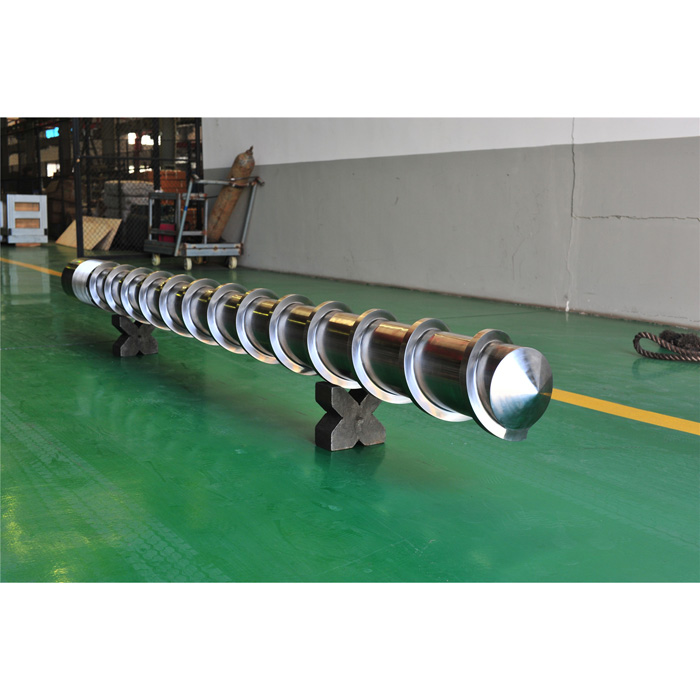
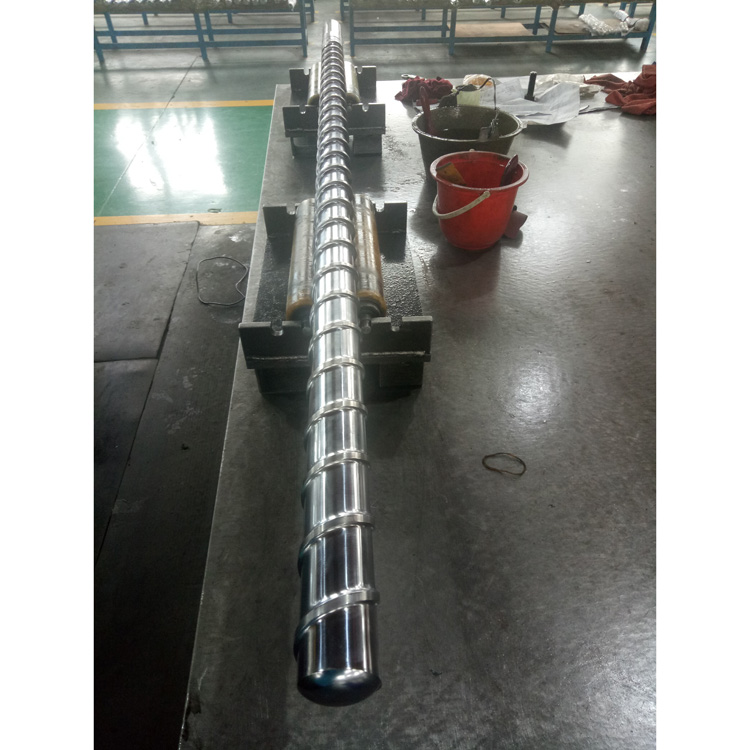
Screws get PTA welding. Plasma transferred arc melts alloy powder onto the flight lands as a weld bead that fuses metallurgically with the base steel. The oversized deposit is then machined back to final flight geometry, leaving 1.0 to 1.5 mm of alloy exactly where the screw touches the bore.
Barrels get centrifugal casting. Molten alloy is poured into the spinning barrel body; centrifugal force throws it against the inner wall where it solidifies as a dense lining, 2.0 to 3.0 mm thick down the full bore. The lining runs thicker than the screw hardfacing because a barrel costs far more to replace.
Chrome Plating
Hard chrome deposits a thin layer that aids release and resists mild corrosion. It is useful for specific jobs. It is not a wear solution for abrasive compounds, because the layer is thin and can flake under thermal cycling and mechanical load.
Processes You Will See Advertised — and What They Are
Buyers comparing quotes run into several other coating names. Here they are described accurately, so you can judge the offers you receive.
| Process | What it is | Practical note |
|---|---|---|
| HVOF / thermal spray (WC-Co) | Powder sprayed at high velocity, mechanically bonded | Thinner than weld overlay and bonded differently. Not offered by EJS. |
| Plasma spray | Powder melted in a plasma jet and sprayed | Sprayed layers are not welds. Not offered by EJS. |
| Laser cladding | Laser-melted alloy deposit, fusion bonded | Sometimes wrongly described as a barrel bore process. Not offered by EJS. |
| Ceramic liner | Ceramic sleeve or coating inside the bore | Specialist niche. Not offered by EJS. |
| DLC / PVD | Very thin vapour-deposited film | Micron-scale; used for friction, not bulk wear. Not offered by EJS. |
Watch for one specific error. Some suppliers describe barrel bores as "laser clad" or "plasma sprayed." Bimetallic barrel linings are produced by centrifugal casting. If a quotation describes the barrel process incorrectly, ask them to walk you through their workshop on a video call before you order.
3. The Alloy Grades Inside "Bimetallic"
The word "bimetallic" confirms an alloy layer exists. The grade determines whether it survives your compound. Most suppliers say "nickel-based" and stop, which tells a buyer nothing — Ni60 and Colmonoy 83 are both nickel-based and behave very differently.
Screw Hardfacing Alloys (PTA-Welded, 1.0–1.5 mm)
| Alloy | Composition | Anti-Wear | Anti-Corrosion | Hardness |
|---|---|---|---|---|
| Ni60 | Ni+Cr+Fe+Si | ★★★ | ★★★★ | HRC 56–62 |
| Colmonoy 56 | Ni+Cr+Si+Fe | ★★★ | ★★★★ | HRC 53–58 |
| Colmonoy 83 | Ni+Wc+Cr+C | ★★★★ | ★★★★ | HRC 50–55 |
Barrel Casting Alloys (Centrifugally Cast, 2.0–3.0 mm)
| Alloy | Composition | Anti-Wear | Anti-Corrosion | Hardness | Max Temp |
|---|---|---|---|---|---|
| EJS01 | Fe+Ni+Cr+B | ★★★ | ★★ | HRC 58–62 | ≤ 400°C |
| EJS02 | Ni+Cr+Co+B | ★★ | ★★★ | HRC 50–58 | ≤ 450°C |
| EJS03 | Ni+Cr+Co+V+B | ★★★ | ★★★ | HRC 55–60 | ≤ 450°C |
| EJS04 | Ni+Wc+Cr+B | ★★★★ | ★★★ | HRC 55–60 | ≤ 600°C |
One published limit is worth knowing because no other supplier states it: Ni60 is rated for glass fibre content under 10 percent. Above that the alloy is outside its intended duty. Recyclate from engineering-plastic scrap often carries glass fibre from the original compound, and buyers exceed that threshold without realising it.
4. Hardness Is Not Wear Resistance
This single misunderstanding drives more wrong purchases than any other.
Look at the tables above. Colmonoy 83 reads HRC 50–55, lower than Ni60 at HRC 56–62. Yet Colmonoy 83 carries the higher anti-wear rating.
The reason is structural. Hardness measures resistance to indentation. Resistance to abrasive particles comes from hard carbide particles embedded in a tougher matrix — the carbides take the grinding while the matrix holds them in place. Colmonoy 83 contains tungsten carbide, which is why it outperforms harder alloys against glass fibre and mineral filler.
Corrosion resistance is a third property again, independent of the other two. EJS01 is the hardest barrel alloy on the list and carries the lowest corrosion rating, which makes it a poor choice for rigid PVC despite the impressive hardness number.
Do not buy by hardness number alone. Three properties matter and they trade against each other: hardness, abrasion resistance, and corrosion resistance. Ask any supplier to state all three for the grade they propose. A quotation that lists only HRC is telling you the least useful of the three.
5. Screw Barrel Material Selection by Polymer
Match the screw barrel material to what the polymer does to metal, not to a general quality tier.
| Polymer | Attack mechanism | Base steel | Surface |
|---|---|---|---|
| Clean PE, PP, PS, ABS | Neither | 38CrMoAlA | Nitrided |
| Rigid PVC | Corrosion (HCl release) | 38CrMoAlA | Bimetallic, corrosion-led (Ni60 / Colmonoy 56 screw, EJS02 / EJS03 barrel) |
| Glass-filled nylon, PC | Abrasion | 38CrMoAlA / 34CrAlNi7 | Bimetallic, carbide grade (Colmonoy 83 screw, EJS01 / EJS04 barrel) |
| Mineral or CaCO₃-filled | Abrasion | 38CrMoAlA | Bimetallic, carbide grade |
| Recycled / post-consumer | Both at once | 38CrMoAlA | Bimetallic, carbide grade |
| Flame-retardant compounds | Corrosion | 38CrMoAlA | Bimetallic, corrosion-led |
| PET (dried, unfilled) | Mild | 38CrMoAlA | Nitrided or bimetallic depending on output |
| High-temperature engineering polymers | Thermal | SKD61 | Bimetallic, EJS04 rated to 600°C |
| Corrosion-critical service | Chemical | SS304 / SS316 | Per application |
Two points buyers miss. First, filler content matters more than the polymer name — unfilled PP and PP with 30 percent talc are different wear problems. Second, regrind counts. Adding 15 percent recycled material to a clean stream can move the whole job into a different material class.
6. Reconditioning: When Material Can Be Restored
Worn wear surfaces do not always mean a new part. Both bimetallic processes can be repeated on an existing component.
A worn screw can be re-welded with fresh PTA hardfacing and machined back to original flight geometry. A worn bore can be re-bored and re-lined by centrifugal casting. Reconditioning keeps the original shaft, keyway and journal, which matters most when the OEM part is discontinued or lead time on a new one is long.
Recondition or replace — the deciding factors
- Recondition when the shaft is straight, the geometry suited the compound, and only the wear surfaces have gone
- Recondition when the OEM part is discontinued or the new-build lead time is unacceptable
- Replace when the shaft is bent or flight roots show cracking
- Replace when the original geometry never suited the resin — the rebuild is the moment to fix the design
- Replace when so much material has been lost that re-machining would take the part below its strength envelope
A screw barrel material specification means little without documentation to prove it. Three lines belong on every purchase order.
Material specification checklist
- Base steel grade, named. Not "alloy steel" — 38CrMoAlA, 42CrMo, SS316, whichever applies
- Surface treatment and depth. Nitrided with case depth stated, or bimetallic with the alloy grade name and layer thickness in millimetres
- Documents required at delivery. Material certificate with heat number, and inspection report with actual measured dimensions
EJS supplies a material certificate and an inspection report with every screw barrel, and stamps a traceable identification number on each part during production. On a first order with any supplier, having a sample independently sectioned and analysed costs very little against the value of a container of parts.
If the application involves food or medical contact, state that at inquiry stage so the base steel selection and documentation can be matched to your own compliance programme. Requirements differ by market and by application, and they belong in the specification rather than being assumed.
EJS works across single screw, parallel twin and conical twin geometries in both nitrided and bimetallic construction, with nitriding, PTA welding and centrifugal casting all performed in-house at the Zhoushan factory. For the wider purchasing picture, see the complete buyer's guide.
8. Frequently Asked Questions
What steel is used for extruder screws and barrels?
The most common base steel is 38CrMoAlA, known in Europe as 1.8509. Other regular grades are 34CrAlNi7 (1.8550), which nitrides deeper and harder, 31CrMoV9 (1.8519), 42CrMo which is equivalent to AISI 4140, SKD61 for hot-work duty, and stainless SS304 or SS316 for corrosion-critical applications. The base steel provides torsional strength and dimensional stability. On a correctly built part it never touches the melt, because the surface treatment does the work at the interface.
What is the difference between a nitrided and a bimetallic screw barrel?
Nitriding diffuses nitrogen into the existing steel surface, forming a hard case 0.4 to 0.7 mm deep without adding any new material. Bimetallic construction adds a genuine alloy layer bonded to the base steel: 1.0 to 1.5 mm of PTA-welded hardfacing on the screw flights, and 2.0 to 3.0 mm of centrifugally cast lining in the barrel bore. Nitriding suits clean unfilled resins at lower cost. Bimetallic suits abrasive and corrosive compounds where a thin case would be cut through quickly.
How do I choose the screw barrel material for my polymer?
Match the material to what the polymer does to metal. Clean PE, PP, PS and ABS cause neither abrasion nor corrosion, so a nitrided screw barrel serves well. Glass fibre and mineral fillers abrade, which calls for a tungsten-carbide-bearing alloy such as Colmonoy 83 on the screw. Rigid PVC corrodes because it releases hydrogen chloride, so the priority shifts to corrosion-resistant grades. Recycled feed attacks both ways at once and needs the most resistant combination available.
Is hard chrome plating better than bimetallic construction?
No, they solve different problems. Chrome plating deposits a thin layer that helps with release and mild corrosion protection, but it can flake under thermal cycling and mechanical load, and it is not a wear solution for abrasive compounds. Bimetallic construction fuses millimetres of alloy to the base steel by welding or casting, so the layer becomes part of the component and cannot peel. Choose chrome for release and light duty, bimetallic for genuine wear resistance.
Does higher hardness always mean longer screw barrel life?
No, and assuming it does leads to the wrong purchase. Hardness resists indentation, while resistance to abrasive filler comes from hard carbide particles held in a tougher matrix. Colmonoy 83 reads HRC 50 to 55, lower than Ni60 at HRC 56 to 62, yet it carries the higher anti-wear rating because it contains tungsten carbide. Corrosion resistance is a third property again, unrelated to both. Ask for hardness, composition and corrosion rating together.
When should a worn screw or barrel be reconditioned instead of replaced?
Recondition when the base steel and geometry remain sound but the wear surfaces have gone. A worn screw can be re-welded with fresh PTA hardfacing and machined back to original geometry, and a worn bore can be re-bored and re-lined by centrifugal casting. Replace instead when the shaft is bent, flight roots are cracked, the geometry never suited the compound, or so much material has been lost that re-machining would take the part below its strength envelope.
What material documents should come with a screw barrel order?
Ask for a material certificate showing the base-steel chemistry and heat number, and an inspection report recording the actual measured dimensions of your parts rather than the design values. For bimetallic construction, the alloy grade name and layer thickness should appear in writing on the quotation, not just the word bimetallic. EJS supplies a material certificate and an inspection report with every screw barrel and stamps a traceable identification number on each part.