Direct Answer
A single screw extruder barrel conveys and melts material with one screw, relying on friction against the barrel wall. It is simpler, more robust and more economical — the right choice for straightforward melting and shaping of most polymers and recycled plastics.
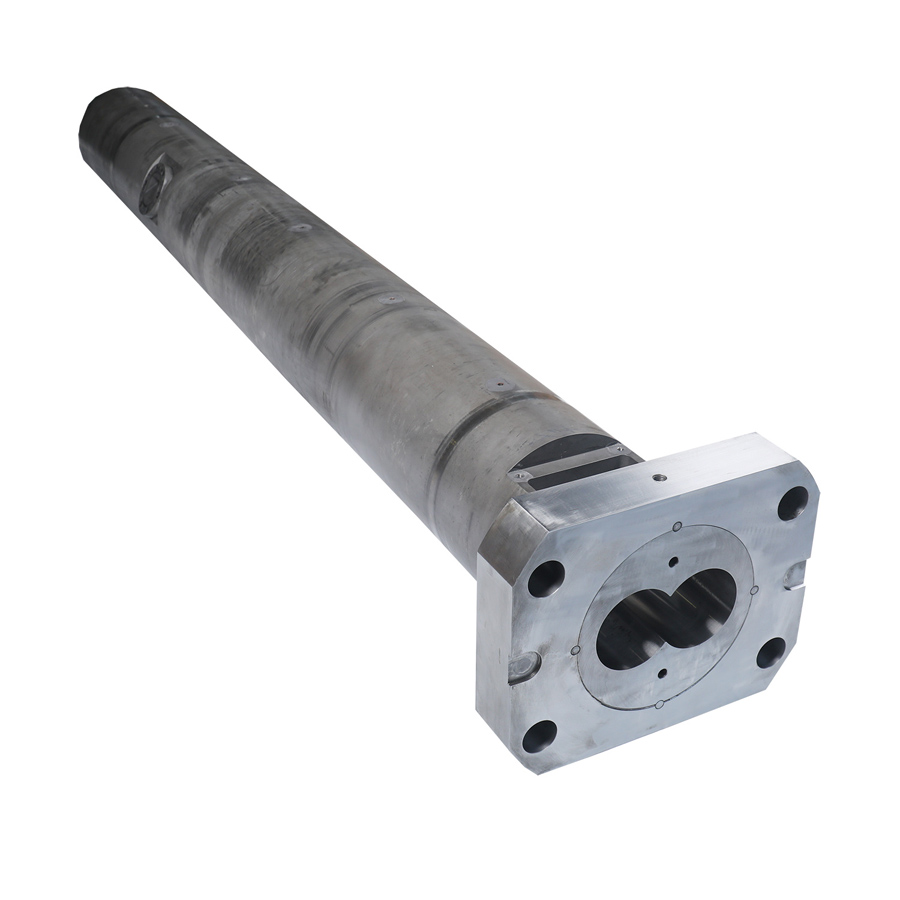
A twin screw barrel uses two intermeshing screws for far stronger mixing, positive conveying and higher output. It is the right choice for compounding, heavily filled or reinforced materials, devolatilizing, and rigid PVC.
Neither is "better." Choose by what your process actually demands.
This is the first decision in any extrusion line, and it is often made for the wrong reason — twin screw sounds more advanced, so it must be better. In practice, a twin screw on a job that only needs melting is money spent on capability you never use, and a single screw on a compounding job will never give you the dispersion you need. This guide sets out how each type actually behaves, where the line falls between them, and how parallel and conical twins differ.
1. How Each One Works
Single screw: friction does the work
One screw turns inside a heated barrel. Material is dragged forward because it sticks to the barrel wall more than to the screw — this is drag conveying, and it is why the barrel surface condition matters so much. The screw's three zones (feed, compression, metering) melt the material by a combination of barrel heat and shear, then meter it to the die at steady pressure.
The consequence: a single screw is excellent at melting and pumping, but its mixing is limited, and output depends on how well the material grips the barrel. That is also why worn barrels hurt single screws so directly — as clearance opens, the drag mechanism loses efficiency.
Twin screw: the screws do the work
Two screws intermesh, so material is positively conveyed — pushed forward by the screw geometry rather than dragged by friction. Where the flights meet, material is repeatedly divided, sheared and recombined, which produces mixing a single screw cannot match. Because conveying does not depend on friction, twin screws handle powders, poor-flowing feeds and high filler loading far better, and residence time can be controlled precisely.
The common mistake: assuming twin screw is an upgrade for every job. If your process is melting and shaping a clean polymer into pipe, film or sheet, a single screw does it more economically and with a cheaper replacement part. Twin screw earns its cost when the process needs mixing, not just melting.
2. Single vs Twin: Side by Side
| Factor | Single screw | Twin screw |
|---|---|---|
| Conveying | Drag (friction-dependent) | Positive (geometry-driven) |
| Mixing | Basic; improved with mixing elements | Intensive, distributive and dispersive |
| Output | Steady, moderate | High — can reach tons per hour |
| Filled / reinforced material | Limited | Handles high loading well |
| Devolatilizing | Difficult | Straightforward with vent sections |
| Temperature control | Less precise; shear heat builds | Precise; short controlled residence time |
| Mechanical complexity | Simple, robust | More complex |
| Purchase & replacement cost | Lower | Higher |
| Typical products | Pipe, film, sheet, profile, recycling | Compounding, PVC profile & pipe, masterbatch, foam |
3. Parallel Twin vs Conical Twin
Choosing twin screw is only half the decision — there are two geometries, and they are not interchangeable.
Parallel twin screw
Two screws of constant diameter running side by side down the full length. Used for profile, tube, sheet, foam and plastic compounding, processing all kinds of polymer at large output that can reach tons per hour at a given size. Because the geometry is modular, screw elements and barrel sections can be configured for the specific process — one reason parallel twins dominate compounding.
Conical twin screw
The screws are larger at the feed end and taper toward the die. That large feed area takes in low-bulk-density powder easily, and the taper provides strong compression and degassing as material moves forward. This makes conical twins the standard for rigid PVC — profile, pipe, and granulation, where PVC powder feeding and heat sensitivity are the defining challenges.
Quick rule for twin screw geometry
- Rigid PVC profile, pipe, granulation → conical twin
- Compounding, masterbatch, high output, modular process → parallel twin
- Sheet, foam, tube from varied polymers → parallel twin
One detail worth knowing: EJS designs conical twin barrels differently according to the CaCO₃ filler level — low, medium or high — in the PVC compound, because the filler content changes the wear duty more than the polymer name does. Two customers both running "PVC pipe" can need different alloy specifications.
4. Which One Does Your Job Need?
Work from the process, not the machine.
| What you are doing | Configuration |
|---|---|
| Melting and shaping a clean single polymer | Single screw |
| Pipe, film, sheet or profile from PE / PP | Single screw |
| Reprocessing recycled plastics | Single screw (bimetallic surface) |
| Compounding two or more materials | Parallel twin |
| Dispersing glass fibre or high filler loading | Parallel twin |
| Masterbatch production | Parallel twin |
| Removing moisture or volatiles (devolatilizing) | Parallel twin, vented |
| Rigid PVC profile, pipe, granulation | Conical twin |
| Very high output PVC with self-cleaning | Planetary screw barrel (500–5000 kg/h) |
Two practical notes. First, a single screw's mixing can be improved substantially without moving to twin screw — Maddock, Pineapple and Saxton mixing elements built into the screw give much better plasticizing on the same machine. Second, the configuration is fixed by your machine; you cannot swap a single screw barrel for a twin one, because the gearbox, drive and feed housing are built around it.
5. Wear and Replacement Cost
The choice has a long tail: twin screw parts cost more to replace, so specifying the surface treatment correctly matters more in cost terms.
On a single screw running clean polymer, a nitrided barrel with a 0.4–0.7 mm case is usually adequate and economical. On a twin screw compounding glass-filled material — where the whole reason for the twin is high filler loading — a bimetallic construction is almost always right, because a nitrided case would be cut through quickly and you would be replacing the more expensive part sooner.
Worth checking before you order: if a twin screw was chosen for high filler content, the surface treatment must match that decision. Buying a twin screw for filled material and then specifying only nitriding undoes the economics of the whole machine choice.
6. Sizes EJS Produces
EJS manufactures all three configurations in-house at the Zhoushan factory, in both nitrided and bimetallic construction.
| Type | Diameter range | Working length | Notes |
|---|---|---|---|
| Single screw | 12 – 500 mm | Up to 10,000 mm | Maddock / Pineapple / Saxton mixers available; feed housing, liner and water jacket produced too |
| Parallel twin | Φ20 – Φ250 mm | Up to 10 m | Screw elements and barrel sections customized |
| Conical twin | 30/70 – 188/330 | Up to 10 m | Standard sizes 35/80, 45/90, 50/105, 55/110, 65/132, 80/143, 92/188, 110/220 |
Popular conical sizes such as 55/110 and 65/132 are kept semi-finished in stock, which allows much shorter delivery on those. All parts are built to a surface roughness of Ra 0.4 µm and a straightness of 0.015 mm, with a material certificate and inspection report supplied.
For how the surface treatment choice affects service life, see the materials guide; for the full purchasing picture, the complete buyer's guide.
7. Frequently Asked Questions
What is the difference between a single screw and twin screw extruder?
A single screw extruder uses one screw rotating in a barrel to convey and melt material, relying mainly on friction against the barrel wall. A twin screw extruder uses two intermeshing screws, which give far stronger mixing, positive conveying, better temperature control and higher output. Single screw suits straightforward melting and shaping of most polymers; twin screw suits compounding, heavily filled materials, devolatilizing and PVC.
Which is better, single screw or twin screw?
Neither is better in general — they solve different problems. Single screw barrels are simpler, more robust and more economical, and are ideal for conveying and melting most polymers and recycled plastics into pipe, film, sheet or profile. Twin screw barrels cost more but are the right answer when you need intensive mixing, compounding, high filler loading, devolatilizing or high output. Choose by what the process demands, not by which sounds more advanced.
What is the difference between parallel twin and conical twin screw barrels?
Parallel twin screw barrels have two screws of constant diameter running side by side, used for profile, tube, sheet, foam and compounding, with output that can reach tons per hour. Conical twin screw barrels have screws that are larger at the feed end and taper toward the die, which gives a large feed area and strong compression — the standard choice for rigid PVC profile, pipe and granulation.
When should I use a twin screw extruder instead of a single screw?
Use a twin screw when the process needs more than melting: compounding two or more materials, dispersing high filler or glass fibre loading, devolatilizing moisture or volatiles, processing heat-sensitive materials like rigid PVC where residence time must be controlled, or when you need higher output from the same footprint.
Is a twin screw barrel more expensive than a single screw?
Yes. A twin screw barrel involves two screws, a twin-bore barrel and more complex machining, so both purchase price and replacement cost are higher than an equivalent single screw. That cost is justified when the process genuinely needs the mixing performance; for simple melting and shaping, a single screw is the more economical choice.
Can I replace a single screw barrel with a twin screw one?
No. The screw barrel must match the machine — the gearbox, drive, feed section and housing are all built around a specific configuration. Changing from single to twin means a different machine, not a different barrel. What you can change is the screw design, L/D, mixing elements and surface treatment within your existing configuration.
What size single and twin screw barrels does EJS make?
EJS produces single screw extruder barrels with diameters from 12 mm up to 500 mm and working lengths up to 10,000 mm. Parallel and conical twin screw barrels run from about 20 mm to 250 mm bore, with conical standard sizes including 35/80, 45/90, 50/105, 55/110, 65/132, 80/143, 92/188 and 110/220. Popular conical sizes are kept semi-finished in stock for shorter delivery.