Conical and parallel twin screw systems can process some of the same products, but that overlap does not make their screws, barrels or drive interfaces interchangeable. For a replacement order, start with the installed machine geometry and drawing. Application comes later.
A conical twin screw changes diameter along its working length, and its matching barrel follows that tapered twin-bore geometry. A parallel twin screw keeps the same nominal diameter through its working section, with two parallel bores at a fixed spacing. Replacing one architecture with the other is not a normal screw-and-barrel order. The gearbox outputs, shaft positions, bore geometry, drive-end connection, barrel flange and downstream datum all belong to the original machine layout. Match the installed architecture first, then verify every interface from the drawing or measured part.
The geometry difference reaches beyond the screw flights
The easiest visual distinction is the diameter profile. The EJS conical product image shows a matched pair with larger drive ends and smaller discharge ends. The parallel pair remains cylindrical through its working length. That difference continues into the barrel bore and the location of the two drive connections.
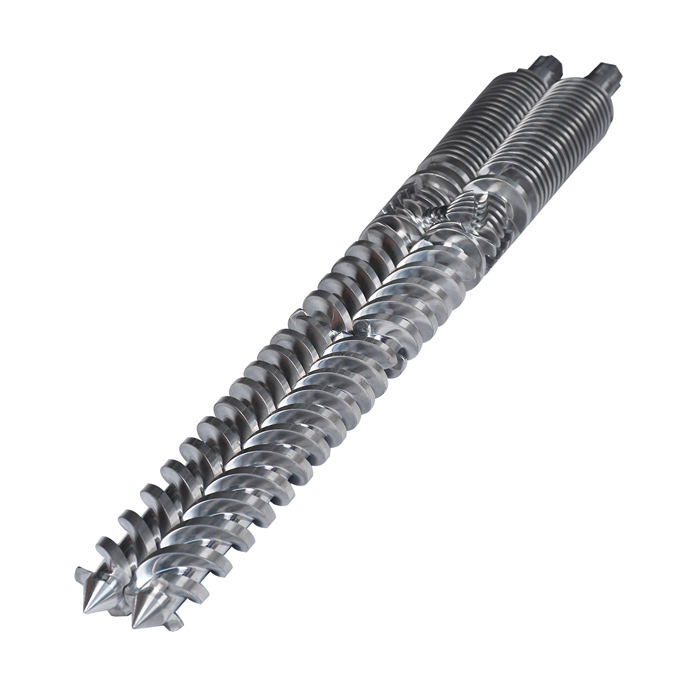
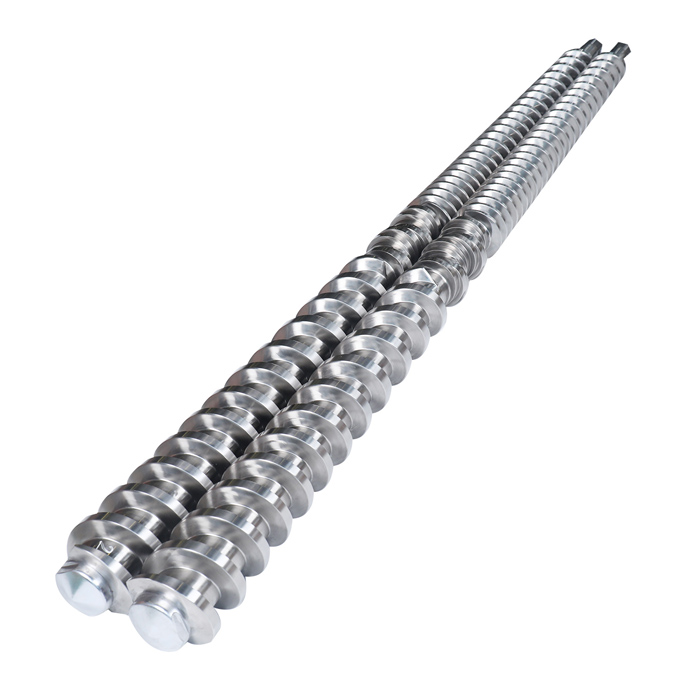
| Comparison point | Conical twin system | Parallel twin system | What the replacement supplier needs |
|---|---|---|---|
| Screw diameter | Changes between the larger and smaller ends. | Remains nominally constant through the working section. | Diameter at defined axial stations, not one isolated reading. |
| Barrel bore | The paired bore follows the conical screw envelope. | The paired bore follows two parallel cylindrical envelopes. | Bore profile, center-distance data and measurement datums. |
| Drive-end layout | Must match the conical machine gearbox and couplings. | Must match the parallel machine gearbox and couplings. | Spline or key geometry, shaft projection, shoulder and retaining features. |
| Size notation | EJS publishes paired numbers such as 65/132 and 80/156. | EJS publishes diameter-style, letter-number and slash-style codes. | The complete maker, model, serial number and code exactly as marked. |
The current EJS twin conical screw barrel page publishes a bore range in paired diameters, from 30/70 through 188/330. The current EJS twin parallel screw barrel page publishes a 25 to 220 bore-diameter range. These are product-page scopes, not a promise that any part inside the range fits an existing machine.
A replacement decision is different from choosing a new extrusion line
A machine buyer can compare complete conical and parallel extruders with the machine manufacturer. The OEM can size the gearbox, drive, process section, heating and cooling, die connection and controls as one system. A replacement buyer has a narrower job: reproduce the geometry and interfaces already fixed by the installed machine.
Changing only the screws and barrel does not convert the surrounding machine. The new parts would still have to meet the original gearbox outputs, shaft positions, coupling details, barrel support, feed opening, vent or port locations, heaters, cooling passages, flange and die centerline. If the requested geometry changes those conditions, treat the project as an engineered machine conversion and involve the equipment OEM or a qualified system designer.
For normal replacement work, retain the installed conical or parallel architecture. If the current identity is unclear, stop at identification. Do not select a geometry from the resin, finished product or a familiar-looking size code.
Product application does not identify the architecture
The application lists on the current EJS product pages overlap. EJS lists panel, profile, sheet, pipe, board and compound extrusion for both its conical and parallel products. The parallel page also lists foam extrusion, while the conical page lists granulation. Those page lists describe EJS product coverage. They do not create an exclusive architecture rule for every extruder.
| Application published by EJS | Conical page | Parallel page | Safe conclusion |
|---|---|---|---|
| Panel, profile, sheet, pipe and board | Listed | Listed | The finished product alone cannot identify the installed geometry. |
| Compound extrusion | Listed | Listed | The word "compound" is not proof of a parallel replacement set. |
| Foam extrusion | Not listed on this product page | Listed | A page omission is not a universal technical prohibition. |
| Granulation | Listed | Not listed on this product page | Confirm the actual machine model and process section. |
Current equipment documentation supports the same caution. KraussMaffei lists conical and parallel series within its counter-rotating twin screw extruder range for PVC processing. A current battenfeld-cincinnati PVC sheet guide also shows parallel twinEX and conical conEX machines in PVC sheet lines. Machine model, screw design and complete line duty decide the configuration. The product name alone does not.
Output claims need the same discipline. Milacron describes its TC line as flexible and its TP line as designed for greater output, but that statement refers to Milacron's current machine families. It is not a universal calculation for every conical and parallel pair. Use the original extruder specification, formulation and operating point when comparing complete machines.
Seven checkpoints establish replacement compatibility
A label such as "65/132," "CM80" or "parallel 90" helps locate a machine family. It does not close the replacement specification. Work through the following checkpoints before material selection or pricing.
| Checkpoint | Record | Why it matters |
|---|---|---|
| 1. Architecture | Conical or parallel; integral or segmented where applicable. | Defines the diameter and bore profile that all later dimensions follow. |
| 2. Matched-pair geometry | Both screw profiles, handedness, rotation direction and relative timing. | Twin screws operate as a pair inside one paired bore. |
| 3. Axial dimensions | Overall length, working length, feed location, tip projection and shoulder positions from one datum. | Prevents dimensions from being mixed between different reference faces. |
| 4. Drive interface | Spline or key form, tooth count, major and minor diameters, engagement length, shoulders, threads and retainers. | Connects the replacement pair to the installed gearbox outputs. |
| 5. Barrel interface | Mounting flange, bolt pattern, register, support points, feed throat and discharge connection. | Locates the barrel in the machine and at the downstream tooling. |
| 6. Services and openings | Heaters, thermocouples, cooling paths, vents, vacuum ports and injection openings. | A correct bore with misplaced services is still the wrong barrel. |
| 7. Condition and clearance | Bore readings, screw outside diameters, worn zones, cracks, spline condition and paired clearances at named stations. | Determines whether to replace screws, barrel or the matched set. |
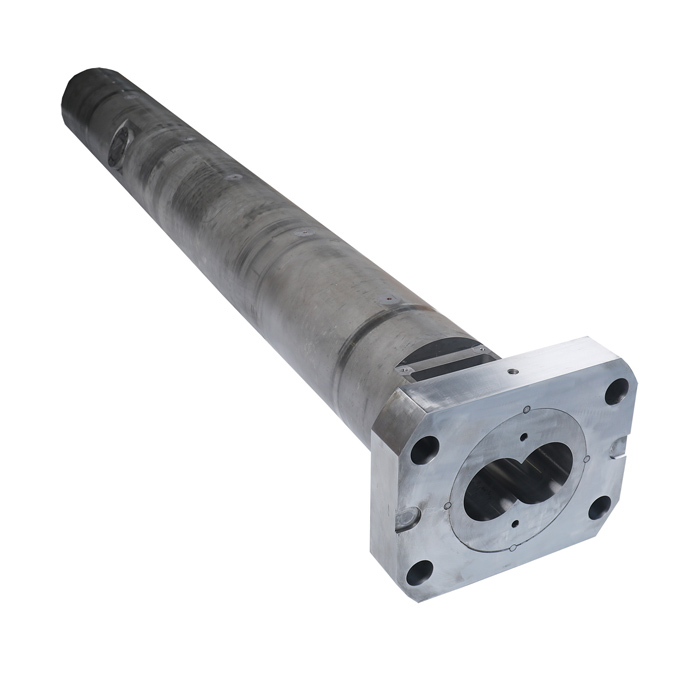
The EJS twin screw barrel problems guide explains why the opposite screw, adjacent flights, barrel bore and drive spline belong in the same inspection. A visibly damaged part may be the first symptom, not the full replacement boundary.
Identify the installed set without guessing from the code
- Copy the nameplate exactly. Record manufacturer, machine model, serial number and every suffix. Preserve slashes, spaces and letters.
- Collect the assembly and part drawings. Note drawing number, revision, units, datums and whether dimensions describe a new part or a wear limit.
- Photograph the complete pair. Include the drive end, working section, tips, both barrel ends, feed opening, ports and flange. Place a label in each frame.
- State feed and discharge direction. "Front" and "rear" are easy to reverse between plants and suppliers. Tie every location to a physical datum.
- Measure both screws and the barrel by station. Use the same axial stations for the two screw outside diameters and the paired bore readings.
- Separate nominal dimensions from wear readings. A worn sample can reproduce existing wear if the drawing does not restore the original geometry.
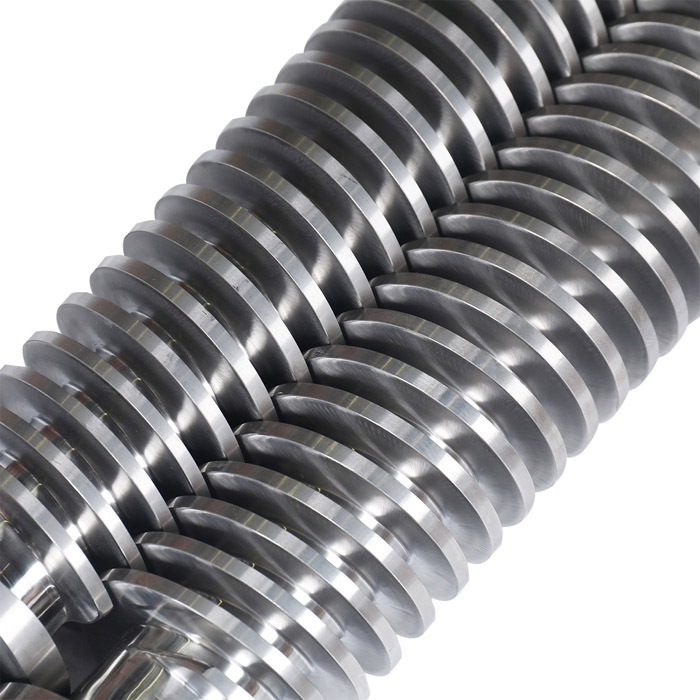
EJS states on its conical product page that connecting dimensions are required for machine-specific work and that cleaned, removed parts can be measured when drawings are unavailable. A sample can help, but a supplier still needs the original design intent, known wear areas and acceptance criteria. The custom twin screw barrel manufacturing guide shows how drawings, checkpoints and inspection records should connect.
Material and wear treatment do not change the architecture
The current EJS pages list many of the same base materials for conical and parallel products: 38CrMoAlA, 34CrAlNi7, 31CrMoV9, 40Cr, 42CrMo, D2 and SKD61. The conical page also lists SKD11. These names describe material options published by EJS. They do not make a conical part compatible with a parallel machine or the reverse.
| Current EJS page | Published treatment routes | What still needs confirmation |
|---|---|---|
| Twin conical screw barrel | Full-body nitriding; bimetallic alloy coating at the extrusion section followed by nitriding; SKD61 or SKD11 lining. | Exact treated zone, base material, hardness specification, final dimensions and process suitability. |
| Twin parallel screw barrel | Full-body nitriding; bimetallic carbide liner for the barrel; bimetallic alloy coating for the screws; SKD61 lining. | Whether the requested route applies to an integral or segmented barrel, the exact alloy specification and drawing requirements. |
Select material after documenting the polymer, fillers, recycled content, additives, corrosive species, cleaning method, temperature profile, screw speed, output, pressure and observed wear location. Ask EJS to state the proposed base steel, treatment, treated zone and inspection evidence on the quotation or drawing. Do not substitute a material name for dimensional compatibility.
Use the question that matches the buying situation
| Buying situation | Correct question | Who must approve | Evidence to send |
|---|---|---|---|
| Direct replacement | Can the new matched set reproduce the installed architecture and every machine interface? | Replacement supplier and buyer against an approved drawing. | Nameplate, drawings, measured parts, process duty and inspection requirements. |
| Unknown machine identity | What evidence establishes whether the set is conical or parallel? | Buyer and supplier after measurement review. | Complete photos, drive-end layout, diameter profile, barrel ends and station measurements. |
| Change of architecture | What machine systems must change with the process section? | Equipment OEM or qualified system engineer. | Complete machine drawings, drive and gearbox data, controls, tooling and performance specification. |
| New extrusion line | Which complete machine configuration meets the material, product, output and line requirements? | Machine builder and buyer. | Formulation, product geometry, output target, utilities, downstream equipment and acceptance test plan. |
This separation prevents two common errors. The first is treating a spare-parts inquiry as permission to redesign the machine. The second is comparing complete machine families as though one isolated screw-and-barrel characteristic determines output, wear or product quality.
Prepare a conical or parallel replacement RFQ
Send enough information to identify the installed architecture and all mating interfaces. EJS can then review the replacement boundary and state which missing dimensions must be resolved before production.
Frequently asked questions
Can I replace a conical twin screw barrel with a parallel one?
Not as a normal replacement order. The two architectures use different screw and bore geometry and must match their machine's gearbox outputs, shaft positions, drive connections, barrel mounting and downstream datum. Treat an architecture change as a machine conversion that requires equipment-level engineering.
How can I tell whether my twin screw barrel is conical or parallel?
Check the machine drawing and parts manual first. A conical set changes diameter along the working length, while a parallel set keeps a constant nominal diameter. Confirm with complete-part photographs and measurements because guards, heaters and partial views can hide the shape.
Does a code such as 65/132 prove that the screw is conical?
The paired numbers are consistent with conical size notation published by EJS, but a code alone is not a manufacturing specification. Copy the complete code and verify the maker, model, serial number, drawing, diameters, lengths and interfaces.
Is a parallel twin screw barrel always for higher output?
No universal output conclusion should be drawn from the architecture name alone. Output depends on the specific machine family, size, process length, screw design, formulation, operating point and downstream line. Compare complete machine specifications from the equipment manufacturer.
Can both conical and parallel twin screw extruders process PVC profiles or sheets?
Yes, current EJS application lists overlap, and current equipment manufacturers show both architectures in PVC profile or sheet lines. The installed machine model and complete process specification still decide which replacement geometry is required.
Do conical and parallel twin screw barrels use different materials?
The current EJS pages list several of the same base materials for both product groups, although their published treatment routes are not identical. Material choice does not change the architecture. Confirm the exact grade, treatment, treated zone and dimensions for the specific part.
What should I send EJS for a replacement quotation?
Send the machine nameplate, model and serial number, assembly and part drawings with revisions, complete photographs, feed direction, screw and barrel measurements, drive-end details, flange and port locations, wear readings, process duty, requested material documents and the proposed replacement scope.