In most extrusion, a gel or an unmelted particle is a quality complaint. In a cable extrusion screw barrel, it is a weak point in a dielectric that will sit in a wall or a duct for thirty years. That difference in consequence is what drives the whole specification.
Wire and cable covers an unusually wide span of compounds — from clean polyethylene that is easy on hardware to halogen-free formulations that eat it. Same process category, same line layout, wildly different demands on the screw and barrel. This guide goes compound by compound, because that is the variable that actually decides your specification.
1. Why a Cable Extrusion Screw Barrel Is Judged Differently
Three things separate cable work from general extrusion, and all three raise the bar on melt quality rather than throughput.
The defect is electrical. A contaminant or unmelted particle embedded in insulation is a local discontinuity in the dielectric. It is not something a customer notices and forgives — it is something that shows up in testing, or worse, in service.
The wall is a specification, not an aesthetic. Insulation thickness is designed. Variation along the run means the cable is thinner than design somewhere, and thickness variation traces directly back to melt delivery stability.
The line runs fast and long. Cable lines run at speed for extended periods, so instability compounds and wear accumulates over long uninterrupted runs.
2. Five Cable Compounds, Five Different Specifications
Here is how the common cable materials behave against metal, from the gentlest to the most punishing.
PE and XLPE insulation
Nitrided usually fineClean, unfilled polyethylene is about as kind to hardware as extrusion gets — neither notably abrasive nor corrosive. The demand here is not wear resistance but melt cleanliness and uniformity, because insulation-grade PE is judged on exactly that.
For crosslinkable grades, temperature control matters in a specific way: the compound carries a crosslinking package that must not activate in the barrel. Excess shear heat is not just an energy cost, it is a scorch risk.
Attacks by — very little. Specify for melt quality and controlled shear, not for wear.
PVC insulation and sheathing
Corrosion-led bimetallicPVC is the workhorse of building wire and general-purpose sheathing, and it brings its familiar problem: as it degrades thermally it releases hydrogen chloride, which corrodes the working surfaces. Cable PVC is also plasticised and usually filled, adding an abrasive component on top.
The alloy choice should lead with corrosion resistance. On EJS barrel alloys that points toward EJS02 or EJS03, with Ni60 or Colmonoy 56 hardfacing on the screw.
Attacks by — corrosion primarily, abrasion secondarily from filler.
LSZH / halogen-free flame retardant
Carbide-grade bimetallicThis is the compound that surprises people. Halogen-free compounds achieve fire performance through very high loadings of mineral flame retardant filler — loadings far above a typical filled compound. Those mineral particles are hard, and there are a great many of them.
A nitrided case of 0.4–0.7 mm can be worn through in a fraction of the time an operation expects from PE experience. This duty wants a tungsten-carbide-bearing alloy: Colmonoy 83 on the screw, EJS04 in the bore.
Attacks by — severe abrasion. The most wear-intensive common cable compound.
Semiconductive layers
Bimetallic + dispersionConductor and insulation screens are loaded with conductive carbon black, which is abrasive, and the layer's entire purpose is to present a smooth, electrically uniform interface. So this duty asks for two things at once: wear resistance, and dispersion quality good enough that the layer is electrically consistent.
That combination is where a mixing element earns its cost alongside a hard alloy — dispersive mixing to break down agglomerates, since an agglomerate here is an electrical defect.
Attacks by — abrasion from carbon black, plus a hard dispersion requirement.
Rubber cable jacket and insulation
Different machine entirelyRubber-jacketed cable is not a variant of plastic cable extrusion — it is a different process on different hardware. Rubber does not melt; it warms, shears and mixes without being allowed to reach cure. Cable-jacket rubber typically runs on pin barrel cold feed extruders, often smaller bore with longer L/D so the mixing zones have room to work.
Bimetallic is standard where the jacket compound carries chlorinated polymers or heavy filler loadings. EJS builds pin screw barrels Ø60–500 mm and hot/cold feed rubber barrels Ø60–650 mm — covered fully in the rubber screw barrel guide.
Attacks by — depends on the compound; the bigger point is that it needs rubber hardware, not plastic hardware.
3. The Cable Compound Selection Table
| Compound | Main attack | Surface treatment | Suggested alloy |
|---|---|---|---|
| PE insulation (unfilled) | Minimal | Nitrided | — |
| XLPE | Minimal, scorch risk | Nitrided | — |
| PVC insulation / sheath | Corrosion + filler | Bimetallic | EJS02 / EJS03 · Ni60 or Colmonoy 56 |
| LSZH halogen-free | Heavy abrasion | Bimetallic | EJS04 · Colmonoy 83 |
| Semiconductive | Abrasion + dispersion | Bimetallic + mixing | EJS04 · Colmonoy 83 |
| Rubber jacket | Varies by compound | Nitrided or bimetallic | Pin barrel hardware |
4. Reading Cable Defects Back to the Hardware
Not every cable problem is a screw problem, but several are, and they are worth recognising early because a cable line running out of spec is expensive by the reel.
| What you see | Likely hardware cause | How to check |
|---|---|---|
| Wall thickness varying along the run | Unstable melt delivery; clearance opened | Measure screw OD and barrel bore vs original |
| Gels or unmelt in insulation | Insufficient melting or mixing | Review mixing section and screw geometry |
| Specks or discoloured streaks | Degradation in dead spots | Inspect flow path and tip streamlining |
| Output falling at same screw speed | Wear — melt slipping over flights | Dimensional check against baseline |
| Rising melt temperature, same settings | Clearance opened, extra shear | Dimensional check |
| Uneven semicon layer resistivity | Poor dispersion of carbon black | Review dispersive mixing section |
A pattern worth watching on LSZH lines: operations that switch from PVC or PE to halogen-free compounds often keep the same replacement interval in their maintenance plan. The compound changed; the wear rate changed with it. If the surface treatment did not change too, the set will reach the end of its useful life much sooner than the schedule expects.
5. Line Speed, Melt Stability and Why Wear Shows Up Here First
Cable insulation is applied to a conductor moving at speed. That means the extruder is not just delivering material, it is delivering it at a steady rate synchronised with line speed — and any fluctuation becomes a dimensional variation in a product measured in microns of wall.
This is why clearance wear shows up in cable quality earlier than most processes would notice it. As the screw-to-barrel gap opens, melt slips backward over the flights instead of being conveyed forward. Output drifts, die pressure becomes less stable, and the wall thickness follows. Long before anyone would call the screw "worn out", the line is producing cable that needs tighter tolerance management to stay in spec.
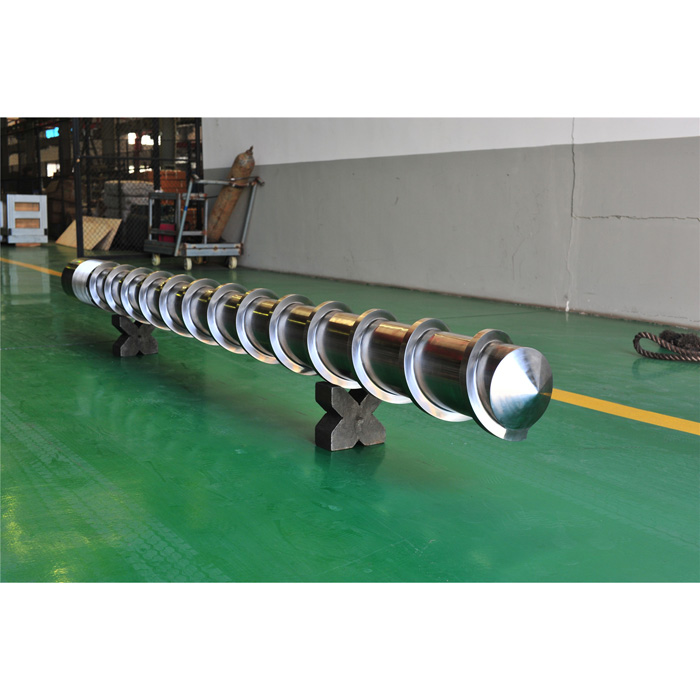
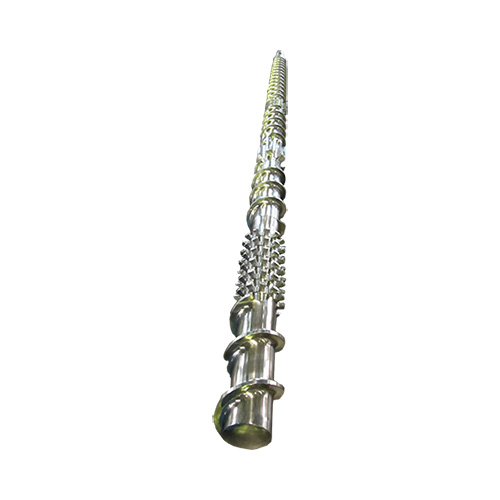
The practical response is to hold a measured baseline from new and check against it periodically, as set out in signs your screw barrel is worn out. On a cable line the payback is not just part life — it is knowing when quality drift has a hardware explanation.
6. Specifying a Wire and Cable Extrusion Screw Barrel
EJS produces wire and cable extrusion screw barrels for the construction, automotive, power cable and communication wire industries. Single screw barrels run from 12 mm to 500 mm diameter with working lengths to 10,000 mm, in nitrided or bimetallic construction, with Maddock, Pineapple and Saxton mixing elements available and the feed housing, feed liner and water jacket produced in-house.
What to state on a cable screw barrel inquiry
- The compound by name and filler loading — "LSZH" and "PVC sheath" lead to different alloys; the filler percentage refines it further
- Which layer — conductor screen, insulation, insulation screen, bedding, sheath
- Machine make, model and screw diameter, plus L/D if known
- Line speed and output target
- Any current defect — wall variation, gels, specks, resistivity issues
- Drawing if available; otherwise photos plus diameter, length and flange details
No drawing is normal on replacement work — our engineers can measure an existing screw barrel on site regardless of machine brand. Parts are built to Ra 0.4 µm surface roughness and 0.015 mm straightness, and ship with a material certificate and inspection report. Offers usually issue within one working day once the information is clear.
Questions we get asked
What screw barrel is used for wire and cable extrusion?
Wire and cable insulation and sheathing are normally extruded on single screw barrels, sized to the conductor and line speed rather than to bulk output. The specification is driven by the compound: PVC, PE, XLPE, halogen-free LSZH and semiconductive layers each behave differently. EJS produces wire and cable extrusion screw barrels for construction, automotive, power and communication cable, in diameters from 12 mm to 500 mm.
Why do LSZH compounds wear screw barrels so quickly?
Halogen-free flame retardant compounds achieve their fire performance through very high loadings of mineral flame retardant fillers. Those mineral particles are abrasive, and the loading is far higher than in a typical filled compound, so they grind the flight lands and bore continuously. A nitrided case of 0.4 to 0.7 mm can be worn through relatively quickly, which is why bimetallic construction with a carbide-bearing alloy is the usual specification for LSZH duty.
Should a cable extrusion screw barrel be nitrided or bimetallic?
It depends on the compound. Clean unfilled polyethylene insulation runs well on a nitrided screw barrel. PVC is corrosive because it releases hydrogen chloride, LSZH is highly abrasive from mineral filler loading, and semiconductive compounds are loaded with conductive carbon black. Those three normally call for bimetallic construction, with the alloy chosen for whichever mechanism leads.
Why does melt uniformity matter more in cable extrusion?
Because a defect in cable is not cosmetic. An unmelted particle, a gel or a contaminant embedded in insulation creates a local weak point in the dielectric, and wall thickness variation means the insulation is thinner than design somewhere along the run. Both are electrical and safety issues rather than appearance issues, which is why mixing quality and consistent output are specified more tightly than in many other extrusion processes.
What causes wall thickness variation in cable insulation?
Unstable melt delivery is a common hardware cause. As the clearance between screw and barrel opens through wear, melt slips backward over the flights, output fluctuates and die pressure surges, and that variation transfers directly to insulation wall thickness at line speed. Measuring screw outer diameter and barrel bore against original dimensions will confirm whether wear is the source.
Do semiconductive cable compounds need a special screw barrel?
They need particular attention to both wear and cleanliness. Semiconductive layers are heavily loaded with conductive carbon black, which is abrasive, so bimetallic construction is common. Dispersion quality also matters because the layer must be electrically uniform, and any degraded or contaminated material carried through becomes a defect in a layer whose whole purpose is a smooth electrical interface.
What size cable extrusion screw barrels does EJS make?
EJS produces single screw extruder barrels from 12 mm to 500 mm diameter with working lengths up to 10,000 mm, covering wire and cable extrusion for construction, automotive, power and communication cable. Mixing elements including Maddock, Pineapple and Saxton designs can be built into the screw, and parts are made to drawing or to machine brand and model code.