Roughly once a month an inquiry arrives asking for a blow moulding screw barrel, and the photographs attached show a blown film line. The names sit next to each other in every catalogue, including ours. The processes have almost nothing in common.
Getting this wrong wastes weeks, because the part is custom and the mistake is only obvious when it arrives. This guide separates the two properly: what each process physically asks of the screw and barrel, why film is the least forgiving extrusion process for melt uniformity, and four questions that settle which hardware you are actually specifying.

1. Two Processes, One Confusing Name
Strip away the shared word "blow" and the difference is immediate.
Blow moulding makes hollow parts. Melt is formed into a tube — the parison — which is then clamped in a mould and inflated with air until it takes the shape of the cavity. Bottles, containers, tanks, drums. The output is a discrete part, and the process is often cyclical, with an accumulator head holding melt between shots.
Blown film makes continuous film. Melt is pushed through an annular die to form a thin tube that is inflated into a vertical bubble, cooled, drawn upward, and collapsed into layflat film to be wound. Bags, liners, agricultural film, packaging. Nothing is cyclical; the line runs, and it runs for a long time.
2. Blow Moulding vs Blown Film Screw Barrel: Side by Side
Process A
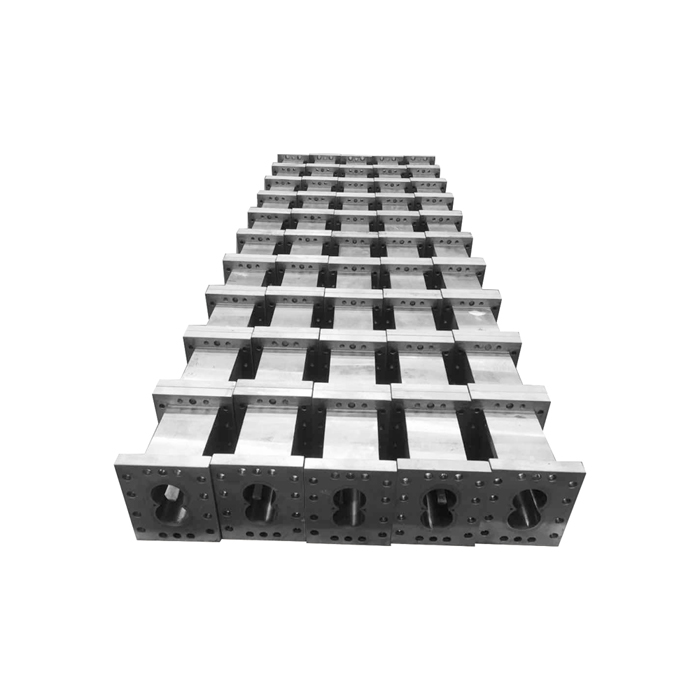
Blow moulding screw barrel
Feeds a parison, often through an accumulator head.
- Frequently cyclical — melt waits between shots
- Dead spots become degradation and black specks
- Even delivery drives parison wall consistency
- Streamlined flow path matters as much as output
Process B
Blown film screw barrel
Feeds an annular die continuously, film drawn very thin.
- Continuous running, no idle melt
- Any gel or unmelt shows in the film immediately
- Melt temperature uniformity governs gauge control
- Mixing capability often matters more than throughput
| Factor | Blow moulding | Blown film |
|---|---|---|
| Output form | Discrete hollow parts | Continuous film web |
| Running mode | Often cyclical / accumulator | Continuous |
| Biggest hardware priority | Even delivery, no dead spots | Melt uniformity, no gels |
| Where defects show | Parison wall thickness, specks | Gauge variation, gels, streaks |
| Residence time concern | Melt sitting between cycles | Shear history through the screw |
| Mixing section | Useful | Often essential |
3. What a Blown Film Screw Barrel Actually Needs
Film is the least forgiving extrusion process we build for, and the reason is geometric rather than chemical: the material ends up extremely thin. A gel, an unmelted particle or a slug of hotter melt that would disappear inside a 3 mm pipe wall becomes a visible defect or a gauge deviation in a 25-micron film.
That reframes the priorities. Raw throughput is rarely the binding constraint — melt homogeneity is. Which is why:
- Mixing sections earn their place. A Maddock, Pineapple or Saxton element does more for film quality than a modest increase in screw speed. Dispersive for gels and unmelt, distributive for streaking and temperature evenness.
- Temperature uniformity is a hardware property, not just a controller setting. Melt leaving the screw with a temperature gradient across it will not be rescued downstream.
- Wear shows up earlier here. As clearance opens, melt slips backward, output falls and uniformity degrades — and film reveals that loss of uniformity long before a pipe line would notice.
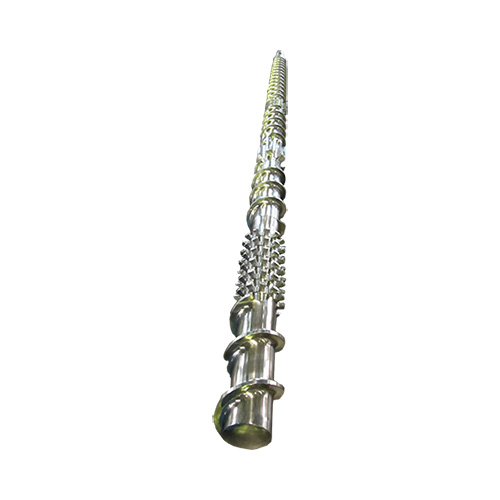

4. What a Blow Moulding Screw Barrel Actually Needs
Blow moulding shifts the problem from uniformity to delivery and dwell.
The parison has to form with consistent wall thickness, which means melt must arrive at the head evenly and predictably. And where the line uses an accumulator, melt sits and waits between shots — so anywhere the flow path is not properly streamlined becomes a place material lingers, overheats, and eventually releases as degraded specks into a product that will be inspected for exactly that.
This makes flow-path geometry and screw tip streamlining as important as the screw's melting capacity. It is the same logic that governs injection molding sets, where intermittent residence time creates the same failure mode.
A symptom worth reading correctly: black specks in blow moulded product are usually a dwell-and-dead-spot problem, not a "dirty material" problem. Changing resin lots rarely fixes it. Inspecting the flow path and tip condition usually does.
5. Four Questions That Settle the Spec
When an inquiry is ambiguous, these are the questions we ask, in this order.
Does your product come out as a part, or as a web?
Hollow parts clamped in a mould means blow moulding. Continuous film wound on a roll means blown film. This alone resolves most cases.
Does the machine have an accumulator head?
If yes, you are on blow moulding, and residence time between shots is part of your specification whether anyone wrote it down or not.
What is the machine make and model?
This is what the part is actually built against. Process category guides the design intent; the machine determines the dimensions, and they must match exactly.
What goes in the hopper — including regrind?
Virgin pellets, film flake, or a blend, plus any filler. This sets both the screw geometry and the surface treatment, and it is the question most often left unanswered.
6. The Regrind Problem, Which Hits Film Lines Hardest
Film operations reprocess their own edge trim and start-up scrap as a matter of routine, which makes this the most common specification drift we see on film screws.
Film flake has very low bulk density and irregular shape. A screw dimensioned around dense virgin pellets, later fed 20–30% flake, is being asked to remove considerably more entrained air than it was built for, and the feed channel no longer fills consistently. The symptoms — surging, erratic output, longer purge times — look like machine faults, so the investigation usually starts in the wrong place.
There is a second effect. Recycled streams carry contaminants and sometimes abrasive residues, which is often enough to move the correct surface treatment from nitrided to bimetallic. A nitrided case runs 0.4–0.7 mm; bimetallic construction puts 2–3 mm of cast alloy in the bore and 1.0–1.5 mm of PTA hardfacing on the flights.
If your line started recycling after the screw was made
- Feeding and output problems that began around the same time are probably design mismatch, not machine failure
- Say so at inquiry — the replacement is the free moment to correct the geometry
- Review the surface treatment at the same time; contaminated streams wear differently
7. Ordering the Right Part
Whichever process you are on, the part is built against the machine, not against the category. EJS produces single screw extruder barrels from 12 mm to 500 mm diameter with working lengths up to 10,000 mm, covering film extrusion, blow moulding and related processes, with mixing elements built in as required and the feed housing, feed liner and water jacket produced in-house.
Send a drawing if you have one. If not — which is normal on replacement work — photos plus diameter, length and flange details are enough to begin, and our engineers can measure an existing screw barrel on site regardless of machine brand. Parts are built to Ra 0.4 µm surface roughness and 0.015 mm straightness, with a material certificate and inspection report supplied. Offers usually issue within one working day.
Questions we get asked
What is the difference between a blow moulding screw barrel and a blown film screw barrel?
They serve two different processes despite the similar names. A blow moulding screw barrel plasticizes material for a parison that is then inflated inside a mould to make hollow products such as bottles and containers. A blown film screw barrel feeds a continuous annular die to form a film bubble that is drawn upward and collapsed into layflat film. Blow moulding is often cyclical with an accumulator; blown film runs continuously and prioritises melt uniformity above all.
What matters most in a blown film screw barrel?
Melt uniformity. Because the film is drawn very thin, any gel, unmelted particle or temperature variation in the melt shows up directly as a defect or a thickness variation in the finished film. That makes mixing sections and consistent melt temperature more important than raw output, and it makes clearance wear noticeable in film quality earlier than in most other processes.
What matters most in a blow moulding screw barrel?
Consistent melt delivery and controlled residence time. The melt must arrive at the die or accumulator head evenly so the parison forms with steady wall thickness, and material should not sit in dead spots between cycles where it can degrade. Streamlined flow paths and a screw geometry matched to the resin matter more than headline output figures.
Can I use the same screw barrel for blow moulding and blown film?
No. The screw barrel must match the machine it is fitted to, and the two machines are built differently. Even where diameters look similar, the screw geometry, mixing requirement and residence time behaviour are specified for the process. Order against the machine make, model and existing part dimensions rather than by process similarity.
Does recycled material change the screw barrel specification for film lines?
Yes, in two ways. Film flake and regrind have much lower bulk density than virgin pellets, so the feed and compression behaviour changes and feeding can become the limiting factor. Recycled streams also carry contaminants and sometimes abrasive residues, which usually moves the surface treatment from nitrided to bimetallic to keep wear under control.
What size screw barrels does EJS make for film and blow moulding lines?
EJS produces single screw extruder barrels with diameters from 12 mm to 500 mm and working lengths up to 10,000 mm, covering film extrusion, blow moulding and related processes. Mixing elements including Maddock, Pineapple and Saxton designs can be built into the screw, and the feed housing, feed liner and water jacket are produced in-house.
Why does film quality get worse as a screw barrel wears?
As the clearance between screw and barrel opens, melt slips backward over the flights instead of being conveyed forward. Output falls, melt temperature rises because the machine works harder, and the melt becomes less uniform. In film, where material is drawn extremely thin, that loss of uniformity shows up as gauge variation and defects long before the part would be considered failed.