In plastic extrusion and compounding industries, the performance of the extruder directly affects production efficiency, material quality, and operating costs. While many people focus on the screw design or extrusion machine itself, the Segment Twin Screw Barrel is one of the key components that determines processing stability and flexibility.
Unlike traditional one-piece barrels, segmented twin screw barrels use a modular structure that allows individual barrel sections to be replaced, customized, or rearranged according to different processing requirements. This design has become increasingly important in applications involving engineering plastics, filled materials, masterbatch production, and high-performance polymer processing.
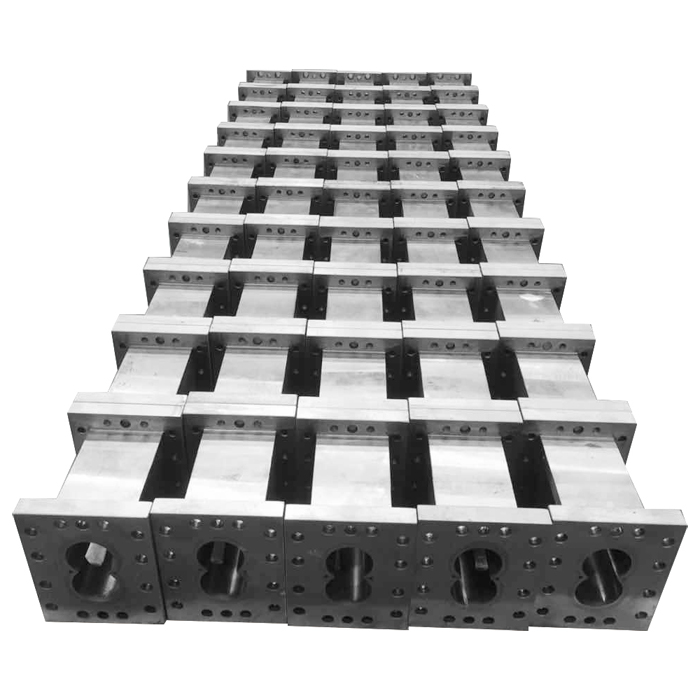
What Is a Segment Twin Screw Barrel?
A Segment Twin Screw Barrel is a modular barrel system used in co-rotating or counter-rotating twin screw extruders.
Instead of manufacturing the barrel as one complete piece, the barrel is divided into multiple independent sections. Each segment can perform different functions, such as:
Feeding
Melting
Mixing
Venting
Reaction processing
Pressure building
A typical segmented twin screw barrel includes:
|
Component
|
Function
|
|
Barrel Segment
|
Provides the processing chamber for material flow
|
|
Heating/Cooling Channel
|
Controls processing temperature
|
|
Wear-Resistant Lining
|
Improves service life under abrasive conditions
|
|
Connection Flange
|
Allows multiple barrel sections to be assembled
|
This modular structure gives manufacturers more freedom to optimize extrusion processes.
Why Are Segmented Twin Screw Barrels Widely Used?
Modern plastic processing often involves complex materials.
Many polymers require special processing conditions because they may contain:
Glass fibers
Mineral fillers
Flame retardants
Color masterbatch
Recycled materials
Functional additives
A fixed barrel design may not provide enough flexibility for different formulations.
Segmented twin screw barrels allow processors to adjust the machine configuration according to production needs.
Main advantages include:
Flexible processing configuration
Easier maintenance
Reduced replacement costs
Better adaptation to different materials
Improved production efficiency
An Industry Secret: Barrel Configuration Can Change Material Performance
A little-known fact in extrusion processing is that the barrel arrangement itself can influence the final polymer properties.
Different barrel zones can control:
Melting behavior
Mixing intensity
Residence time
Material dispersion
Degassing performance
For example:
A stronger mixing section may improve additive dispersion, but excessive shear can increase material degradation.
Therefore, engineers carefully design barrel combinations based on:
Material characteristics
Production speed
Product requirements
Processing temperature
The barrel is not simply a protective shell around the screw; it is an active part of the material processing system.
Materials Used for Segment Twin Screw Barrels
Because twin screw extrusion often involves high temperature, pressure, and friction, barrel materials require excellent wear resistance.
Common materials include:
Nitrided Steel
Used for general extrusion applications because of:
Good hardness
Cost efficiency
Reliable performance
Bimetallic Barrel
A bimetallic barrel uses a wear-resistant alloy layer inside the barrel.
Advantages include:
Higher abrasion resistance
Longer operating life
Suitable for filled polymers
Special Alloy Materials
For highly corrosive or abrasive applications, special alloys may be selected to improve:
Corrosion resistance
Wear resistance
Thermal stability
The Manufacturing Process Behind Segment Twin Screw Barrels
Producing a high-performance barrel requires precision machining and material technology.
Steel Material Preparation
High-quality alloy steel is selected according to application requirements.
Precision Machining
The internal bore must maintain accurate dimensions to ensure proper cooperation between:
Screw elements
Barrel segments
Processing materials
Heat Treatment
Heat treatment improves mechanical properties and increases resistance to operating stress.
Surface Treatment
Special treatments or alloy layers may be applied to improve:
Wear resistance
Corrosion resistance
Service life
Quality Inspection
Typical inspections include:
Dimensional accuracy
Hardness testing
Internal surface inspection
Pressure testing
Applications of Segment Twin Screw Barrels
Plastic Compounding
Segmented barrels are widely used for producing modified plastics containing additives, fillers, or reinforcing materials.
Masterbatch Production
They support effective pigment dispersion and uniform mixing during color masterbatch manufacturing.
Engineering Plastics Processing
Materials such as:
PA
PC
ABS
POM
often require precise temperature and mixing control.
Recycling Industry
Twin screw systems with segmented barrels are increasingly used for processing recycled polymers due to their flexibility in handling different material conditions.
The Hidden Challenge: Wear Resistance and Processing Efficiency Must Be Balanced
A harder barrel surface does not always mean better performance.
In extrusion applications, manufacturers need to balance:
Wear resistance
Heat transfer efficiency
Machining accuracy
Cost
For example, extremely wear-resistant materials may increase manufacturing difficulty and affect thermal conductivity.
The best barrel design depends on the actual processing environment rather than using the most expensive material.
Future Trends of Segment Twin Screw Barrels
Longer Service Life Materials
New alloy technologies are being developed to improve resistance against:
Abrasion
Corrosion
High-temperature operation
More Flexible Modular Designs
Future extrusion systems will continue moving toward easier customization, allowing faster adaptation to new materials and formulations.
Smart Monitoring Technology
Advanced extrusion systems may integrate sensors to monitor:
Temperature changes
Wear conditions
Processing stability
This helps reduce unexpected downtime and improve production management.