- English
- 简体中文
- Español
- Português
- русский
- Français
- 日本語
- Deutsch
- tiếng Việt
- Italiano
- Nederlands
- ภาษาไทย
- Polski
- 한국어
- Svenska
- magyar
- Malay
- বাংলা ভাষার
- Dansk
- Suomi
- हिन्दी
- Pilipino
- Türkçe
- Gaeilge
- العربية
- Indonesia
- Norsk
- تمل
- český
- ελληνικά
- український
- Javanese
- فارسی
- தமிழ்
- తెలుగు
- नेपाली
- Burmese
- български
- ລາວ
- Latine
- Қазақша
- Euskal
- Azərbaycan
- Slovenský jazyk
- Македонски
- Lietuvos
- Eesti Keel
- Română
- Slovenski
- मराठी
- Srpski језик

Extruder Screw Barrel: The Complete Guide to Types, Materials & How to Choose | EJS
Extruder Screw Barrel Guide
Direct Answer
An extruder screw barrel is the core plasticizing unit of an extrusion machine: a rotating screw turning inside a heated cylindrical barrel that conveys, melts, mixes, and pressurizes plastic or rubber so it can be pushed through a die.
The right barrel for your line is decided by three things — the machine and screw diameter, the material you process (and any fillers or fibers in it), and the surface treatment that protects against wear and corrosion.
Search "extruder screw barrel" and you get a wall of near-identical supplier pages that all say "high quality" and tell you almost nothing useful. This guide is the opposite. It walks through the decisions our engineers actually take customers through before quoting — using the real material grades and tolerances we build to every day. Whether you run the machine, engineer the line, or purchase the parts, use the menu on the left to jump to what you need.
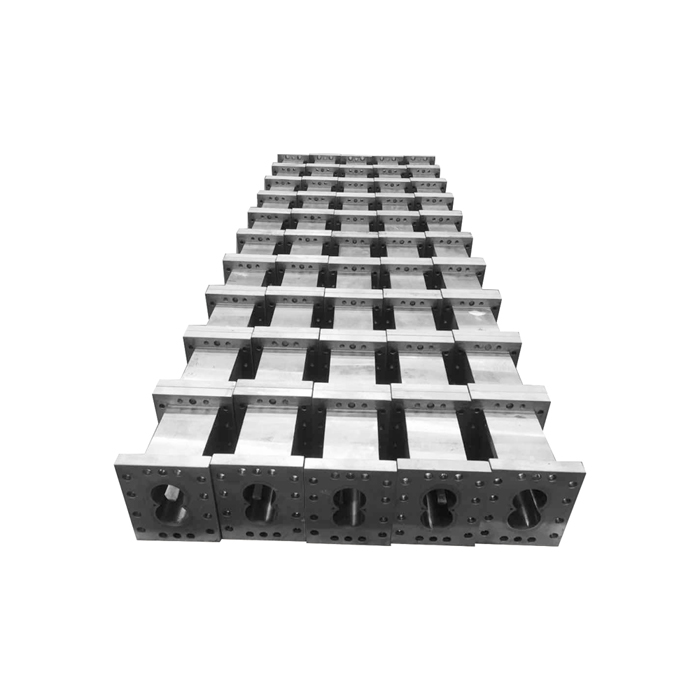
01What an Extruder Screw Barrel Actually Does
The screw is often called the heart of the machine, and that is not marketing — it is the single component that determines how well the machine plasticizes. Everything upstream feeds it and everything downstream depends on what it delivers.
The screw and the barrel work as one part
People say "screw barrel" as one word because in practice they are a matched pair. The screw rotates; the barrel is the fixed heated cylinder it turns inside. The gap between them — the clearance — is tiny, and holding that gap is most of what quality manufacturing is about. As the two wear, the gap opens, and output and pressure fall off with it.
The three working zones
Along its length a single screw is divided into three sections, and understanding them is the key to reading any screw spec:
- Feed zone — deep flights near the hopper that take in cold material and convey it forward.
- Compression (transition) zone — flight depth shrinks, pressing material against the hot barrel wall so it melts and trapped air is driven back out.
- Metering zone — shallow flights that build steady pressure and deliver a uniform, homogenous melt to the die.
General industry note: the three-zone model describes standard single-screw geometry and applies across the industry, not only to EJS parts.
Why the clearance matters more than the brochure
A new barrel does not just make more parts — it makes better ones, at lower energy per kilo. When the screw-barrel gap widens through wear, molten material slips backward over the flights instead of being carried forward. Output drops, melt temperature climbs because the machine works harder, and quality drifts. A worn barrel is rarely cosmetic: it shows up in your scrap rate and your power bill.
02The Key Specifications You Must Check
Because screw barrels are almost 100% custom, there is no "part number" to point at — you specify one by its parameters. These decide whether a barrel fits your machine and survives your material.
Screw diameter and working length
Diameter has to match your machine; length has to match your process. For extruder screw barrels, EJS handles diameters from 12 mm up to 500 mm, with single-screw working lengths reaching as long as 10,000 mm. Twin-screw barrels (parallel and conical) run Φ20–Φ250 mm.
L/D ratio
The length-to-diameter ratio describes how long the screw is relative to its bore. A longer L/D gives more residence time for melting and mixing; a shorter one is more compact. The right L/D depends on the polymer and the process, so it is set per job rather than off a shelf.
General industry note: L/D as a selection concept is standard across extrusion; confirm the ideal value against your own process and machine.
Base steel selection
The steel underneath everything determines strength and wear behavior. EJS commonly works in these grades:
- 38CrMoAlA (1.8509) and 34CrAlNi7 (1.8550) — nitriding steels for hard nitrided surfaces
- 42CrMo (4140), 31CrMoV9 (1.8519), 40Cr, 45 steel
- SS304 / SS316 stainless for corrosive materials
- SKD11 / SKD61 and W6Mo5Cr4V2 for screw elements and high-demand work
Clearance, roughness, and straightness
These are the quiet numbers that separate a good barrel from a rough one. EJS builds to a surface roughness of Ra 0.4 µm and a straightness of 0.015 mm — the finish and geometry that let screw and barrel hold their designed clearance in service.
| Parameter | Single-screw (extrusion) | Twin-screw (parallel / conical) | Why it matters |
|---|---|---|---|
| Bore diameter | 12 – 500 mm | Φ20 – Φ250 mm | Must match the machine |
| Working length | Up to 10,000 mm | Up to 10 m | Sets melting / mixing capacity |
| Surface roughness | Ra 0.4 µm | Ra 0.4 µm | Holds clearance, cuts friction |
| Straightness | 0.015 mm | 0.015 mm | Prevents uneven wear & scoring |
| Nitriding layer | 0.4 – 0.7 mm | 0.4 – 0.7 mm | Surface hardness & wear life |
| Bimetallic layer | Screw 1.0–1.5 / Barrel 1.5–3.0 mm | Screw 1.0–1.5 / Barrel 2.0–3.0 mm | Protection vs fillers & fibers |
03Types of Extruder Screw Barrel Systems
"Extruder screw barrel" covers several very different configurations. Choosing the family is the first fork in the road.
Single-screw vs twin-screw
Single-screw barrels are the workhorse of extrusion — simple, robust, and ideal for straightforward conveying and melting of most polymers and recycled plastics. Twin-screw barrels use two intermeshing screws for much stronger mixing, better control, and higher output, and are the standard where compounding, devolatilizing, or heavily filled materials are involved.
Parallel vs conical twin-screw
Parallel twin-screw barrels are used for profile, tube, sheet, foam and compounding, processing many polymers at output that can reach tons per hour. Conical twin-screw barrels are widely used for PVC — profile, pipe, and granulation — with screws larger at the feed end that taper toward the die. EJS is the largest manufacturer of twin conical screw barrels and has been for many years.
Worth knowing: EJS designs conical twin barrels differently by CaCO₃ filler level (low, medium, high) in the PVC compound, and keeps popular sizes like 55/110 and 65/132 semi-finished in stock for shorter delivery.
Feed sections and mixing elements
A barrel is more than a plain tube. EJS also produces the feeding section — feed housing, feed liner, and water jacket — and builds mixing elements into the screw for better plasticizing, including Maddock, Pineapple, and Saxton designs.
| Type | Mixing capability | Typical output | Best suited for |
|---|---|---|---|
| Single-screw | Basic | Steady, moderate | General extrusion, recycled plastics, pipe/film/sheet |
| Parallel twin-screw | High | Up to tons/hour | Profile, tube, sheet, foam, compounding |
| Conical twin-screw | High | High | PVC profile, pipe, granulation |
| Planetary screw barrel | Very high, self-cleaning | 500–5000 kg/h | Rigid, semi-rigid & soft PVC |
04Materials & Surface Treatments: Bimetallic vs Nitrided
This is where lifespan is won or lost. The base steel gives the part its body; the surface treatment decides how long it survives your material. The two customers ask about most solve different problems.

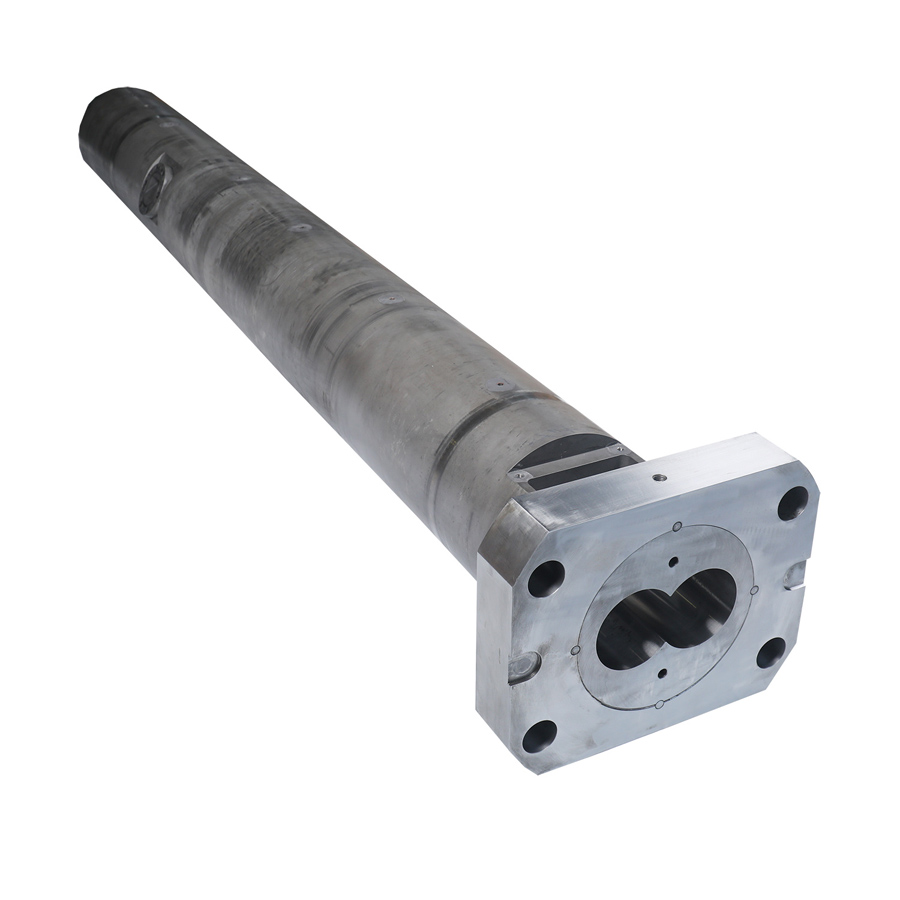
Nitrided screw barrel
Nitriding hardens the surface of a nitriding steel (like 38CrMoAlA) to a depth of 0.4–0.7 mm. It is the cost-effective choice for clean, unfilled plastics where abrasion and corrosion are moderate. Good value, proven, widely used.
Bimetallic screw barrel
When you run materials with fillers and fibers — glass fiber, mineral fillers, hard additives — a nitrided surface wears too fast. A bimetallic barrel carries an alloy layer, applied by centrifugal casting, that is far more wear- and corrosion-resistant. EJS has made bimetallic barrels for over 20 years and offers four barrel alloys tuned to different service conditions:
| Alloy | Components | Max temp | Strength |
|---|---|---|---|
| EJS01 | Fe+Ni+Cr+B | ≤ 400 °C | Good value, general wear |
| EJS02 | Ni+Cr+Co+B | ≤ 450 °C | Better corrosion resistance |
| EJS03 | Ni+Cr+Co+V+B | ≤ 450 °C | Strong wear & corrosion |
| EJS04 | Ni+Wc+Cr+B | ≤ 600 °C | Best wear resistance |
Alloy layer thickness 2–3 mm; hardness up to HRC 50–62 depending on grade.
Hardfacing on the screw
The matching screw is protected by hardfacing applied by PTA welding. Beyond the common Ni60 (HRC 56–62), EJS offers Colmonoy 56 (HRC 53–58) and Colmonoy 83 (HRC 50–55, tungsten-added, the top choice for combined wear and corrosion resistance), with a hardfacing layer of 1.0–1.5 mm.
The short rule: clean plastics → nitrided; filled or abrasive materials → bimetallic; corrosive materials → the right stainless base plus the right alloy. Tell a supplier your exact material and they should tell you the treatment — not the other way around. For the full breakdown, see our bimetallic vs nitrided surface treatment guide.
05Extruder Screw Barrels by Application
The same core part is tuned to the job it does. EJS builds application-specific extruder screw barrels for the main extrusion processes:
- Tube / pipe extrusion — screw barrels for plastic pipe and tube lines.
- Film extrusion — for both cast (flat) film and blown film.
- Sheet extrusion — flat plastic sheet from a range of resins, single- or twin-screw.
- Wire & cable extrusion — for construction, automotive, power and communication cable.
- Rubber extrusion — dedicated rubber screw barrels (pin and cold/hot feed types).
06Wear, Clearance, and Lifespan
Every screw barrel wears out. What varies is how fast, and whether you see it coming. The gap between screw and barrel quietly governs your output — as it opens, performance falls, long before the part fails outright.
Signs your barrel is worn
- Output drops at the same screw speed
- Melt temperature rises without a setpoint change
- Motor load, amperage, or energy per kilo creeps up
- Product quality drifts — dimensions, surface, consistency
- Pressure at the die fluctuates
Repair, recondition, or replace?
Not every worn barrel needs replacing. Where the base steel is sound but the surface is worn, refurbishment — re-machining and re-applying the hard surface — can return a part to service for a fraction of a new one. EJS does both custom new production and refurbishment. When the wear is deep, replacement is the honest answer.
| Symptom | Likely cause | How to check | Typical action |
|---|---|---|---|
| Output down, temp up | Clearance opened by wear | Measure screw OD & barrel bore vs original | Recondition or replace |
| Localized wear / scoring | Foreign object, hard filler, misalignment | Inspect flight lands & bore surface | Repair zone or replace |
| Fast general wear | Treatment under-specified for material | Review material vs treatment | Upgrade to bimetallic next time |
General industry note: these pairings reflect common extrusion experience; measure against your own baseline before deciding.
07How to Buy an Extruder Screw Barrel
Because these parts are custom, buying one is not like ordering off a catalogue. What you give the supplier determines whether the quote — and the part — is right.
What a manufacturer needs to quote you
A drawing is ideal. When a drawing is not possible, product photos plus the major dimensions — diameter, length, and flange information — are a must, together with the material you process and the surface treatment you want. With that, EJS can usually make an offer within one working day.
- Provide a drawing, or photos + key dimensions Diameter, length, flange details at minimum. No drawing? EJS can measure on-site.
- State your material and any fillers This drives the base steel and surface treatment.
- Specify the surface treatment (or ask) Nitrided, bimetallic, chrome-plated — matched to the material.
- Confirm the offer and drawing Production starts once the drawing is confirmed.
Lead time and what drives price
Lead time is production time plus shipping. EJS production time typically ranges from 20 to 70 days depending on the part, quantity, and schedule, and is always stated on the offer. Price is driven mainly by size, base steel, and surface treatment.
OEM, aftermarket, and warranty
EJS supplies both OEM machine builders and end-users buying replacement spare parts, and produces injection barrels to match specific machine brands or codes. All screw barrels carry a one-year warranty when run with pure plastics, with free replacement against a formal non-conforming report (buyer covers freight).
08Why Trust EJS on This
Advice is only as good as the shop behind it. EJS has manufactured screws and barrels since 1992, growing from a small workshop making double-conical screw barrels into a factory in Zhoushan with 400 full-time employees, around 800 pieces of equipment, and 40,000 m² across some 20 workshops.
In 2020 the factory produced US$39 million of twin screw barrels and US$7.8 million of single screw barrels — roughly 30,500 pieces — shipped to the United States, Brazil, Mexico, Germany, Italy, Russia, Turkey, the UK and more. Quality is backed by ISO 9001 and every part is inspected against its spec; the Ra 0.4 µm finish and 0.015 mm straightness cited above are the numbers we build and check to, not slogans.
We are candid about where we sit: on quality and service, EJS is a strong China-based alternative to premium names like Xaloy and Bernex, at a considerably lower price, with quality that keeps improving.
09Frequently Asked Questions
What is an extruder screw barrel?
It is the plasticizing unit of an extrusion machine — a screw rotating inside a heated barrel that conveys, melts, mixes, and pressurizes plastic or rubber so it can be pushed through a die. The screw and barrel are a matched pair and are specified together.
How do I choose the right extruder screw barrel?
Match three things: the machine and screw diameter, the material you process (including any fillers or fibers), and the surface treatment that protects against wear and corrosion. Give a supplier those and they can specify the rest.
What is the difference between a single-screw and twin-screw barrel?
Single-screw barrels convey and melt most polymers simply and robustly. Twin-screw barrels use two intermeshing screws for much stronger mixing and higher output, used for compounding, filled materials, and PVC (conical twin).
Bimetallic or nitrided — which do I need?
Nitrided suits clean, unfilled plastics and is more economical. Bimetallic is for materials with fillers or fibers that would wear a nitrided surface too quickly. Choose based on your exact material.
How do I know when to replace a screw barrel?
Watch for falling output at the same screw speed, rising melt temperature, higher motor load, drifting product quality, and pressure fluctuation. These usually mean the clearance has opened through wear. Measure against original dimensions to confirm.
Can a worn screw barrel be repaired instead of replaced?
Often, yes. If the base steel is sound but the surface is worn, refurbishment restores service life at lower cost. EJS does both refurbishment and new custom production.
How much does an extruder screw barrel cost?
There is no fixed price because parts are custom. Cost is driven by size, base steel grade, and surface treatment. Send a drawing, or photos plus diameter, length and flange details, and EJS can usually quote within one working day.
Can EJS make a barrel if I don't have drawings?
Yes. Experienced EJS engineers can take on-site measurements of your existing screw barrel regardless of the machine brand, then build a replacement to match.
Send your specs, not your guesswork
Have a drawing, or a worn part and its dimensions? Send the diameter, length, flange details and your material, and our engineers will come back with an offer — usually within one working day.
Get a Quote