What 55/110, 65/132, 80/156 and similar numbers tell you—and what they leave out when you order a replacement screw and barrel set.

Conical twin screw buyers often begin with a short code from a machine nameplate, purchase record or spare-parts list. That code is useful, but it is only the first line of the specification. Two sets carrying similar numbers can still differ at the spline, overall length, center distance, flight profile and barrel connection.
EJS publishes conical twin screw sizes from compact sets through large replacement systems. Our current conical twin screw barrel category lists common pairs such as 55/110, 65/132, 80/156 and 92/188. The purpose of this guide is to help you read those numbers correctly, then collect the details that determine whether a replacement will fit.
What Does a 65/132 Conical Twin Screw Code Mean?
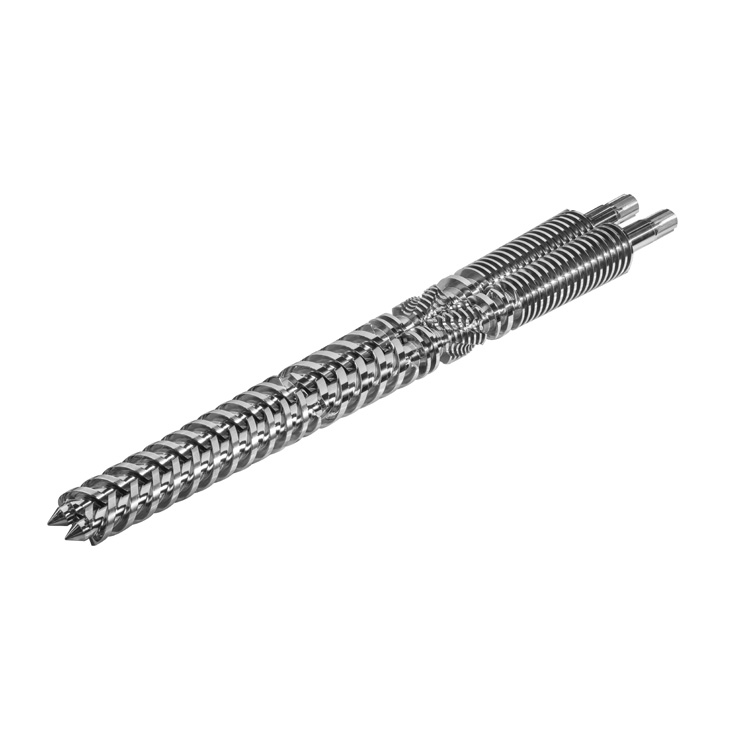
The two numbers normally refer to nominal screw diameters in millimeters. In a 65/132 set, the smaller front diameter is about 65 mm and the larger rear diameter is about 132 mm. The taper is what distinguishes the geometry from a parallel twin screw, which keeps a constant nominal diameter along its working length.
This reading is supported by current equipment documentation. Milacron's 2025 extrusion brochure labels its TC65 as “Screw Diameter (Front / Rear) (mm) 65 / 132”. The same table identifies TC80 as 80/156. Its earlier technical specification sheet also lists front/rear screw diameters for several conical models.
| Example code | Usual reading | What it does not tell you |
|---|---|---|
| 55/110 | About 55 mm front diameter and 110 mm rear diameter | Length, spline, center distance, screw profile and barrel interface |
| 65/132 | About 65 mm front diameter and 132 mm rear diameter | Machine platform, rotation, thermal layout and process-specific geometry |
| 80/156 | About 80 mm front diameter and 156 mm rear diameter | Whether a part fits every machine marketed under an 80-class name |
Why the Size Code Is Not a Complete Replacement Specification
A size family describes the scale of the processing unit. It does not describe every surface that must connect with the gearbox, barrel, heaters, cooling circuits and downstream equipment. The replacement must match the original machine at each of those interfaces.
The EJS twin conical screw barrel page makes the same practical point from the manufacturing side: screw-to-screw clearance and screw-to-barrel clearance must be controlled as a matched system. EJS also accepts connecting dimensions for custom manufacture and offers on-site measurement when a drawing is unavailable and the removed parts are cleaned.
The code cannot identify these details
- Overall and working length: The tapered diameters do not define the axial dimensions.
- Center distance: The gearbox fixes the relationship between the two shafts.
- Spline connection: Tooth count, form, outside diameter and engagement length must match the drive.
- Flight geometry: Pitch, compression, mixing features and tip details depend on the original design and application.
- Barrel interfaces: Flanges, bolt circles, feed opening, vent position, thermocouple holes and heating or cooling connections all matter.
- Material and surface treatment: The process formulation and wear mechanism determine the suitable construction.
A buyer who sends only “65/132” has identified a size family, not an order-ready part. That is enough to begin a technical conversation, but not enough to release a drawing for production.
Conical Twin Screw Barrel Sizes Published by EJS
EJS currently publishes the following main size pairs on its conical twin screw barrel category page. The detailed product page also states a broader available bore range of Ø30/70 to Ø188/330. Treat this list as a capability and identification guide; confirm the exact geometry against your machine or approved drawing.
| Size group | EJS-published size pairs | RFQ priority |
|---|---|---|
| Compact | 24/52, 45/90, 45/100, 50/105, 51/105, 55/110, 55/120, 58/124 | Confirm the exact pair; several families share a similar first diameter. |
| Medium | 60/125, 65/120, 65/132, 68/143, 68/147, 70/135, 70/140, 75/150 | Do not order by the first number alone. A 65/120 and a 65/132 are different sets. |
| Large | 80/143, 80/156, 92/188, 105/216, 110/220 | Confirm handling, interfaces, drawing revision and inspection documents before production. |
EJS identifies 65/132, 80/156 and 92/188 as popular sizes for which shorter production arrangements may be available. Availability still depends on the final drawing, material, treatment and current production schedule, so request a project-specific confirmation rather than assuming stock.
Why 55/110, 55/114 and 55/120 Are Not the Same Part
Size conventions vary between machine platforms and design generations. EJS lists both 55/110 and 55/120 among its main sizes. Milacron's current brochure publishes 55/114 for its TC55, while an older technical sheet lists both 55/109 and 55/114 configurations. These are useful examples of why a familiar first number does not prove compatibility.
A difference in the large-end diameter changes the taper and affects the complete matched geometry. The gearbox, shaft angle, center distance, barrel bores and screw profile must agree with that geometry. A supplier cannot safely convert one family into another from the marketing code alone.
| Information received | Safe conclusion | Next check |
|---|---|---|
| Machine label says 55 | The unit belongs to a 55-class family. | Find the complete diameter pair and machine model. |
| Purchase record says 55/110 | The nominal diameter pair is identified. | Check drawing revision, spline, length and interfaces. |
| Old screws measure below nominal | The part may be worn; the smallest measured value is not automatically the original dimension. | Compare several positions and use the machine record or an approved reference. |
| A similar set is available from stock | It may shorten production only if its semi-finished geometry suits the approved drawing. | Complete the dimensional review before accepting it. |
How to Identify a Replacement Conical Twin Screw Set
Start with the strongest evidence you have. An approved OEM drawing is best because it records nominal dimensions rather than wear. A previous EJS drawing or order number can also establish the design. If neither exists, send the machine make and model, nameplate photos and clear images of the removed parts.
Use the old part carefully
A worn screw can still show the spline, connection, overall length and major geometry. It cannot always reveal the original flight diameter or clearance. Clean the parts before measuring, mark the two screws as a pair, and avoid mixing them with another set from the same plant.
EJS states that its team can measure removed and cleaned conical twin screw barrels on site when drawings are not available. Whether on-site measurement is practical depends on location and project scope, so confirm the arrangement during inquiry.
Keep the pair together
Conical twins operate as a matched pair inside matched barrel bores. Record left/right position, rotation and drive-end connection before removal. If one screw has suffered local damage, inspect its partner and the barrel rather than assuming the other components remain within the correct working clearance.

The Size Code Does Not Select the Material or Surface Treatment
A 65/132 set can process different formulations on different lines. The diameter code therefore cannot decide the base steel, nitriding specification or wear-protection route. Send the resin, filler type and approximate loading, corrosive additives, operating temperature range, output target and the wear pattern found on the old parts.
For conical twin screw barrels, EJS currently publishes base-material options including 38CrMoAlA, 34CrAlNi7, 31CrMoV9, 40Cr, 42CrMo, D2, SKD61 and SKD11. The published treatment options include full-body nitriding, bimetallic alloy protection in the extrusion section followed by nitriding, and SKD61 or SKD11 lining. Final selection should be tied to the formulation and approved quotation, not copied from another machine of the same nominal size.
The same rule applies to PVC pipe and profile work. Milacron's current TC-series data shows that application throughput changes with raw material grade, bulk density and other processing parameters. A diameter code helps identify the hardware family, but it does not promise output or product quality.
What to Send for an Accurate Conical Twin Screw Barrel Quote
A complete RFQ reduces repeated questions and prevents the wrong assumptions from entering the drawing. Send the information below even when the old purchasing record already contains a size code.
- Machine manufacturer and exact model
- Complete size pair, such as 65/132
- OEM or previously approved drawing
- Overall and working lengths
- Center distance and shaft relationship
- Spline tooth count, form and engagement length
- Left/right screw position and rotation
- Barrel flange, bolt circle and feed opening
- Vent, sensor, heater and cooling locations
- Resin, filler, additive and recycled-content details
- Photos of the nameplate and complete removed set
- Observed wear, corrosion, cracking or output problem
- Required inspection and material documents
- Target delivery destination and required date
For a repeat order, include the previous EJS quotation, drawing or part number. For a first replacement with no drawing, provide a cleaned sample or ask whether measurement support is available for your location.
Start With the Size Code—Finish With the Drawing
Send EJS the full code, machine model, drawings or clear photos, and material formulation. The team can review the information and tell you what is still missing before a replacement set moves into production.
Frequently Asked Questions
What does 65/132 mean on a conical twin screw?
It normally identifies the nominal screw diameters in millimeters: about 65 mm at the smaller front end and 132 mm at the larger rear end. It is a size-family code, not a complete replacement specification.
Does the second number mean the screw length?
No. In common conical twin screw notation, the second number identifies the larger nominal screw diameter. Overall length and working length must be stated separately on the drawing.
Is every 65/132 conical twin screw barrel interchangeable?
No. Sets can differ in length, center distance, spline, rotation, flight geometry, barrel ports and machine interfaces. Confirm the machine model and approved dimensions before ordering.
Can a 55/110 set replace a 55/114 set?
Do not assume it can. The different large-end diameter changes the taper and matched geometry. The gearbox, shafts, barrel bores and connection dimensions must be reviewed as a complete system.
What information does EJS need to quote a replacement?
Send the machine make and model, complete size pair, drawing or cleaned sample, lengths, spline and connection details, formulation, wear condition, required documents and delivery destination.
Can EJS make a conical twin screw barrel without a drawing?
EJS states that it can work from connecting dimensions and can provide measurement support for removed, cleaned parts when drawings are unavailable. Confirm whether on-site measurement is practical for your location and project.
Does the conical twin screw size determine the material?
No. Material and surface treatment depend on the resin, filler, additives, temperature, wear pattern and required service conditions. Two machines with the same size code may need different material specifications.